Intelligence Brief · September 22, 2026 · NN-IB-2026-0922
SEC opens the gate for tokenized NMS stocks, Commerce flags Chinese CGI brake drums, and FDIC rewrites bank mergers
Temporary SEC relief for distributed-ledger venues trading tokenized NMS stock; Commerce’s preliminary circumvention call on compacted-graphite-iron brake drums from China; FDIC proposes a Bank Merger Act overhaul; FCC reopens RF-exposure questions on a D.C. Circuit remand.

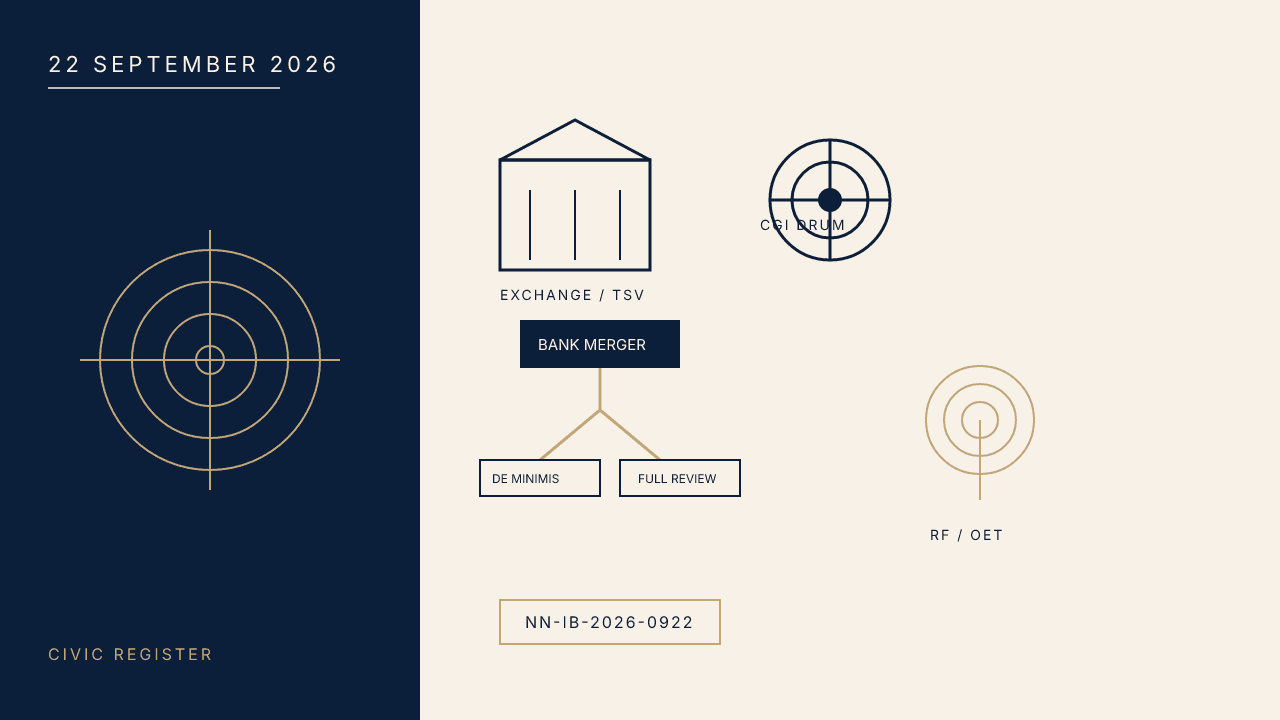
Navy exchange silhouette stamped §3(a)(1) with a dotted bypass into a permissioned AMM pool under temporary §36(a)(1) TSV relief. 01
Tokenized NMS stocks get a temporary exchange waiver
Catch-up · SEC 14a-8 / proxy guest list · September 21, 2026
The Securities and Exchange Commission published a long Order granting temporary, conditional exemptive relief under Exchange Act section 36(a)(1). So-called Tokenized Securities Venues that match buyers and sellers of Tokenized NMS Stock through permissioned automated-market-maker liquidity pools can sit outside the statutory “exchange” definition for the life of the relief, and certain liquidity providers that supply tokenized NMS stock into those pools can sit outside the “dealer” definition. Tokenized NMS Stock here means an NMS stock tokenized by or for the issuer, or by an unaffiliated third party — not synthetic linked tokens or security-based swaps dressed as crypto. The Commission frames the Order as a controlled on-ramp for distributed-ledger trading experiments that retail and institutional desks already want, while asking for comment on how far the carve-out should run. For a publisher-desk watch, the spice is structural: federal market plumbing is being rewritten in public FR paper so on-chain venues can clear U.S. equity exposure without first registering as exchanges.

Navy brake-drum cross-section labeled CGI beside an AD/CVD stamp and a later-developed circumvention arrow to a U.S. port glyph. 02
Commerce: Chinese CGI brake drums as later-developed circumvention
The International Trade Administration preliminarily determines that compacted graphite iron (CGI) brake drums imported from the People’s Republic of China are later-developed merchandise circumventing the existing antidumping and countervailing duty orders on certain Chinese brake drums. The determination is applicable September 22, 2026, and invites party comment before any final. Later-developed circumvention is the quiet trade weapon: when exporters shift metallurgy or product form just enough to leave the literal order scope while serving the same U.S. aftermarket, Commerce can pull the new SKU back under AD/CVD cash deposits. Pair this with yesterday’s governance stack and today’s FR book reads like markets-plus-trade: tokenized equity venues at home, and a China auto-parts metallurgy fight that will show up in port entries and Customs entries long before it shows up in headlines.

Navy Bank Merger Act flowchart splitting into de minimis letter/deemed approval versus tailored full review, with a credit-union icon. 03
FDIC proposes to rewrite Bank Merger Act processing
The FDIC invited comment on a proposed rule that would fundamentally reform how it processes and evaluates Bank Merger Act transactions. The package would pull credit unions and centrally booked deposits into the initial competitive-effects screen, create a letter-filing path with deemed approval for de minimis mergers, tailor other filing burdens to size and risk, limit when staff can yank a deal off expedited processing, and codify a reformed approach to the statutory BMA factors. Companion parity paper the same day would align host-state law treatment for out-of-state state banks with national banks when those host laws do not apply to nationals. For community banks and their counsel, this is not a footnote — it is a redesign of who gets a soft landing and who still waits in the long queue.

Navy radio mast with concentric RF rings and a court-gavel badge labeled D.C. Cir. remand to OET comment. 04
FCC reopens RF-exposure questions after the D.C. Circuit remand
Catch-up · Cuba nickel / Outcast · September 18, 2026
The FCC’s Office of Engineering and Technology seeks comment on radiofrequency exposure issues the D.C. Circuit remanded in Environmental Health Trust v. FCC, 9 F.4th 893 (D.C. Cir. 2021). The notice does not rewrite the exposure limits today; it restarts the public record the court said was incomplete. For an OSINT desk, the beat is institutional memory: a 2021 remand still driving 2026 FR paper means wireless siting, device certification, and local tower fights will keep citing this docket until OET closes it. Set beside today’s SEC tokenized-equity Order and Commerce’s CGI circumvention call, the FR book is a three-lane day — capital markets plumbing, trade metallurgy, and spectrum health science still litigating its homework.
Anchored on Base
SHA-256 b11ef14f 8e393b34 c28576bd b75c95a8 3b2c8d58 8119e5bd 700f05f8 ef5bfa3f
A content hash may be anchored on Base. The chain stores a hash, not the brief. The hash is not statutory publication. The full text stays on Notice Nearby.
After a Base anchor, this day’s body is locked. A correction is a new dated brief or a dated correction note that itself is hashed.
This is a Notice Nearby Intelligence Brief — a publisher-desk open-source federal watch. It is not official minutes, not a newspaper story, and not Legal Publication. It does not satisfy a statutory notice requirement.