American War Heroes · Archived memorial essay
Never Forget: Remembering September 11
Twenty-five years have passed since a clear Tuesday morning was broken on purpose. This page is a memorial, not a theory and not a score. It honors the Americans who were murdered, the men and women who ran toward the fire, the passengers who fought a hijacked airliner to the ground, the wounded Pentagon, and the military that took the watch afterward. The duty is simple. Remember them. Say their country out loud.
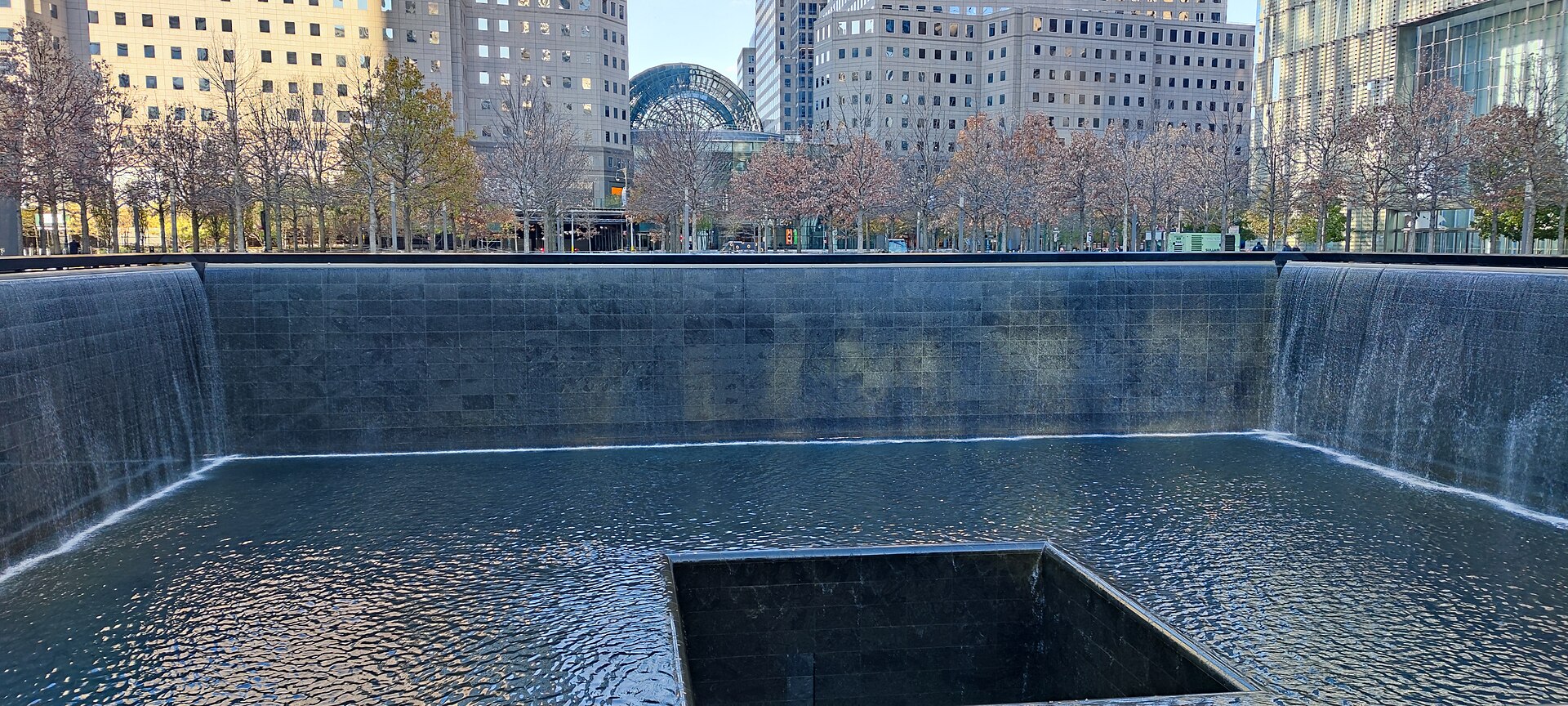
National September 11 Memorial, New York. Photograph released under CC0 and hosted locally. No claim is made to the memorial design.
On September 11, 2001, nineteen hijackers from al-Qaeda seized four American airliners in a coordinated attack on the United States. American Airlines Flight 11 left Boston for Los Angeles and was flown into the North Tower of the World Trade Center at 8:46 a.m. Eastern. United Airlines Flight 175, also Boston to Los Angeles, struck the South Tower at 9:03. American Airlines Flight 77 left Washington Dulles for Los Angeles and was flown into the Pentagon at 9:37. United Airlines Flight 93 left Newark for San Francisco, was turned toward Washington, and crashed at 10:03 a.m. in a field near Shanksville, Pennsylvania, after passengers and crew tried to retake the aircraft.
Those are the public facts. They are not improved by rumor. The South Tower fell at 9:59. The North Tower fell at 10:28. 7 World Trade Center, burning and abandoned, collapsed later that afternoon. By night the lower end of Manhattan was a wound the country could see from orbit, and Arlington was a wound the country could see from the river. Nearly three thousand people who had woken up American civilians, service members, and first responders did not go home. The commonly cited count of those murdered that day is 2,977, not including the hijackers. The National September 11 Memorial also carries the six names from the February 26, 1993, bombing of the same complex. This register will not invent a rounder number to make the grief neater.
Notice Nearby writes this essay as a publisher-curated memorial on the American War Heroes register. It is not a legal notice, not a paid press release, and not an obituary enrollment. It does not add private families to a war roll. It does not treat a coupon as proof of valor. The dead of that morning do not need a badge from a website. They need a country that can still tell the truth about what was done to them.
New York
The towers were workplaces. That is the first American fact, and it is easy to lose under the footage. People had badges, coffee, and a Tuesday. Brokers and dishwashers. Windows on the World. Fire-safety directors. A man who sold tickets. A woman who answered a phone on a high floor because that was her job. They were not symbols when they sat down. They became a national cemetery in an hour because someone decided that American civilian life was a legitimate target.
This page will not invent the private last minutes of people whose families still own those minutes. The public record is enough, and it is already almost too much. Calls went to operators and to kitchens and to precincts. Some people got below the impact. Some people could not. Stairwells filled with a line that moved down while another line — heavier, slower, carrying hose and tools — moved up. That second line is why a republic still uses the word hero without irony.
When the South Tower came down, it took a standing city block and turned it into a weather system of dust and steel. When the North Tower followed, it took more of the same and took the command posts that had been set in the shadow of the first collapse. The pile burned for months. Recovery was not a metaphor. It was a search through a building that had become the ground. New York counted its dead the way a port city counts anything — by name, by precinct, by house, by the company that did not come back to quarters.
The rest of the country watched and discovered it was not watching a local disaster. An attack on those towers was an attack on the American habit of gathering in a tall building to do ordinary work. If that habit is not defended, the skyline is only real estate. The United States decided, that morning, that the skyline was a flag.
The Pentagon
Flight 77 hit the western side of the Pentagon, the headquarters of the Department of Defense, at 9:37 a.m. One hundred eighty-four people were murdered there: fifty-nine passengers and crew on the aircraft, and one hundred twenty-five in the building — soldiers, sailors, airmen, Marines, and the civilians who keep a defense department running. The hijackers meant to strike the brain of American arms. They struck a workplace that happens to wear a uniform.
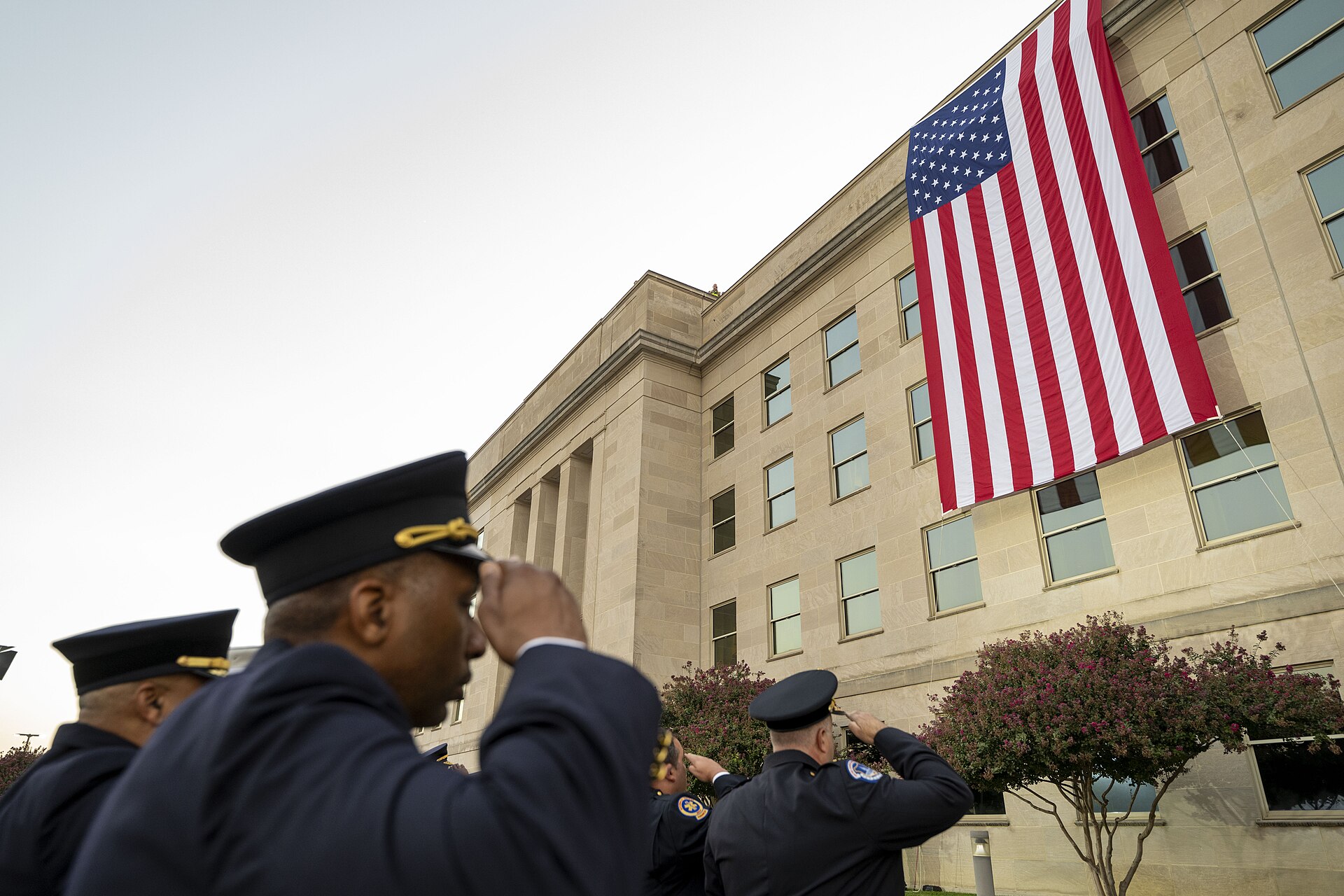
September 11 observance at the Pentagon, 2024. Public-domain U.S. government photograph, hosted locally.
People inside the building ran toward the fire and pulled colleagues out of smoke. Arlington County firefighters and military personnel worked a crash scene that was also a crime scene and also a battlefield. The wall was rebuilt. The work of the department did not stop. That is not a public-relations line. It is what a country's defense staff does when it is hit in its own house: it accounts for the dead, and it stays on duty.
The National 9/11 Pentagon Memorial stands on the grounds where the aircraft came in. One hundred eighty-four benches face a line that marks the path of Flight 77. Age and name are cut so a visitor can tell a child from a colonel without a brochure. Dedicated on September 11, 2008, it is not a park that happens to be next to the Pentagon. It is the Pentagon keeping a grave in the yard.
Flight 93
United Airlines Flight 93 had thirty-three passengers, seven crew, and four hijackers. It was the last of the four aircraft to be taken. By then the country was awake. People on the plane learned, from airphones and from the people they loved, that the other flights had been used as weapons. They voted. They moved. The cockpit voice recorder, recovered from the Somerset County field, preserves a fight, not a legend. The aircraft came down at 10:03 a.m. about twenty minutes of flying time from Washington.
The intended target was not written on the side of the plane. The later public assessment has long been the United States Capitol or the White House — the houses of a self-governing people. What is not in dispute is the American answer onboard. Ordinary passengers and a working crew decided that a hijacked airliner would not be delivered as a bomb if they could still stand up. Todd Beamer's last public words to a ground operator — “Let's roll” — entered the national language because they were plain. They were not a speech. They were a decision.
Forty Americans died in that field. They are not “collateral.” They are the reason a third Washington landmark was not added to the morning's list. The Flight 93 National Memorial, kept by the National Park Service, holds a Wall of Names along the flight path and, later, the Tower of Voices — forty wind chimes for forty people. A visitor stands in a reclaimed strip mine and looks at a hemlock grove the country has agreed not to turn into anything else. That agreement is a kind of patriotism: we will not pave the place where Americans spent themselves to stop a second strike on the capital.
This register already keeps Flight 19 as a missing-in-action case: names without a grave the next of kin can stand on. Flight 93 is the other American problem solved in reverse — a grave the next of kin can stand on, and a Capitol that is still there. Both belong in the same civic ledger. One is unfinished recovery. The other is finished courage.
First responders
Three hundred forty-three members of the Fire Department of the City of New York were killed. Thirty-seven officers of the Port Authority Police Department. Twenty-three officers of the New York City Police Department. Emergency medical workers from city and private services died in the same hour. Those figures are public, counted, and still insufficient to the thing they describe: a professional class that treats other people's panic as an assignment.
They went up the stairs. Say it until it is not a slogan. Men in bunker gear walked into a standing skyscraper that had already been hit by an airliner because someone above them might still be alive. Police and Port Authority officers evacuated, directed, and then stayed. Chaplain Mychal Judge of the FDNY was among the dead; his is the first official recorded death certificate of the attack. This page will not invent a last conversation for him, or for any other named responder. The public act is enough. He went to the site. He did not leave it.
In the months after, the pile was a workplace again — a worse one. Searchers looked for the living first and then for the identifiable dead. Illness followed some of the people who did that work. A country that cheers a firefighter on the anniversary and forgets him in the clinic has not yet told the whole truth. Honor is not a September ceremony. Honor is a budget, a doctor, and a refusal to pretend the air that week was ordinary air.
First responders outside New York belong in the same sentence. Arlington County. The Pentagon's own fire and medical staff. Pennsylvania State Police and local companies who answered a crater in a field. The National Guard that stood posts in train stations and airports while the civilian country learned a new kind of Tuesday. America is not only the people who died. It is the people who showed up because showing up is the job.
The military
Service members died in the Pentagon as they had lived — at desks, in corridors, in the unglamorous rooms where a nation's defense is actually written. Others died as passengers on the aircraft, traveling the way Americans travel. The attack was an act of war against the United States. The uniformed dead are not a separate category of grief. They are the reminder that the civilian and the soldier were hit on the same morning, in the same country, by the same enemy.
Combat air patrols went up over American cities. Fighter aircraft that had been built to meet a foreign air force found themselves watching their own skyline. On September 14, at Ground Zero, President George W. Bush stood on the wreckage with a bullhorn and told the rescue workers what the country already felt: the people who knocked the buildings down would hear from the United States. That is not a partisan souvenir. It is the public record of a commander-in-chief speaking for a wounded republic.
On October 7, 2001, American and allied forces opened the campaign in Afghanistan against al-Qaeda and the Taliban government that had sheltered it. The wars that followed — Afghanistan, later Iraq, and the long work of a generation — are not this essay's argument. They are this essay's aftermath. Young Americans enlisted because their country had been attacked at home. Some of them did not come back. Their names belong on the later rolls of this register, written the same way the older wars are written: from the public record, without stolen valor, without scraping a living family's private grief onto a publisher's page.
The Persian Gulf, Iraq, and Afghanistan list on this site is still growing. That is honest. A growing list is better than a finished fiction. September 11 is one of the reasons that list exists. A country that will not connect the two has already started to forget.
The names
The National September 11 Memorial opened on the tenth anniversary, September 11, 2011, in the footprints of the towers. Water falls inward on all four sides and disappears into a void that does not return it. Bronze parapets carry the names — arranged not by alphabet alone but by the company, the firehouse, the flight, the adjacency of people who died together. A visitor can put a hand on a name and feel that it is cut through, open to the dark. That is the correct design. The dead are not a closed surface.
The museum under the plaza holds steel and a slurry wall and the ordinary objects that survived an extraordinary morning. This essay will not turn those objects into a tour. If you go, go quietly. If you cannot go, say the sentence the country already knows: we do not forget. The Tomb of the Unknown Soldier at Arlington exists because some Americans never come home with a name. The 9/11 memorial exists because these Americans came to work with names and were murdered in a pile. One grave is anonymous on purpose. The other is a roster on purpose. Both are American accounting.
Shanksville has the field. Arlington has the benches. New York has the voids. Three places, one date, one republic. Flags at half-staff are not enough if the next generation cannot tell you what the date means. Teach it without the footage that turns death into a loop. Teach the flights, the times, the departments, the field in Pennsylvania, the rebuilt wall in Virginia, the water in Manhattan. Teach that the people who did this hated a free country and that the free country is still here.
Twenty-five years
A quarter century is long enough for children who were not born to ask what the adults are standing for. It is long enough for a culture to grow bored with solemnity and to start bargaining with memory. Bargaining is how a country loses a war after it has already buried the dead. The opposite of Never Forget is not a conspiracy. The opposite is a shrug.
Notice Nearby is an Oregon publisher of public notices, obituaries, and a curated heroes register. We do not own September 11. We do not sell it. We will not mix this page with a company press release or a paid legal advertisement. We will not enroll a living veteran on a war roll because a family mentioned service in an obituary. American War Heroes is a publisher-curated historical register. Notice Nearby writes these entries from documented public records. Checkout does not add a name to a war roll, and we do not issue Heroes badges, MIA labels, or a “verified veteran” mark. A paid Community memorial may mention military service in the family’s own words. That mention stays on the obituary. It is not verification, and it does not enroll anyone on these lists. Claiming service that was not given is stolen valor. It is disrespectful to those who served.
What we can do is keep a public page that tells the story in original prose, from the public record, on the anniversary and on the ordinary days after it. If you came here looking for a name that is not yet on a war roll, start with missing in action for the unfinished recoveries, or with a family memorial that a household chose to place. Do not ask this publisher to invent a private death. The 2,977 already fill the sky.
Never Forget is not a hashtag. It is a civic instruction. Remember the people who went to work. Remember the companies that climbed. Remember the field in Pennsylvania. Remember the rebuilt wall. Remember the soldiers who left home because home had been hit. Remember that the United States of America was the target, and that the United States of America is still the answer. The water keeps falling in those two squares in New York. Let it. Stand there, or stand where you are, and keep the names.