American War Heroes · Arlington
Tomb of the Unknown Soldier
A country that cannot name every dead still owes them a place that will not be bargained. The Tomb on the plaza at Arlington is that place. It is not a riddle and not a tourist prop. It is a grave for men who were American soldiers and who could not be named when the war was over.
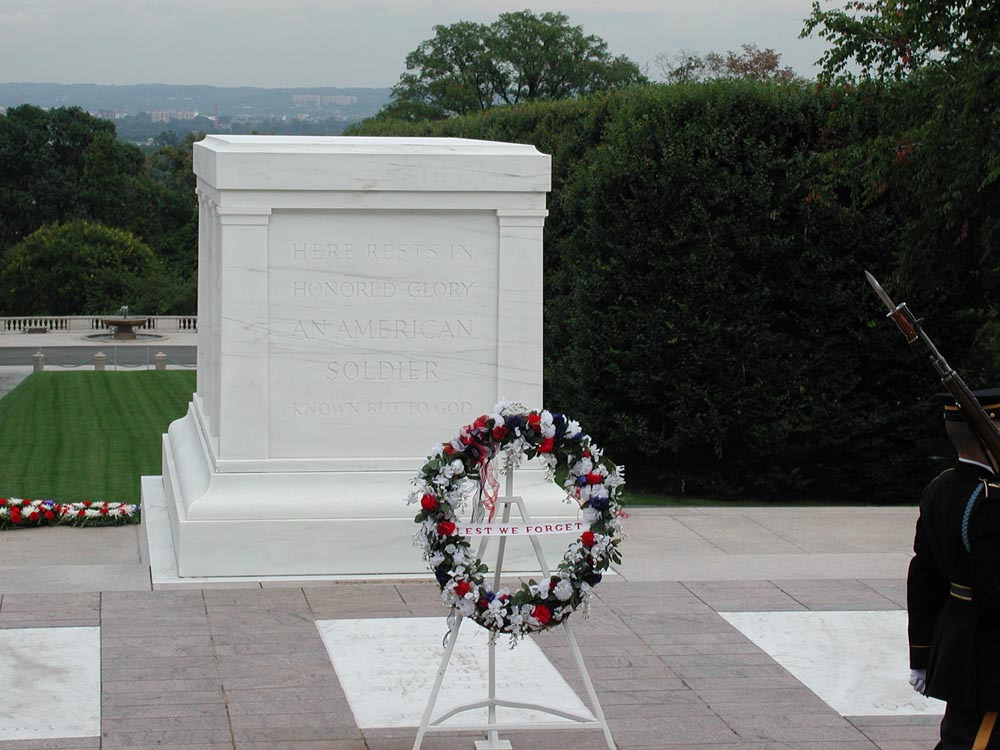
Arlington National Cemetery. Public-domain U.S. government photograph, hosted locally.
On November 11, 1921 — three years to the day after the Armistice — the United States buried an unidentified American from the First World War under a marble tomb on the east terrace of Arlington House. Four unidentified remains had been disinterred from American cemeteries in France. At Châlons-sur-Marne, Sgt. Edward F. Younger of the Army chose one casket by laying white roses on it. The other three went back into French ground. The chosen Unknown crossed on USS Olympia and lay in the Capitol rotunda before the burial. President Harding spoke. The inscription cut later into the west face is the sentence the country still uses: here rests in honored glory an American soldier known but to God.
The marble is Yule stone from Colorado. The architect was Lorimer Rich. Thomas Hudson Jones carved the figures. Those are workshop facts. The meaning is older. Every army that industrializes death produces men who cannot be sorted. Britain and France had already raised Unknowns in 1920. America was late and then thorough. The Tomb is not a copy of Westminster. It is an American decision that a republic can honor a man without a name if it will not stop looking for the rest.
On May 30, 1958 — Memorial Day — two more Unknowns were buried in crypts beside the First World War grave: one from the Second World War and one from Korea. The selection again used unidentified remains and a ceremonial choice. The plaza became a set of graves, not a single gesture. The wars were different. The accounting problem was the same. Fire, water, and time still erase dog tags.
A Vietnam Unknown was interred on May 28, 1984. In 1998 that man was identified by mitochondrial DNA as 1st Lt. Michael Joseph Blassie, USAF, shot down near An Lộc in 1972. The remains were returned to his family. The Vietnam crypt was left vacant. That vacancy is not a failure of the Tomb. It is the Tomb doing the work it promised: identification when science can, an empty honor when it cannot. This register will not treat Blassie as missing now. He was missing. He was found. The crypt remembers the ones who have not been.
The 3rd U.S. Infantry Regiment — the Old Guard — has kept the watch since 1948. A continuous military guard at the Tomb dates to July 2, 1937. The sentinels walk a measured post in heat and ice. The ceremony of the changing of the guard is public. The discipline is not theater for its own sake. It is a way of saying the Unknowns are not off duty. Visitors are asked to be quiet. That is not a museum rule. It is a cemetery rule with a rifle.
Notice Nearby writes this page as a publisher-curated essay, not as a user submission and not as a verification of any living veteran. The War Heroes rolls name documented Americans. The Tomb names no one, on purpose. Both are forms of accounting. One uses a biography. The other uses a marble box and a vacant crypt.
If you are looking for a man who did not come home with a name the family can visit, start with missing in action. The modern Defense POW/MIA Accounting Agency is a later institution than 1921. It is the country’s attempt to keep the promise the Tomb made: we will not stop because the first identification failed. Flight 19 is one public case where the names are known and the aircraft are not yet a grave the next of kin can stand on.