American War Hero · Spanish–American War · Notice Nearby
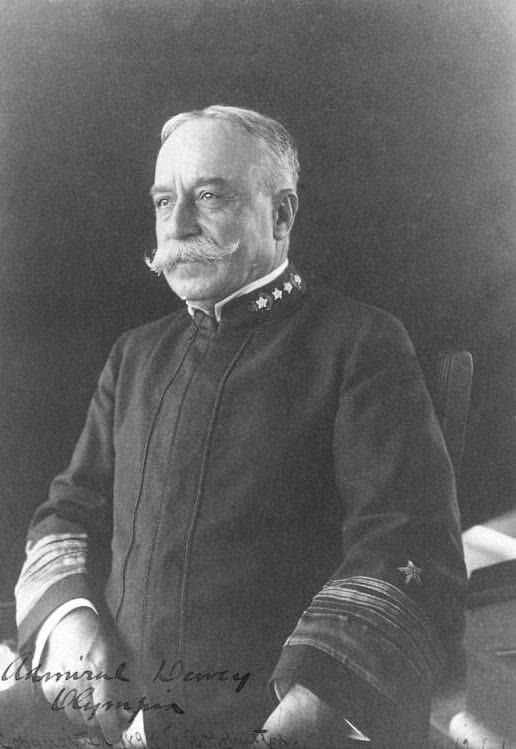
George Dewey
December 26, 1837 – January 16, 1917
Born Montpelier, Vermont
Died Washington, D.C.
Commodore, Asiatic Squadron; Battle of Manila Bay, May 1, 1898
George Dewey took the Asiatic Squadron into Manila Bay before dawn on May 1, 1898, and ended the Spanish Pacific squadron before the country had finished reading the war declaration. He was a commodore then, flying his flag in USS Olympia. The sentence the navy kept — that Gridley might fire when he was ready — is in the contemporary accounts. The work was a column of American cruisers and gunboats making firing runs past Cavite until the Spanish ships were wrecks or burning. American losses in the action were slight. Spanish losses were not.
He was born in Montpelier, Vermont, on December 26, 1837, Annapolis 1858, already blooded under Farragut in the Civil War. This page is the morning in the bay, not a second New Orleans. After Manila he stayed as the army and the insurgency arrived and the short war became a longer occupation. The war page will not pretend May 1 settled the Philippines. It settled the Spanish fleet.
Congress created the rank of Admiral of the Navy for him. No other officer has held it. The Dewey Medal put his own face on a decoration the men of the squadron could wear — a fact of 1898 politics, not a Medal of Honor, and this register will not confuse the two. He died in Washington on January 16, 1917, and is buried at Arlington.
The photograph on this page was made on Olympia in 1899, when the country still wanted the man who had opened a bay. Later presidential talk came to nothing. The documentary likeness is a commodore who crossed a minefield that did not behave as advertised and then spent the morning methodically wrecking a squadron that could not get out.
- Publication
- NN-HERO-1898-001
- Content hash
- c022e46f df539fd8 91b327b5 aa5cf8b9 d5522f89 22874aeb 32b25581 500b17e1
- Base anchor
- 0x7cdb23 5c6aa9e3 e3f6094a 285c902c 21feca31 c5d15d0e b824b842 2fced0d4 fa
Base stores the content hash, publication number, memorial id, and timestamp — not the full obituary text. The complete memorial remains on Notice Nearby. This is not a legal affidavit.