Commentary · Intelligence Brief
Notice Nearby is a paid public-notice register — not a newspaper.
The line
NN-FI-2026-15 · October 7, 2026
Part 13 treated the reload as a lift. Part 14 treated the dump as the pile behind that lift. This brief is the industrial restock: the plant, the forge, and the skilled magazine crew on the CONUS end that has to surge sealed canisters on a wartime clock instead of a peacetime shift.

Part 13 treated the reload as a lift. Part 14 treated the dump as the pile behind that lift. This brief is the industrial restock: the plant, the forge, and the skilled magazine crew on the CONUS end that has to surge sealed canisters on a wartime clock instead of a peacetime shift. A dump that empties after week one is not a logistics failure alone. It is a production failure that began years earlier, when the line was sized for the quietest year of the last decade.
A vertical launch cell is a consumer. The dump is inventory with a street address. The line is the only thing that puts a new sealed canister into that address after the first exchange. Part 2 counted rounds. Part 13 counted certified reload points. Part 14 counted what those points can still draw when the raid calendar is live. Part 15 counts whether anything is still coming out of the thin set of CONUS plants and solid-rocket-motor houses that gate every other rate on the chart.


What “the line” actually is
In peacetime language the line is a production schedule: SM-6, SM-2, ESSM, Tomahawk, LRASM, Standard Missile variants, heavyweight torpedoes, and the seekers, airframes, and canisters that wrap them. In wartime language the line is a clock — not the clock on a briefing slide about “industrial surge,” but the clock that starts the day a forward dump empties and asks how many months before the next lot leaves a CONUS door with a certification stamp a Pacific pad will accept.
The public record through 2024–2026 is clearer on intent than on delivered rate. Navy weapons spending jumped after years of minimum sustaining buys. Multiyears for Standard Missile, LRASM, Naval Strike Missile, and AMRAAM were meant to give primes a reason to hire, tool, and qualify second sources. Capacity money moved into plants and test cells. Framework agreements announced in early 2026 pointed SM-6 above five hundred a year and Tomahawk above a thousand — multiples of rates treated as normal for a generation. Those targets are not inventory. They are promises that still have to clear rocket motors, electronics, energetics, and the people who build them without scrap.
China’s interior lines matter here the way they mattered on the dump. A PLAN combatant that empties cells can, in principle, reach a Chinese magazine and a Chinese plant on a domestic net. The United States is still the visiting team with a trans-Pacific conveyor. Fuel UNREP remains a habit. VLS UNREP remains a test. The line that feeds either is a finite input with a badge reader, a second shift that may not exist, and a sub-tier supplier that can stop the whole lot for a nozzle or a circuit card.
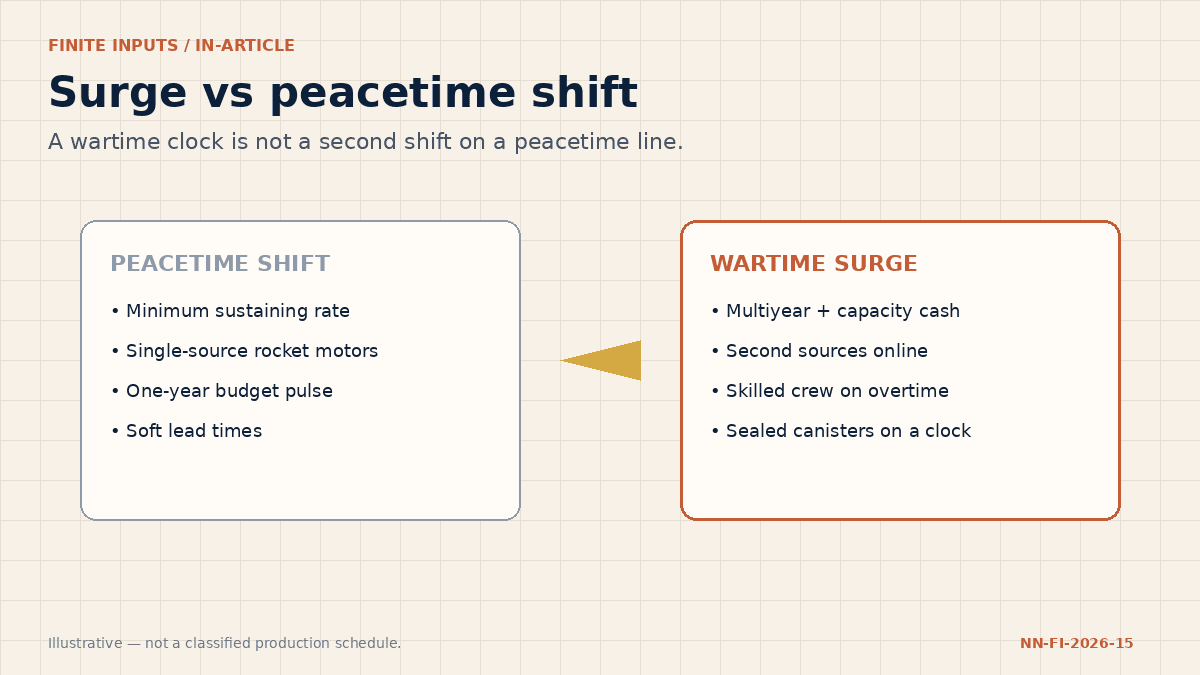
Surge is not a second shift
Buying more missiles on paper is not surging them. A peacetime line runs at the rate that keeps the lights on. A wartime line needs floorspace that was not rented, tooling that was not bought, test cells that were not built, and second sources that were not qualified while the budget preferred the cheapest single vendor. Congress can stuff capacity cash into a bill. The forge still has to pour, cure, machine, and certify years after the first dollar clears.
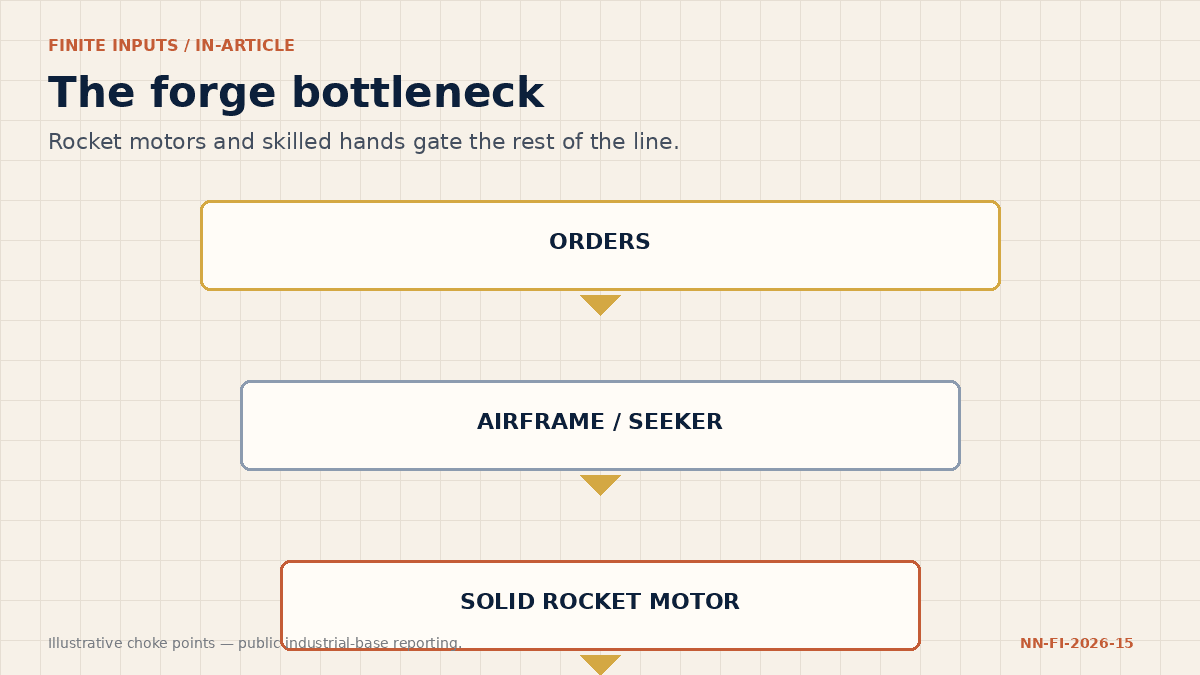
Solid rocket motors remain the honest choke. For years the tactical-motor base ran through a short list of qualified houses — Aerojet Rocketdyne under L3Harris, Northrop Grumman, and a thin set of new entrants still proving they can deliver at rate. Primes said publicly that motors, not final assembly halls, were the gate on SM-6 and related stocks. The Navy issued OTAs to grow Mk 72 and Mk 104 vendors. Money went into cases, nozzles, igniters, and valves because the same sub-tier shops feed everyone. That is not a slogan about resilience. It is a street map of single points of failure.
Skilled labor sits on the same ledger. Part 12’s apprentice was never only a shipyard story. A magazine crew that can surge sealed canisters — load, mate, test, stamp, ship — is a finite input with a retirement date. Software belongs on the line the way it belonged on the reload and the dump: lot tracking, supplier risk, and drawdown math are model jobs. What the model cannot do is qualify a motor vendor, mint a seeker lot that left three years too late, or teach a crew the evolution until it is boring.
Production targets are not the pile
Published rates move. In early 2024, industry talk put SM-6 near a hundred a year on contract, with multiyears aimed at one-fifty and then two hundred, while Navy budget books talked Standard Missile variants climbing toward two hundred by FY26 and three hundred by FY28. LRASM buys stepped up from the low dozens toward the low hundreds. Tomahawk sat near minimum sustainment for years before leaders talked doubling and then framework language about a thousand-plus. FY26 capacity analysis and early 2026 framework headlines pointed higher still.
None of those numbers is a sealed canister on a Guam pad Tuesday after Monday’s raid. Treat every announced maximum rate as a claim that still has to survive motors, electronics, energetics, and workforce — and refuse counting a press release as inventory. Money that buys another UNREP rendering while the munitions plant runs one shift is the Trojan-horse move this series has named since Part 1.
What this is not
This is not an argument that American missile plants are idle, or that every Pacific canister is a cardboard box. Prepositioning, multiyears, capacity cash, second-source work, and existing handling sites are real. It is also not an argument that every expensive interceptor must be replaced one-for-one by cheap mass. Part 7’s swarm changes the mix that leaves the line and does not erase the SM-6 and Tomahawk lots that keep a ship alive long enough for the cheap mass to matter. The line has to make both, in the right mix, on a clock that matches the dump’s drawdown.
Bottom line
A reload without a dump is a gesture. A dump without a line is a one-week story. Count production lots, motor vendors, test cells, and certified magazine crews the way Part 2 counted cells, Part 13 counted lifts, and Part 14 counted pads. Put the models on drawdown and supplier risk. Put the money on floorspace, second sources, energetics, and the apprentices who will still be on the floor when the second week starts.
The war is not won by the side that leaves home with a full launcher. It is not won by the side that can fill the launcher once from a surviving dump. It is won by the side whose line is still putting sealed canisters on a truck when the raid calendar is in its second month.
Come back for 16
Even a surging line is still CONUS inventory until something moves the lot across an ocean that is not a peacetime shipping lane. Fuel is the quiet finite input between the plant door and the Pacific pad — the oiler, the UNREP pair, the tanker that keeps the ammunition ship and the combatant on the same clock.
Part 15 is the line that restocks the pile. Part 16 is the tanker that moves the pile — and the shooters that still have to reach it.
The tanker is the next finite input.
Daily IB insert. The pier is the lift. The dump is the magazine. The line is the plant that decides whether week two still has something to lift.
Notice Nearby is a paid public-notice register — not a newspaper. This item is commentary prepared for the publisher desk. It is not Legal Publication. It does not satisfy newspaper or other statutory legal-notice requirements. Notice Nearby is operated by Record of Sale, LLC, an Oregon limited liability company.
Content hash
SHA-256 c56047f336d68f83364c895ae7a4c3a8ba1f479e9f3e04d6f7e012b09520f8d1