Historical figure · Notice Nearby
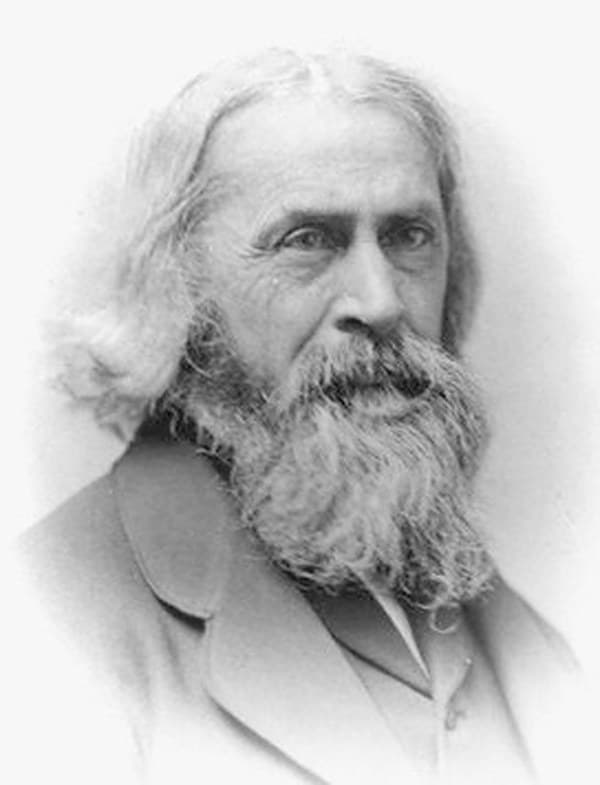
Benjamin Peirce
April 4, 1809 – October 6, 1880
Cambridge, Massachusetts
Benjamin Peirce, often called the first American mathematician whose research could stand beside Europe's best, died in Cambridge, Massachusetts, on October 6, 1880. He was seventy-one and had taught at Harvard for nearly fifty years.
He was born in Salem, Massachusetts, on April 4, 1809, the son of the Harvard librarian. After graduating from Harvard in 1829 he taught at the Round Hill School in Northampton, then returned in 1831 as a professor of mathematics. In 1842 he added astronomy to his title, and he never left. Students remembered a white-bearded lecturer who could lose an entire room in a cloud of symbols and still leave them certain they had seen something important.
His work ranged widely. He studied the motions of the planets, proved that an odd perfect number would need at least four distinct prime factors, and in 1870 coined the words idempotent and nilpotent in his study of linear associative algebra, a work so specialized that he first had it printed as a lithograph for friends. He also proposed a rule, still called Peirce's criterion, for deciding when a strange measurement should be thrown out.
He was practical too. From 1867 to 1874 he ran the United States Coast Survey, and in 1863 Congress named him a founding member of the National Academy of Sciences. In the famous Howland will case he testified, with his son Charles, that a disputed signature matched another too perfectly to be honest, an early courtroom use of probability.
He liked to say that mathematics is the science that draws necessary conclusions. Not every conclusion he drew aged as well; he defended slavery before the Civil War as a support for a learned elite, a view history has rightly rejected.
He married Sarah Hunt Mills, a senator's daughter. Their son James Mills Peirce succeeded him at Harvard, and Charles Sanders Peirce became one of America's great philosophers. A crater on the Moon carries the family name.
Services
Died in Cambridge, Massachusetts, October 6, 1880, aged 71. Perkins Professor of Mathematics and Astronomy at Harvard; superintendent of the U.S. Coast Survey, 1867–1874; charter member of the National Academy of Sciences. Portrait: 19th-century engraved portrait (public domain), hosted by Notice Nearby.