Public paper · October 4, 2026 · Energy desk
Driveway Gate and Fence Automation: A Start-to-Finish Buyer Guide to Automatic Gates and Gate Openers
A plain-language buyer guide to automating a driveway gate: swing versus slide gates, picking a gate operator by gate weight and length, solar versus AC power, UL 325 and ASTM F2200 safety rules, entrapment protection, keypads, remotes, phone apps, vehicle loops and sensors, fire and emergency access, permits and HOA rules, cost drivers, contractor questions, install day, maintenance, and the first years of ownership.
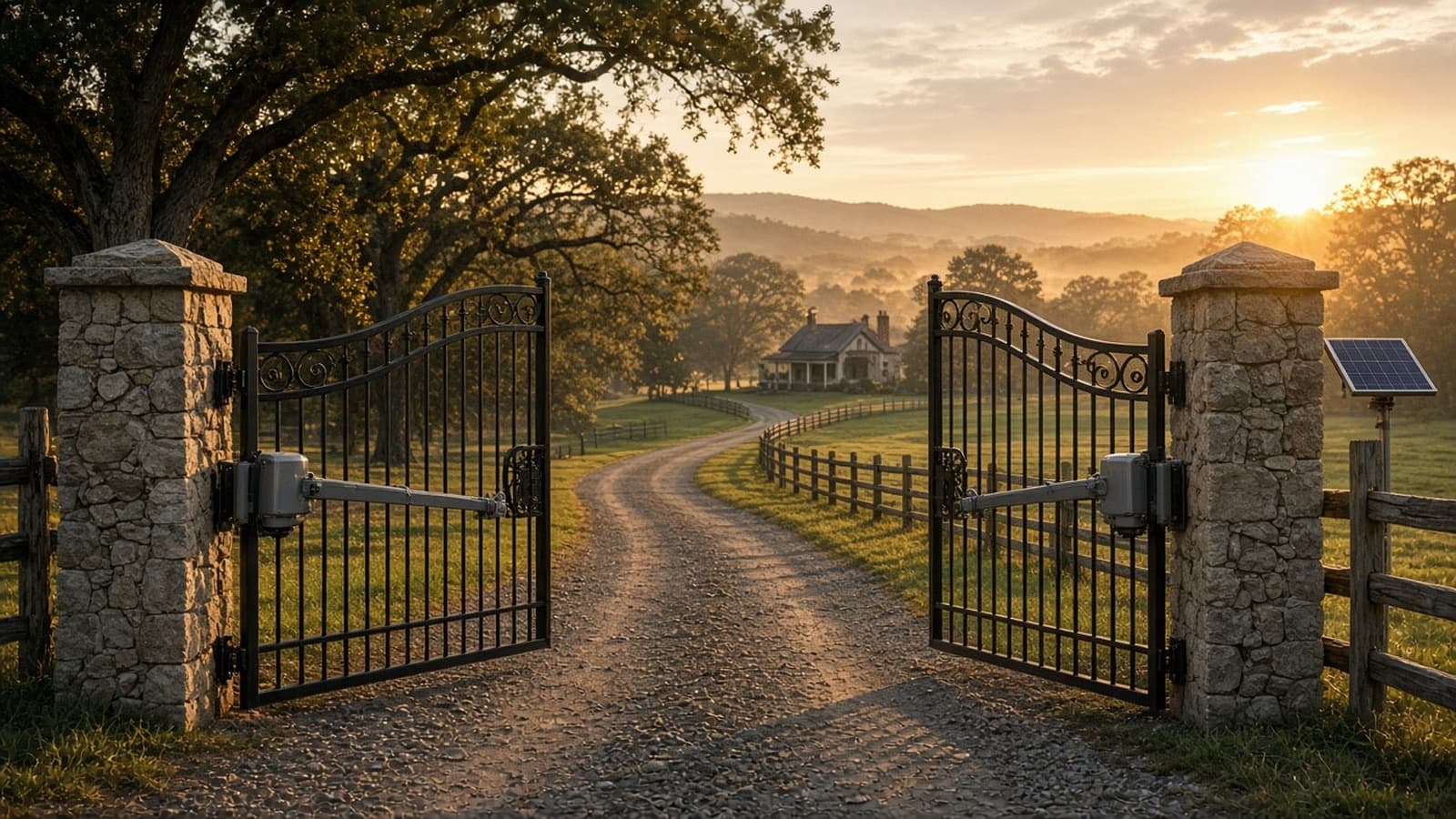
noticenearby.com/papers/driveway-gate-fence-automation.pdf
Getting out of the car in the rain to open a heavy farm gate, a dog that keeps slipping out to the road, packages left at the end of a long drive, or a neighbor's cattle wandering up to the house is often the moment a homeowner starts pricing an automatic driveway gate. The idea sounds simple: put a motor on the gate and push a button. The real project is not. An automatic gate is a large, heavy, moving machine that can crush, pinch, or trap a person or a pet. It touches your fence, your driveway, your power supply, your fire department, your mail and delivery drivers, and possibly your HOA and your county. The expensive-consumer mistake is bolting a motor to an old gate that was never built to be automated, with no safety sensors, no plan for power outages, and no way for an ambulance to get in.
This paper is a start-to-finish buyer guide to automating a driveway gate at a typical U.S. home, farm, or rural property. It is education, not a bid, not an engineering review, and not legal advice. Your local building department, your fire marshal, your HOA, the gate operator's installation manual, and a trained gate installer win when they disagree with anything here.
Companion Notice Nearby papers on related big home purchases: whole-home standby generators at https://noticenearby.com/papers/whole-home-standby-generators — home solar + battery packages at https://noticenearby.com/papers/home-solar-battery-packages — EV Level 2 hardwired chargers at https://noticenearby.com/papers/ev-level-2-hardwired-chargers — whole-home water softener / RO at https://noticenearby.com/papers/whole-home-water-softener-ro — septic system replacement at https://noticenearby.com/papers/septic-system-replacement — metal roofing replacement at https://noticenearby.com/papers/metal-roofing-replacement — private well drilling + pump at https://noticenearby.com/papers/private-well-drilling-pump — commercial-grade home security + monitoring at https://noticenearby.com/papers/commercial-grade-home-security-monitoring — heat pump HVAC full replacement at https://noticenearby.com/papers/heat-pump-hvac-full-replacement
Why people automate a driveway gate
Most people do not set out to buy a gate operator. They get there for a few common reasons:
- They already have a manual gate and are tired of opening and closing it by hand, often in bad weather or after dark.
- They want to keep kids, dogs, horses, or livestock in, or keep stray animals and unwanted cars out.
- They live on a long private drive and want to control who comes up to the house.
- They want a safer way for an older family member or someone with limited mobility to come and go.
- They want a clear line between public road and private property, often after trouble with trespassing or dumping.
- They are building a new fence and want the gate planned in from the start.
An automatic gate can make daily life easier and add a layer of privacy. It is not a full security system. A gate slows people down and sends a clear message, but a determined person can often climb a fence or walk around the side. If security is your main goal, read the companion paper on commercial-grade home security and plan cameras, lighting, and alarms together with the gate.
How an automatic gate system works, in plain words
An automatic gate system has a few main parts that work together:
- The gate itself, which moves.
- The gate operator, which is the motor, gearbox, and control board that moves the gate. People also call it a gate opener.
- A power source: household AC power, a battery, solar panels charging a battery, or a mix.
- Controls that tell the gate to open, such as remotes, keypads, intercoms, card readers, phone apps, or vehicle sensors.
- Safety devices that stop or reverse the gate if something is in the way, such as photo eyes and sensing edges.
- Hardware such as hinges, rollers, tracks, posts, stops, and locks that let the gate move smoothly and stop where it should.
When you press a remote button, the control board checks its settings and safety devices, turns the motor on, and moves the gate until it reaches its open limit. Then it waits. Depending on how it is set up, it may close on its own after a timer runs out, close when a car passes a sensor, or stay open until someone presses the button again. While the gate moves, the board watches its safety devices and the motor's effort. If something blocks the gate, it is supposed to stop and reverse.
The gate and the operator have to match. A great operator on a sagging, binding, or badly hung gate will wear out early and may not stop safely. A big part of a good install is fixing the gate first.
Swing gates versus slide gates
The first big choice is how the gate moves.
A swing gate opens like a door on hinges. It can be a single leaf or a pair of leaves that meet in the middle, sometimes called a bi-parting or dual gate. Swing gates are common on homes and farms because they look traditional and work with many existing gates.
Swing gates need clear space to swing through. They usually swing in, toward the property, so they do not swing into the road. A swing gate on a hill can hit the ground as it opens uphill. Swing gates also catch the wind like a sail, which strains the operator and hinges.
A slide gate rolls sideways along the fence line. Some roll on wheels that ride on a track or V-shaped rail set in the driveway. Others are cantilever gates that hang from rollers on posts and do not touch the ground across the opening.
Slide gates need room alongside the fence for the gate to roll into when it opens, roughly the length of the gate plus some extra. They work well on short driveways where cars wait close to the gate, on slopes where a swing gate would hit the ground, and in windy places. Tracked slide gates can be bothered by snow, ice, gravel, and debris in the track. Cantilever gates avoid the track but need a stronger frame and more fence length.
Other types exist, such as vertical lift, vertical pivot, overhead pivot, and bifold gates. They show up more often at businesses and tight sites than at homes. The ASTM F2200 standard, which covers automated vehicular gate construction, lists horizontal slide, horizontal swing, vertical lift, vertical pivot, overhead pivot, and horizontal bifold gates.
Picking a gate that can be automated
Not every gate should get a motor. Before buying an operator, look hard at the gate:
- Is it strong and square? A gate that sags, twists, or drags will fight the operator.
- Does it swing or roll freely by hand, with little effort, from fully closed to fully open?
- Are the hinges or rollers in good shape, and rated for the gate's weight?
- Are the posts solid, plumb, and set deep enough in concrete for the load?
- Does the gate have gaps, rails, or decorative pieces that could trap a hand, arm, or head as it moves?
- Is it a pedestrian gate or garden gate that was never meant to carry an operator?
Gates built for automation are made to meet ASTM F2200. That standard sets construction rules meant to reduce pinch points and openings where a person could be caught, and it says automated vehicular gate systems shall also comply with UL 325. Many older farm and decorative gates do not meet these rules. The fix may be screening or mesh on the gate, covering rollers, changing the gate, or buying a new gate built for automation. Ask your installer to tell you, in writing, whether your existing gate can meet ASTM F2200 and what it will take.
Separate pedestrian gates are part of a safe plan. Gate operator manuals warn that vehicle gates are for vehicles, not for people walking through. If people will walk in and out, plan a separate walk gate near the driveway gate.
Sizing the operator by gate weight and length
Gate operators are rated by how big and heavy a gate they can move. Manufacturers publish charts for each model that show the maximum gate length and weight, and often how those limits change together. A long, light gate and a short, heavy gate can be very different jobs.
To size an operator, your installer needs:
- The gate's length, from hinge to tip for a swing gate, or the opening width for a slide gate.
- The gate's weight. This can be estimated from the material and design, or measured. Solid wood, solid metal panels, and ornamental iron can be much heavier than they look.
- How solid the gate is. A solid privacy gate catches far more wind than an open picket or bar gate.
- Whether the driveway slopes, and which way.
- How often the gate will open and close each day.
- Whether it is a single swing, a dual swing, or a slide gate.
For swing gates, the length of the leaf matters as much as the weight. The farther the end of the gate is from the hinge, the more force the operator has to push, especially in wind. Some manufacturers give limits by both length and weight for each operator. Dual gates need either two operators that work together or a primary and secondary pair.
For slide gates, weight and rolling resistance matter most. A smooth, level track or a well-adjusted cantilever system takes much less force than a gate dragging through gravel.
Think about duty cycle too. That is how many times the operator can open and close in a given time without overheating. A home gate used a few times a day is a very different load than a shared gate used by several families. Manufacturer specs list the duty or cycle rating for each model.
Choose an operator with some margin above your gate's real size and use, not one right at its limit. An operator that is always working at its top rating will wear faster.
Types of swing gate operators
Swing gates can be moved by a few kinds of operators:
- Linear, or ram-style, operators: a long arm that pushes and pulls the gate, mounted between the post and the gate. They are common on residential and farm gates and on many solar kits.
- Articulated arm operators: a folding arm on a motor box mounted on or near the post. They can work where the post is wide or the hinge sits far from the gate's pivot point.
- Pad-mounted, or post-mounted, operators: a larger motor box set on a concrete pad near the gate with an arm to the gate. These are often heavier duty.
- Underground operators: a motor set in a box under the hinge so almost nothing shows above ground. They look clean but need good drainage and careful install.
The mounting geometry matters a lot. How far the operator is set back from the hinge, and where it attaches to the gate, changes how wide the gate opens, how hard the motor works, and whether the gate swings smoothly. Each operator's manual has measurements for this. A good installer follows them instead of eyeballing it.
Swing gates can be set to pull to open, swinging toward the operator, or push to open, swinging away. Most homes use pull to open with the gate swinging into the property. Push to open needs a different bracket and is used when the gate must swing outward and that is allowed.
Types of slide gate operators
Slide gate operators are usually pad-mounted boxes beside the gate. A motor turns a gear that runs along a chain or a toothed rack attached to the gate. Chain drives are common on heavier gates. Rack-and-pinion drives are common on lighter residential gates.
Key points for slide gates:
- The operator needs a solid concrete pad, set level and at the right spot.
- The chain or rack must be lined up and tensioned right.
- The gate needs positive stops at both ends so it cannot roll off its track.
- Rollers, wheels, and the gap between the gate and posts must be covered or guarded where a hand could be caught.
- The space the gate rolls into must be kept clear and guarded so no one can get trapped between the gate and the fence.
AC power versus DC, battery, and solar
Gate operators run on a few kinds of power:
- AC operators run directly on household power. They are strong and steady but stop in a power outage unless they have a battery backup.
- DC operators run on a battery that is charged by household power or solar. Many can keep working for a while when the power goes out, and many can run slow starts and slow stops that are gentle on the gate.
- Solar operators are DC operators whose battery is charged by solar panels. They avoid running a power line down a long drive.
The right choice depends on your site.
AC power makes sense when power is already near the gate, the gate is large or heavy, the gate is used often, or the site gets little sun. The cost and work of trenching a power line from the house can be large on long driveways.
Solar makes sense when the gate is far from power, the gate is light to medium size, and it opens a modest number of times a day. Solar kits are common on farm and ranch gates.
Solar sizing depends on:
- How many times the gate opens and closes per day.
- How much power the operator and its accessories use, including keypads, receivers, intercoms, cellular modules, and lights.
- How many hours of good sun the site gets in winter, the worst season, not summer.
- Shade from trees, buildings, and hills.
- The size and condition of the batteries.
Manufacturers publish charts showing how many cycles a day a given panel and battery setup can support in different sun conditions. Ask the installer to size solar for your winter and your real use, with all the accessories you plan to add. A gate that works great in June and dies every December is a common complaint.
For general background on how solar panels and sun hours work, the U.S. Department of Energy's homeowner's guide to solar is a useful starting point. Gate solar is much smaller than home solar, but the same sun and shade ideas apply.
Power outages and manual release
Every gate operator needs a plan for when power fails or the operator breaks.
- Battery backup lets many operators keep working for a number of cycles during an outage. Ask how many, and with what battery.
- Some operators can be set to open and stay open, or stay closed, when the battery runs low. Which one you want depends on your situation. For fire safety, many people prefer fail-open. For livestock, some prefer fail-closed. Your fire department may have rules.
- Every operator should have a manual release so the gate can be opened by hand. Learn where it is and how to use it. Some need a key.
The companion paper on whole-home standby generators covers house power during outages, but a generator at the house does not help a solar gate at the end of the drive unless the gate is wired to it.
Safety standards: UL 325 and ASTM F2200
Automatic gates have hurt and killed people, often children playing on or near a moving gate. Two standards are at the center of gate safety in the U.S.
UL 325 is the safety standard for electric operators for doors, gates, and similar products. It covers gate operators, complete gate assemblies, and accessories such as external entrapment protection devices. The current edition also covers battery-powered operators. UL 325 sets classes for where an operator is used:
- Class I: residential vehicular gate operators, for homes of one to four single-family units or a garage or parking area tied to them.
- Class II: commercial or general access, such as apartment buildings, hotels, and public parking.
- Class III: industrial or limited access, not meant for the general public.
- Class IV: restricted access with supervised security staff, such as prisons or airport security areas.
Buy an operator that is listed to UL 325 for the right class. A listed product has been tested by a certification body. Look for the listing on the product label and in the manual.
ASTM F2200 is the construction standard for automated vehicular gates. It covers how the gate itself is built, including openings, pinch points, rollers, and stops, so the gate is safe to automate. As noted above, it says automated gate systems shall comply with ASTM F2200 and be compliant with UL 325.
For comparison, garage door openers have their own federal rule at 16 CFR Part 1211, the safety standard for automatic residential garage door operators. That rule is about garage doors, not driveway gates, but it shows how seriously the government treats automatic door and gate hazards.
You do not need to read the standards yourself to buy a gate. You do need an installer who knows them and will show you how your system meets them.
Entrapment protection, in plain words
Entrapment means a person or an animal getting caught between a moving gate and something else, like a post, the fence, or the ground. UL 325 calls the dangerous spots entrapment zones.
UL 325 describes several kinds of entrapment protection:
- Inherent protection, built into the operator, which senses when the gate hits something and reverses.
- Non-contact sensors, such as photoelectric sensors, often called photo eyes. A beam crosses the gate path. If something breaks the beam, the gate stops or reverses.
- Contact sensors, such as edge sensors. These are soft strips on the gate or posts. If something presses the strip, the gate stops or reverses.
- Constant-pressure controls, where someone has to hold a button the whole time the gate moves, usually only allowed in certain settings.
Current UL 325 rules require the operator to monitor its external entrapment devices. That means the operator checks that the photo eyes or edges are connected and working. If they are missing or fail, the operator will not run normally. This change was made because people used to skip or disconnect the sensors.
For a swing gate, the danger spots include where the gate closes against the post or the other leaf, and the area the gate swings through. For a slide gate, they include where the gate closes against the post and where it rolls into its open position next to the fence.
The installer should plan sensors for each entrapment zone your gate creates, in both the opening and closing directions where needed. The operator manual lists which devices are required and where they go.
More safety rules that save lives
A few more safety points come up in nearly every gate operator manual:
- Warning signs. UL 325 calls for warning placards on both sides of the gate, where people can see them. Do not take them down.
- Controls out of reach. Keypads, push buttons, and other controls should be placed so someone cannot reach through or over the gate to work them, and so children cannot easily reach them. Manuals usually give a minimum distance from the gate.
- No riding or playing. Children should never play on or near a gate, and no one should ride on it.
- Watch the gate move. Do not run the gate unless you can see it, or unless the system has been set up for that use with the right safety devices.
- Separate walk gate. People on foot should use a pedestrian gate, not the vehicle gate.
- Keep remotes away from kids. Treat a gate remote like car keys.
- Test safety devices. Check that the gate reverses when the photo eyes are blocked and when the edges are pressed, on the schedule the manual gives.
If a gate installer tells you sensors are optional, find another installer.
Access control: remotes, keypads, intercoms, and phone apps
Access control is how the gate decides who gets in. Most homes use a mix:
- Remote controls: small transmitters for each car. Look for rolling-code or encrypted remotes, which are harder to copy than old fixed-code remotes.
- Keypads: a code entered at the gate. Wired keypads need a cable run. Wireless keypads use batteries. Many let you set different codes for family, guests, and service workers, and turn codes off later.
- Intercoms and telephone entry systems: a visitor presses a button and talks to you, sometimes with video, and you open the gate from inside or from your phone.
- Phone apps: many operators can connect to Wi-Fi or a cellular module so you can open, close, and check the gate from your phone, get alerts, and see a log of who came and went.
- Card readers and vehicle tags: common on shared and commercial gates, and sometimes used on homes.
- Exit devices: a sensor in the driveway that opens the gate automatically when a car drives up from inside.
Think about everyone who needs in: family, guests, mail carriers, package and grocery drivers, trash pickup if it comes past the gate, propane and septic trucks, farm suppliers, contractors, and emergency crews. Plan codes or other access for each one.
Wi-Fi often does not reach the end of a long driveway. Some systems use a cellular module, a wireless bridge, or a long-range radio instead. Ask the installer how the gate will stay connected and what happens if the internet goes down.
Phone apps and cloud services can change or end over time. Ask how long the maker supports the app, whether there are monthly fees, and whether the gate still works with remotes and keypads if the app stops.
Vehicle loops and sensors
Vehicle detectors tell the operator that a car is there. They are used for safety and for convenience.
Inductive loops are the classic choice. A loop is a coil of wire buried in the driveway, often cut into concrete or asphalt or set in a pre-formed sleeve under pavers. A detector in the operator senses the metal of a car over the loop.
Loops are used for a few jobs:
- Free exit loop: opens the gate when a car approaches from inside.
- Safety or reversing loop: keeps the gate from closing on a car sitting in the gate path.
- Shadow loop: on swing gates, keeps the gate from starting to move while a car sits in the swing area.
Gravel driveways make loops harder. Many people use a wireless or wired exit wand, a buried probe that senses a car's metal without a full loop cut into pavement.
Loops sense vehicles, not people. They do not replace photo eyes and edges for protecting people. Many systems use photo eyes across the gate path in addition to loops.
Loops and their wiring need careful layout. A loop too close to the gate, too far, or the wrong size can miss small cars, catch passing traffic, or reverse at the wrong time. Detector settings also need tuning. Follow the operator and detector makers' layout guides.
Fire and emergency access
A locked gate is a problem if a fire engine or ambulance cannot get in. Plan emergency access from the start.
Many local fire codes are based on the International Fire Code. Its chapter on fire service features has a section on security gates across fire apparatus access roads. In plain words, it says the fire code official has to approve such gates, the gates need an approved way for emergency crews to open them, the gates and emergency opening have to be kept working, electric gate operators should be listed to UL 325, and gates meant for automatic operation should be built and installed to ASTM F2200. Your local fire department decides what counts as approved.
Common emergency access options include:
- A fire department key switch or lock box at the gate. Knox is one maker of these products. The fire department usually tells you which kind it uses.
- A siren-sensing device that opens the gate when it hears an emergency siren, where the local fire department accepts it.
- A strobe or radio receiver used by some agencies.
- A manual release that responders can reach.
Ask your fire marshal, not just the installer, what your area requires. Rules can differ by county, city, fire district, and whether your driveway counts as a fire access road. Rural and wildfire-prone areas may have extra rules about gate width and placement so engines can turn in.
In wildfire areas, think about evacuation too. If the power is out and smoke is coming, you need to get out fast. Know how your gate behaves on battery, how to release it, and whether it should fail open. Ready.gov and the NFPA's Firewise USA program have general wildfire preparation guidance.
Also make sure your house number or address is easy to see from the road, as your local rules require, so responders find the right gate.
Mail, packages, and deliveries
Before you close off a driveway, think about deliveries.
- Mail: check whether your mailbox is outside the gate. Most homes with a driveway gate keep the mailbox at the road.
- Packages: many people put a package box outside the gate or give a delivery code. Some intercoms and apps let you open the gate for a driver remotely.
- Large deliveries: propane, heating oil, septic pumping, well service, feed, and furniture trucks may need a code or a scheduled opening.
- Trash and recycling: if pickup is inside the gate, plan access or move the bins outside.
A gate that blocks deliveries is a common source of frustration in the first months.
Gate location, setback, and stacking room
Where the gate sits on the driveway matters more than people think.
If the gate is right at the road, a car waiting for it to open may sit partly in the road. That is unsafe. Many installers and some local rules want the gate set back from the road far enough for at least one vehicle, or a vehicle with a trailer on farms, to pull fully off the road while it waits.
Also think about:
- Room for a keypad or intercom post that a driver can reach from the car window without getting out.
- Turnaround room for drivers who are turned away.
- Sight lines so drivers pulling out can see traffic.
- Grade: a level area at the gate makes swing gates and loops work better.
- Drainage, so water does not pool at a slide gate track or an underground operator.
- Snow plowing and where the snow will go.
Permits, codes, and HOA rules
An automatic gate may need more than one approval:
- Building or fence permits: many cities and counties regulate fence and gate height, location, and setbacks from the road or property line.
- Electrical permits: running power to the gate usually needs one, and the work must meet the electrical code your area uses, which is often based on NFPA 70, the National Electrical Code.
- Fire department approval: as described above, especially if the driveway is a fire access road.
- Road or right-of-way rules: if the gate is near a public road, the road owner may have rules.
- HOA or deed restrictions: many HOAs have rules about gate styles, colors, heights, and whether gates are allowed at all.
- Easements: if utility companies, neighbors, or others have rights to use your driveway, a gate may need their access too.
Call 811 before any digging for posts, pads, loops, or trenches so buried utility lines get marked. It is free and is the national call-before-you-dig number. If trenching is deep, the work also has safety rules for the crew; OSHA has guidance on trenching and excavation for workers.
Your city or county website is the best place to start on permits. USA.gov has a directory to find local governments.
Cost drivers (not a quote)
This paper does not give prices. Gate prices vary widely by region, gate, and site, and any number here would be wrong for many readers. Instead, here are the things that push costs up or down:
- New gate versus automating an existing gate, and whether the existing gate needs repair, screening, or replacing to meet ASTM F2200.
- Gate size, weight, and material.
- Swing versus slide, and single versus dual swing.
- Operator class, duty rating, and brand.
- Power: distance to the nearest power, trenching, conduit, and wiring versus a solar setup with panels and batteries.
- Posts, footings, concrete pads, and any new fence sections.
- Number and type of safety devices: photo eyes, edges, and their mounting posts.
- Access control: remotes, keypads, intercoms, video, cellular modules, and app subscriptions.
- Vehicle loops, especially if concrete or asphalt has to be cut and patched, or exit wands for gravel.
- Fire department devices such as key switches or siren sensors.
- Permits, inspections, and any engineering or survey work.
- Site conditions: slope, rock, poor soil, drainage, and access for equipment.
- Ongoing costs: batteries, service visits, app plans, and repairs.
Ask each installer to break the bid into these parts so you can compare.
Choosing an installer: questions to ask
Gate automation is specialized work. A general fence builder or handyman may not know UL 325 and ASTM F2200 well. Ask:
- Have your installers had gate operator safety training from a manufacturer or trade group? Groups like the American Fence Association, the International Door Association, and DASMA offer education on gates and operators.
- Are you licensed and insured for this work in my area? Who does the electrical work?
- Which operator brands do you install and service, and are you an authorized dealer?
- Will you check my gate against ASTM F2200 and tell me in writing what needs to change?
- How will you size the operator, and can I see the maker's chart for my gate's length and weight?
- What entrapment protection will you install, and where? How does the operator monitor it?
- How will the gate get power, and what happens in an outage?
- How will you size solar for my winter, if solar?
- How will you handle fire department access, and will you get the fire marshal's approval?
- Who pulls the permits?
- What warranty comes with the operator, and what do you warrant on your own work?
- Do you offer service plans, and how fast can you respond if the gate stops working?
Watch for warning signs: an installer who wants to skip sensors, does not mention UL 325, will not give a written bid, or wants a large cash payment up front. The FTC has general advice on avoiding home improvement scams.
Reading bids side by side
Put each bid in a simple table. For each one, note:
- Gate work: new gate, repairs, screening, or none.
- Gate type and size used for sizing.
- Operator make, model, UL 325 class, and its rated limits.
- Power plan: AC, DC with battery backup, or solar, with battery and panel sizes.
- Safety devices: how many photo eyes and edges, and where.
- Access control: number of remotes, keypad type, intercom, app, and any monthly fees.
- Loops or exit wands.
- Fire access device.
- Permits and inspections included or not.
- Warranty on parts and labor, and service terms.
- Timeline.
The cheapest bid is often the one missing safety devices, permits, or gate fixes. A bid that lists every part and every safety device is easier to trust.
Brands and spec sheets to compare
Many companies make residential and commercial gate operators and accessories. Examples include LiftMaster, Elite, FAAC, DoorKing, Viking Access, HySecurity, Nice, Apollo, Mighty Mule, Ghost Controls, BFT, US Automatic, and Linear. Vehicle detectors and safety sensors come from makers such as EMX and Miller Edge, as well as the operator companies.
Use maker pages and spec sheets to check:
- UL 325 listing and class.
- Maximum gate length and weight.
- Duty or cycle rating.
- Power options and battery backup.
- Solar charts, if solar.
- Supported safety devices and how they are monitored.
- Supported access controls and apps.
- Warranty terms.
Notice Nearby does not recommend one brand over another. Your installer's training and local service support matter as much as the badge on the box.
Install day
A typical install goes something like this, though the order varies:
- Utilities are marked after the 811 call.
- Posts, footings, or pads are set, and concrete is given time to cure.
- The gate is hung or repaired, and checked for smooth, free movement by hand.
- The operator is mounted to the maker's measurements.
- Power is run: trench, conduit, and wire for AC, or panel and battery for solar.
- Safety devices, controls, loops, and fire access devices are installed.
- The control board is set: open and close limits, force or obstruction sensitivity, speed, auto-close timer, and accessory settings.
- The installer tests everything, including reversing on obstructions.
- Inspections happen if required.
Expect some noise, some digging, and possibly a day or two when the gate cannot be used. Plan for pets and livestock during that time.
Testing and handover: how to know it was set up right
Before you sign off, walk the system with the installer:
- Open and close the gate several times with each remote, keypad, and app.
- Block the photo eyes while the gate moves. It should stop or reverse.
- Press each sensing edge while the gate moves. It should stop or reverse.
- Drive over each loop and confirm it does what it should.
- Use the manual release yourself.
- Check the warning signs are posted on both sides.
- Confirm the auto-close timer and other settings fit your needs.
- See how the fire department device works, if you have one.
- Ask how to tell when batteries are low.
Get written copies of the operator manual, the settings, the list of installed safety devices, the permit sign-off, the warranty registration, and the installer's contact information. Store them where you can find them.
The first weeks: what is normal
In the first weeks you may notice:
- Small adjustments are needed as hinges, posts, and concrete settle.
- Guests and drivers get confused until codes and instructions are shared.
- Solar systems may need tuning if the gate is used more than planned.
- Phone app alerts may be too many or too few until you adjust them.
Things that are not normal and need a service call:
- The gate does not reverse when the sensors are blocked.
- The gate grinds, binds, jerks, or slams.
- The gate stops partway for no reason, often a sign of a sensor, limit, or power problem.
- The battery dies quickly.
Maintenance and first years of ownership
Automatic gates live outside in sun, rain, snow, and dust. Regular care keeps them safe and working:
- Test entrapment protection on the schedule in the manual, often monthly.
- Clean photo eye lenses and check that they are lined up.
- Keep hinges, rollers, and chains or racks clean and lubricated as the manual says.
- Keep slide gate tracks clear of gravel, ice, leaves, and snow.
- Check posts and hinges for looseness and the gate for sagging.
- Trim plants that block sensors or solar panels.
- Check batteries and replace them when they no longer hold a charge. Batteries wear out over time.
- Watch for ants, wasps, and rodents in control boxes.
- Keep remote and keypad codes up to date, and remove codes for people who no longer need access.
- Update app software when asked.
- Consider a yearly service visit for a professional check.
Over the years, plan for parts to wear out: batteries, sensors, remotes, and sometimes control boards. Keep the operator model and serial number handy for parts. If the maker stops supporting your model, you may need to upgrade.
Common mistakes that blow budgets
- Automating a gate that cannot meet ASTM F2200, then paying again to fix or replace it.
- Choosing an operator too small for the gate's real weight, length, or wind load.
- Sizing solar for summer instead of winter.
- Skipping safety devices to save money.
- Forgetting fire department access until an inspector or emergency points it out.
- Putting the gate too close to the road.
- Not planning deliveries, trash, and guest access.
- Skipping the 811 call and hitting a buried line.
- Relying on Wi-Fi that does not reach the gate.
- Ignoring HOA rules and having to redo the work.
Comparing options side by side
Swing gate with linear operators: common, flexible, and works with many existing gates. Watch out for wind, slopes, and the swing area.
Swing gate with underground operators: clean look. Needs good drainage and careful install.
Slide gate on a track: good for slopes, short setbacks, and wind. Needs fence space to roll into and a clean track.
Cantilever slide gate: no track across the drive, good in snow and gravel. Needs more fence length and a stronger frame.
AC power: strong and steady for heavy or busy gates. Needs a power run and a battery backup for outages.
Solar power: avoids long trenches. Needs good winter sun, right-sized panels and batteries, and modest use.
Keypad plus remotes: simple and dependable. Add an intercom or app for guests and deliveries.
Phone app with cellular module: remote control and logs. Watch for fees and long-term support.
Standards and education links (manufacturer, standards, and public agencies only)
- UL 325 standard (UL Standards & Engagement): https://www.shopulstandards.com/ProductDetail.aspx?productId=UL325
- UL Standards & Engagement: https://ulse.org
- ASTM F2200, automated vehicular gate construction: https://store.astm.org/f2200-24.html
- ASTM International: https://www.astm.org
- 16 CFR Part 1211, garage door operator safety standard (for comparison): https://www.ecfr.gov/current/title-16/chapter-II/subchapter-B/part-1211
- International Fire Code 2024, Chapter 5, fire service features: https://codes.iccsafe.org/content/IFC2024P1/chapter-5-fire-service-features
- International Code Council: https://www.iccsafe.org
- NFPA 1 Fire Code: https://www.nfpa.org/codes-and-standards/nfpa-1-standard-development/1
- NFPA 70 National Electrical Code: https://www.nfpa.org/codes-and-standards/nfpa-70-standard-development/70
- NFPA Firewise USA: https://www.nfpa.org/education-and-research/wildfire/firewise-usa
- U.S. Fire Administration: https://www.usfa.fema.gov
- Ready.gov wildfires: https://www.ready.gov/wildfires
- Ready.gov power outages: https://www.ready.gov/power-outages
- U.S. DOE homeowner's guide to solar: https://www.energy.gov/cmei/systems/homeowners-guide-solar
- 811 call before you dig: https://811beforeyoudig.com
- OSHA trenching and excavation: https://www.osha.gov/trenching-excavation
- USA.gov local governments: https://www.usa.gov/local-governments
- FTC on avoiding home improvement scams: https://consumer.ftc.gov/articles/how-avoid-home-improvement-scam
- DASMA (door and access systems manufacturers): https://www.dasma.com
- International Door Association: https://doors.org
- American Fence Association: https://www.americanfenceassociation.com
- American Fence Association education: https://www.americanfenceassociation.com/education
- Manufacturer examples for spec reading: https://www.faac.com — https://www.doorking.com — https://www.vikingaccess.com — https://hysecurity.com — https://elitegates.net — https://www.apollogateopeners.com — https://mightymule.com — https://ghostcontrols.com — https://linear-solutions.com
- Detection, safety edge, and emergency access makers: https://www.emxinc.com — https://milleredge.com — https://www.knoxbox.com
Notice Nearby does not link to retailers or affiliate shopping pages in this series.
What to bring to the first meeting
- Photos of the gate, posts, hinges, and driveway from both sides.
- The gate's length and, if known, its weight and material.
- A rough sketch of the driveway, the road, and where power is.
- Your HOA rules, if any.
- A list of everyone who needs access, including deliveries and service trucks.
- Notes on pets, kids, and livestock.
- Any fire department or county rules you already know about.
- Plans for cameras, lighting, or a security system.
How this paper fits the expensive-consumer series
Notice Nearby's expensive-consumer papers walk large home purchases with standards links and no retailer carts. Generators cover backup power. Solar and battery cover on-site electricity. EV Level 2 covers hardwired charging. Water softener and RO cover water treatment. Septic replacement covers onsite wastewater. Metal roofing covers the weather surface. Private wells cover the water supply. Commercial-grade security covers the systems that watch over the house. Heat pump replacement covers year-round comfort. Driveway gate automation closes the series at the property line, where power, safety, access, and emergency planning all meet. The same honesty rules apply: education links, cost drivers instead of fake bids, and an install path you can hand to a trained gate installer, your electrician, your fire marshal, your HOA, and your local building department.
Bottom line
Start with the gate, not the motor. Make sure the gate is strong, moves freely, and can meet ASTM F2200. Choose an operator listed to UL 325 for the right class, sized with margin for your gate's real length, weight, wind, and daily use. Pick AC or solar based on your site and your winter sun, and plan for power outages and manual release. Insist on monitored entrapment protection for every danger zone, warning signs, controls out of reach, and a separate walk gate. Plan access for family, guests, deliveries, and emergency crews, and get your fire marshal's approval. Call 811 before digging, check permits and HOA rules, and compare bids part by part. Do not make the final payment until you have tested the safety devices yourself and have the manual, settings, permits, and warranty in hand. Then keep testing and maintaining the system for as long as you own it.
Not legal advice. Not a newspaper. Not Legal Publication. Record of Sale, LLC (Oregon).
Notes and sources
- Author: Ryan Standley / Record of Sale, LLC / Notice Nearby.
- Discussed on @NoticeNearYou: (pending — fill xPostUrl after live post).
- Not legal advice. Not a newspaper. Not Legal Publication. Record of Sale, LLC (Oregon).
Energy desk · Notice Nearby public papers shelf. @NoticeNearYou post pending.
Not legal advice. Not a newspaper. Not Legal Publication. Record of Sale, LLC (Oregon).