Public paper · October 2, 2026 · long read
Federal Deaths in Custody Fell in FY 2024 — What BJS’s New Tables Show
Federal arrest-related deaths fell 8% and custody deaths 1% in FY 2024 — BJS’s new DCRA statistical tables, in plain English.
noticenearby.com/papers/federal-deaths-custody-arrest-2024-bjs.pdf
Federal deaths tied to arrest and custody edged down in fiscal year 2024 — and that is welcome news.
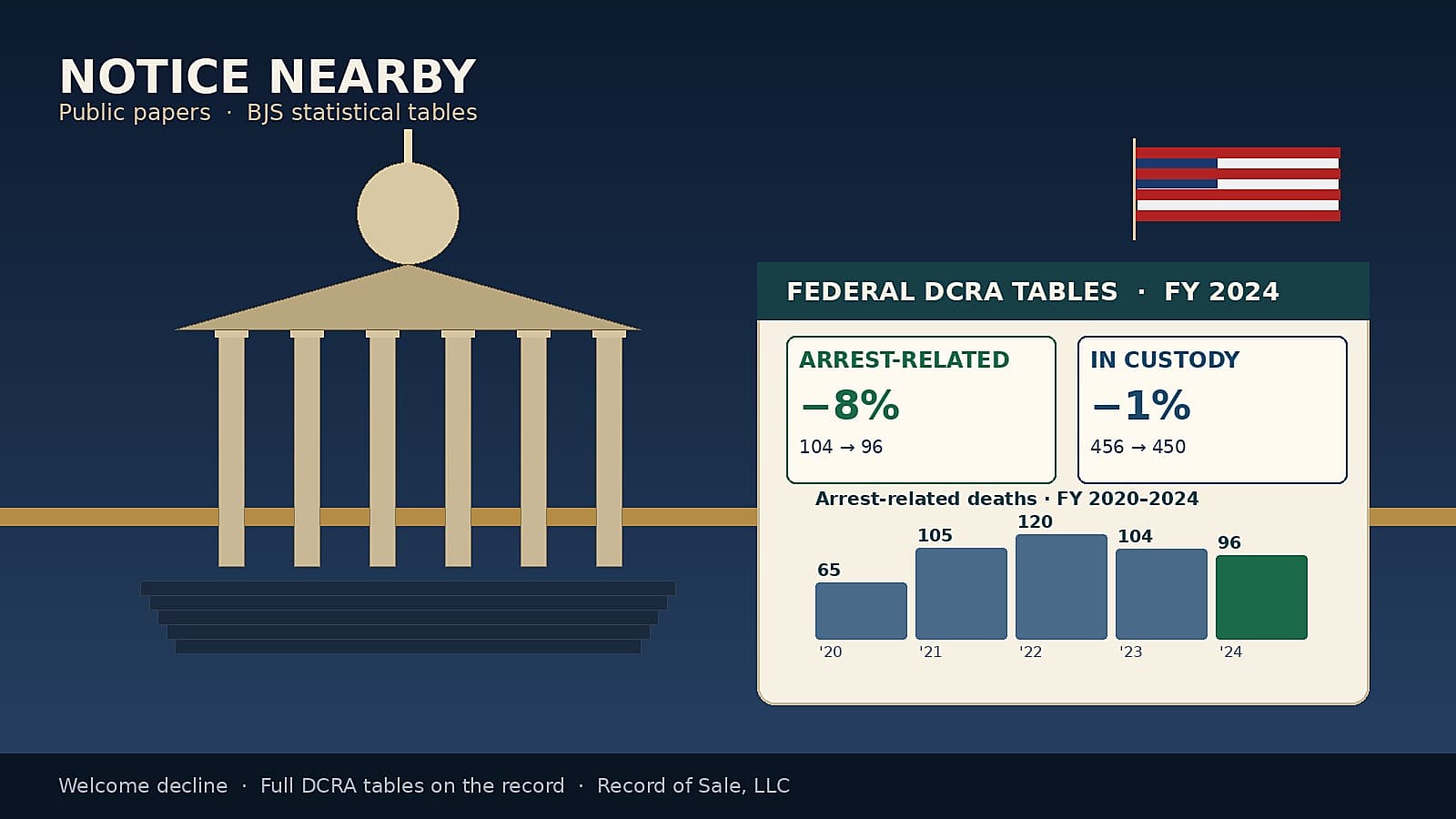
The Bureau of Justice Statistics (BJS) released Federal Deaths in Custody and During Arrest, 2024 – Statistical Tables (NCJ 311869, October 2026). Authors Sean E. Goodison, PhD, and Charlotte Lopez-Jauffret, PhD, report 96 arrest-related deaths and 450 deaths in federal custody for FY 2024 (October 1, 2023–September 30, 2024). From FY 2023 to FY 2024, arrest-related deaths fell 8% (104 → 96) and deaths in custody fell 1% (456 → 450). The report excludes federal executions.
Those year-over-year drops matter. They do not erase the remaining deaths. This Notice Nearby brief celebrates the decline first, then walks the public tables in civic English so neighbors, reporters, and local officials can see what the statistical series actually says — without inventing scores or soft-pedaling what is still on the record.
The short version
BJS’s Federal Law Enforcement Agency Deaths in Custody Reporting Program (FDCRP) collects these counts under the Death in Custody Reporting Act (DCRA) of 2013. From FY 2016 through FY 2024, federal agencies reported an average of about 78 arrest-related deaths and about 490 deaths in custody each year.
The trend line is not flat. Arrest-related deaths peaked at 120 in FY 2022, then fell to 104 in FY 2023 and 96 in FY 2024. Deaths in custody spiked to 614 and 613 in FY 2020 and FY 2021, then stepped down to 483, 456, and 450. FY 2024 continues that downward path on both series.
Manner of death still includes homicide, suicide, illness/natural causes, accident, and other or unknown categories. BJS notes that homicide means the willful killing of one person by another and may include justifiable homicide by a law enforcement officer. Readers should keep that definition in mind when they see the arrest-related homicide share.
Arrest-related deaths in FY 2024
Among the 96 arrest-related deaths:
- Manner: homicide 39% (34), suicide 38% (33), accident 22% (19). A smaller share were natural or unknown/missing at reporting time.
- Decedents: 94% male; 65% white; 51% ages 25–44.
- Contact: officers were serving a warrant in 53% of cases; a violent alleged offense was the most serious offense in 49% of arrest-related deaths.
- Force and firearms: decedents discharged a firearm in 52% of arrest-related deaths; law enforcement officers discharged firearms in 51%; decedents attempted to injure officers in 34%.
Those percentages describe reported incidents. They are not a verdict on any single case. They are the national federal picture BJS published for the fiscal year.
Which agencies reported arrest-related deaths
Table 1 breaks arrest-related deaths by federal agency. The largest counts in FY 2024 were:
- U.S. Marshals Service — 48
- Customs and Border Protection (CBP) — 23
- Bureau of Indian Affairs (BIA) — 10
- Drug Enforcement Administration (DEA) — 6
- ATF — 3 and FBI — 3
Smaller counts appear for other Department of the Interior and Veterans Affairs units. Agency totals are counts of reported deaths, not rankings of “safety.” Different agencies have different missions, geographies, and contact volumes.
Deaths in federal custody
Among the 450 deaths in custody:
- Manner: illness/natural causes 74% (318); accidents 11%; suicide 8%; homicide 6%.
- Agencies: Federal Bureau of Prisons (BOP) — 373; U.S. Marshals Service — 61; ICE — 12 (plus smaller counts elsewhere, including BIA custody deaths).
- Decedents: 95% male; 60% white and 33% black; 54% age 55 or older.
- Offense and time served: drugs were the most serious offense for 30% of custody decedents; 72% had served more than 365 days under the current admission.
Illness and natural causes dominate the custody series. That is a different profile from arrest-related deaths, where homicide and suicide together account for most of the known manners. Location of death often includes medical centers outside the facility and general housing units inside — details BJS publishes in Table 8 for readers who need the facility split.
Who answered the survey
BJS surveyed 135 eligible federal agencies for FY 2024. All 135 responded (100% response). Nine agencies reported any arrest-related death. Four reported any death in custody. Many agencies with arrest or detention authority reported zero deaths for the year — that is part of the public record too.
The program sits under DCRA 2013. Agencies report deaths of persons detained, under arrest, or held in federal correctional, pretrial, or administrative detention settings covered by the statute. Duplicate matching and out-of-scope rules (including the execution exclusion) are described in BJS’s methodology.
How to read the homicide note
BJS is explicit: homicide is the willful killing of one person by another and may include justifiable homicide by a law enforcement officer. In the arrest-related table, many homicide cases are attributed to federal officers, with additional shares for state/local task force officers, tribal officers, and other categories.
That footnote is not a political slogan. It is a definitional warning so readers do not treat “homicide” in these tables as identical to a criminal conviction for murder. The tables count manner of death as agencies reported it under the survey instruments.
Why the year-over-year drop still matters
A decline from 104 to 96 arrest-related deaths (−8%) and from 456 to 450 custody deaths (−1%) is a real movement on a long federal series. After the custody spike of 2020–2021 and the arrest-related peak of 2022, FY 2024 extends the cooling trend.
Celebrating that drop does not mean pretending 546 federal deaths (96 + 450, executions excluded) are a small story. It means telling the truth in order: the direction improved, the remaining counts are still serious, and the detailed tables are public so anyone can check the agency, manner, and demographic splits.
Notice Nearby’s job is the public record — hearing clocks, federal statistical releases, and plain-language briefs — not advocacy for either side of a policing debate. Neighbors who want the source should read BJS directly.
The FY 2016–2024 appendix in one glance
Appendix table 1 lists the annual counts behind Figure 1. Arrest-related deaths ran 51, 41, 53, 68, 65 across FY 2016–2020, then jumped to 105 (FY 2021) and 120 (FY 2022) before easing to 104 and 96. Custody deaths sat near the mid-400s for years, then hit 614 and 613 in the pandemic-era spike years, then 483, 456, and 450.
That is why the FY 2024 averages — about 78 arrest-related and about 490 custody across the nine-year window — sit above the newest single-year totals. Averages smooth spikes. The newest year is what just happened. Both views belong in a fair reading.
BJS also reminds readers that executions in FY 2020–2024 are excluded from these tables and live on a separate capital-punishment page. Mixing those series would blur two different policy stories.
Arrest contact reasons and alleged offenses
Table 4 adds texture beyond the headline manner split. Warrant service was the reason for initial officer contact in just over half of arrest-related deaths. General law enforcement response or patrol accounted for about a third. Detention or transport cases were rare in the reported set.
On alleged offense, violent crimes (as BJS groups them — including homicide, attempted homicide, sex offenses, aggravated assault, assault, and kidnapping) led nearly half of cases with a known offense. Drug offenses were a much smaller share of the arrest-related series than of the custody series. That contrast is useful: people who die during federal arrest contacts and people who die after longer federal incarceration are not the same statistical populations.
Custody location and time served
Table 8 shows where custody deaths occurred. Medical centers outside the facility and general housing units inside the facility together account for a large share. Special medical units, segregation, transit, and mental-health units appear in smaller counts. Those location splits matter for readers who want to know whether deaths clustered in acute medical transfer settings or in everyday housing.
Table 10’s time-served distribution reinforces the long-stay pattern: more than seven in ten custody decedents had served more than a year under the current admission. Drug offenses were the single largest most-serious-offense category among custody decedents (about 30%), followed by weapons and sex offenses. Legal status at death was overwhelmingly convicted new commitment.
None of that invents a narrative about guilt or innocence. It describes the reported custody population that died in FY 2024 under federal detention or incarceration authority.
Where to read the official tables
- BJS publication page: https://bjs.ojp.gov/library/publications/federal-deaths-custody-and-during-arrest-2024-statistical-tables
- PDF (NCJ 311869): https://bjs.ojp.gov/document/fdcda24st.pdf
This brief restates figures from that PDF. If a number here ever appears to conflict with BJS, trust BJS. We do not invent scores, midterms, or Legal Publication status. We point to the agency tables and keep the honesty footer in view.
What this means for local readers
Federal DCRA tables will not replace your county jail dashboard or your city’s use-of-force reports. They answer a different question: what did federal agencies report for arrest-related and custody deaths in one fiscal year?
If you follow Notice Nearby for local hearing clocks, treat this paper as national context — the kind of statistical backbone that sits behind headlines. When local coverage cites “deaths in custody,” ask which jurisdiction, which definition, and whether executions or justifiable-homicide categories are in or out. BJS’s footnotes are there for a reason.
Sources and honesty
Primary source: Bureau of Justice Statistics, Federal Deaths in Custody and During Arrest, 2024 – Statistical Tables, Sean E. Goodison, PhD, and Charlotte Lopez-Jauffret, PhD, October 2026, NCJ 311869 (FDCRP / DCRA 2013 series; FY 2024 = Oct 1, 2023–Sep 30, 2024). Executions excluded as noted by BJS.
Author: Ryan Standley / Record of Sale, LLC / Notice Nearby.
Not legal advice. Not a newspaper. Not Legal Publication. Record of Sale, LLC (Oregon).
Notes and sources
- Source: Bureau of Justice Statistics, Federal Deaths in Custody and During Arrest, 2024 – Statistical Tables (NCJ 311869), Sean E. Goodison, PhD, & Charlotte Lopez-Jauffret, PhD. PDF: https://bjs.ojp.gov/document/fdcda24st.pdf — Page: https://bjs.ojp.gov/library/publications/federal-deaths-custody-and-during-arrest-2024-statistical-tables
- Homicide may include justifiable homicide by a law enforcement officer (BJS definition). Excludes federal executions.
- Author: Ryan Standley / Record of Sale, LLC / Notice Nearby.
- Discussed on @NoticeNearYou: https://x.com/NoticeNearYou/status/2106007073443979576
- Not legal advice. Not a newspaper. Not Legal Publication. Record of Sale, LLC (Oregon).
Public papers shelf · BJS DCRA statistical tables. Discussed on @NoticeNearYou: https://x.com/NoticeNearYou/status/2106007073443979576
Not legal advice. Not a newspaper. Not Legal Publication. Record of Sale, LLC (Oregon).