Public paper · October 4, 2026 · Energy desk
Heat Pump HVAC Full Replacement: A Start-to-Finish Buyer Guide to Replacing Your Furnace and AC
A plain-language buyer guide to replacing a furnace and central AC with a whole-home heat pump: how heat pumps work, ducted versus ductless mini-splits, cold-climate models, Manual J, S, and D, SEER2 and HSPF2 ratings, the R-454B and R-32 refrigerant switch, electrical panels, backup heat, thermostats, permits, rebates, cost drivers, contractor questions, install day, commissioning, and the first years of ownership.
noticenearby.com/papers/heat-pump-hvac-full-replacement.pdf
A dead furnace in January, an air conditioner that quits in a heat wave, a big repair quote on a system that is fifteen or twenty years old, or a power bill that keeps climbing is often the moment a homeowner first hears the words "heat pump." One machine that heats and cools the whole house sounds simple. The real project is not. A full heat pump replacement touches your ducts, your electrical panel, your thermostat, your comfort in the coldest week of the year, and your bills for the next fifteen years or more. The expensive-consumer mistake is letting someone swap equipment by the tonnage on the old nameplate, without a load calculation, without checking the ducts, and without a plan for the coldest nights.
This paper is a start-to-finish buyer guide to replacing a furnace and central air conditioner with a whole-home heat pump in a typical U.S. house. It is education, not a bid, not an energy audit, not a tax opinion, and not legal advice. Your local building department, your electric utility, your state energy office, the IRS, and a licensed HVAC contractor win when they disagree with anything here.
Companion Notice Nearby papers on related big home purchases: whole-home standby generators at https://noticenearby.com/papers/whole-home-standby-generators — home solar + battery packages at https://noticenearby.com/papers/home-solar-battery-packages — EV Level 2 hardwired chargers at https://noticenearby.com/papers/ev-level-2-hardwired-chargers — whole-home water softener / RO at https://noticenearby.com/papers/whole-home-water-softener-ro — septic system replacement at https://noticenearby.com/papers/septic-system-replacement — metal roofing replacement at https://noticenearby.com/papers/metal-roofing-replacement — private well drilling + pump at https://noticenearby.com/papers/private-well-drilling-pump — commercial-grade home security + monitoring at https://noticenearby.com/papers/commercial-grade-home-security-monitoring
Why people replace a furnace and AC with a heat pump
Most homeowners do not wake up wanting a heat pump. They get there for one of a few reasons:
- The old air conditioner or furnace is near the end of its life, and they would rather replace both at once than pay for two separate jobs a few years apart.
- They have no central air and want cooling, and a heat pump gives them cooling plus heat in one system.
- They heat with propane, heating oil, or electric baseboard and want lower running costs.
- They want to stop burning fuel inside the house, often to get rid of a gas line, an oil tank, or carbon monoxide worries.
- They are adding solar panels or a battery and want to use more of their own electricity.
- A room or addition is always too hot or too cold, and a ductless unit can fix it without new ducts.
A heat pump is not always cheaper to run than gas. It depends on your local prices for electricity and fuel, how cold your winters are, how well your house holds heat, and which equipment you buy. A good contractor or energy auditor should be able to explain the trade-off for your house, not just say "heat pumps save money."
How a heat pump works, in plain words
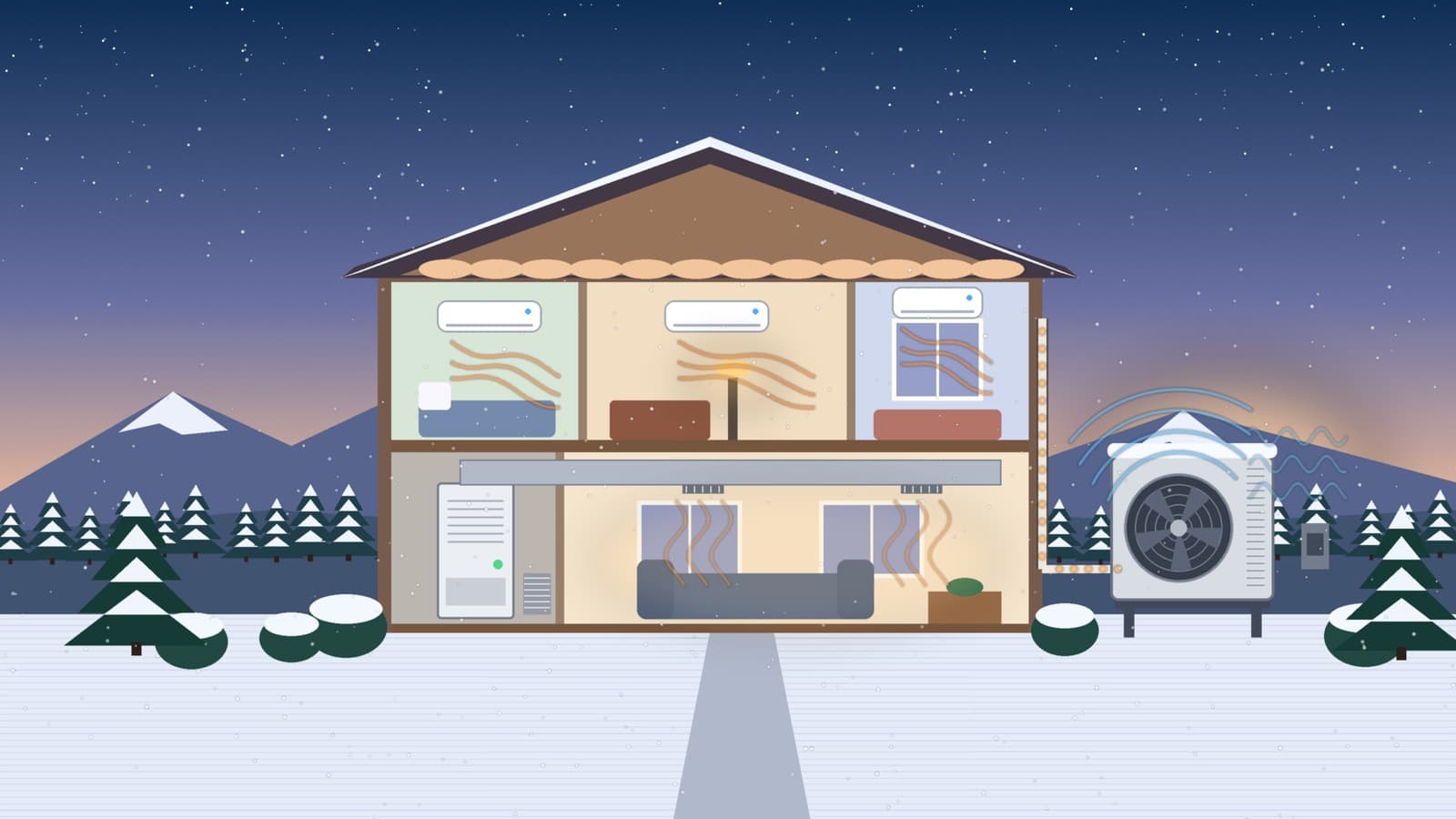
A heat pump does not make heat by burning anything. It moves heat from one place to another, the same way your refrigerator moves heat out of the food box and into your kitchen.
In summer it works like a normal central air conditioner. It pulls heat out of the air in your house and dumps it outside.
In winter it runs the same loop in reverse. Even cold outdoor air holds some heat. The outdoor unit pulls that heat in, a compressor squeezes the refrigerant to make it hotter, and the indoor coil releases the heat into your home.
A part called a reversing valve switches the system between heating and cooling. Because it moves heat instead of making it, a heat pump can deliver more heat energy than the electric energy it uses. That is why heat pumps can cost less to run than electric baseboard or an electric furnace.
As the outdoor air gets colder, there is less heat to grab, and the heat pump has to work harder. Older heat pumps lost a lot of output in deep cold. Newer variable-speed and cold-climate models keep much more of their heating power when it is well below freezing. That change is the main reason heat pumps now make sense in many places where they did not years ago.
A whole-home system usually has three main parts:
- An outdoor unit with the compressor, the outdoor coil, and a big fan.
- An indoor unit, either an air handler connected to your ducts or one or more wall, ceiling, or floor heads for ductless systems.
- Refrigerant lines, a drain line for condensation, and control and power wiring connecting them.
Full replacement versus a hybrid, or dual-fuel, setup
Full replacement means the heat pump does all the heating and cooling. The old furnace comes out. Backup heat, if any, comes from electric heat strips in the air handler.
Hybrid, or dual-fuel, means the heat pump does most of the work, and a gas or propane furnace stays in place and takes over when it gets very cold or when fuel is cheaper than electricity at that temperature. The thermostat or control board picks which one runs.
Full replacement makes sense when you want to get rid of fuel entirely, your winters are mild to moderate, or you choose a true cold-climate heat pump sized for your coldest weather.
Hybrid makes sense when your furnace is fairly new, your winters are very cold, your electricity is pricey compared to gas, or your electrical panel cannot easily handle large backup heat strips.
This paper focuses on full replacement, but the same planning steps apply to a hybrid. Ask every contractor to explain both options for your house and to show you the temperature at which they would switch from heat pump to backup.
Ducted, ductless mini-split, and mixed systems
Ducted heat pump. An outdoor unit connects to an indoor air handler, which pushes air through your existing duct system to every room. This is the most common choice when a house already has decent ducts from a furnace or central AC. It looks and feels like the system you already know.
Ductless mini-split. An outdoor unit connects to one or more indoor heads mounted on walls or ceilings. There are no ducts. Each head heats and cools its own room or zone. Mini-splits are great for homes with boilers, baseboard heat, or no ducts at all, and for additions, garages turned into rooms, and finished attics.
Multi-zone mini-split. One outdoor unit runs several indoor heads. It saves space outside, but every head shares one compressor, and small rooms can end up with a head that is too big. Some contractors prefer several single-zone systems for better efficiency and control.
Ducted mini-split and slim-duct units. Small ducted air handlers hide in a closet, attic, or ceiling and serve a few rooms through short ducts. They are a middle path when you do not want wall heads in every room.
Mixed systems. Many homes end up with a ducted heat pump for most of the house plus one or two ductless heads for problem rooms such as a bonus room over the garage.
Ask what each option means for comfort, noise, filter changes, and how each room is controlled. Ductless heads need their filters cleaned more often and need to be placed where they can throw air across the room.
Cold-climate heat pumps
If your winters regularly drop well below freezing, the words "cold climate" matter more than almost any other spec.
ENERGY STAR has a cold-climate designation for air-source heat pumps that keep strong efficiency and heating output in low temperatures. Its heat pump pages are at https://www.energystar.gov/products/air_source_heat_pumps and https://www.energystar.gov/products/ductless_heating_cooling
The Northeast Energy Efficiency Partnerships, or NEEP, keeps a cold-climate air-source heat pump list with detailed performance data at several outdoor temperatures. It is at https://ashp.neep.org and the group's main site is https://neep.org
What to look for on a cold-climate spec sheet:
- Heating capacity at a low outdoor temperature, not only at the mild rating point.
- The ratio of low-temperature capacity to rated capacity. A higher number means it holds its output better as it gets cold.
- Efficiency at low temperatures, sometimes shown as COP, or coefficient of performance.
- The lowest outdoor temperature the unit is designed to keep running.
- Defrost method and base-pan heater, which keeps ice from building up in the bottom of the unit.
Ask the contractor to show you where the heat pump's output line crosses your home's heat loss line on a chart. That crossing is called the balance point. Below it, the heat pump alone cannot keep up and backup heat has to help. A good design puts the balance point low enough that backup only runs on the coldest days.
Start with the house: audit, insulation, and air sealing
A heat pump is only as good as the house it heats. Leaky windows, thin attic insulation, and gaps around the rim joist all add load, which means a bigger, more expensive system and higher bills.
Before you size a new system, think about:
- A home energy assessment, often called an energy audit, with a blower-door test that measures how leaky the house is.
- Air sealing the attic floor, top plates, plumbing and wiring holes, and rim joists.
- Adding attic insulation if it is thin.
- Fixing ducts that run through hot attics or cold crawlspaces.
Doing these first can let you buy a smaller heat pump and keep rooms more even. ENERGY STAR's general advice pages and rebate finder are at https://www.energystar.gov/rebate-finder
Sizing: the Manual J load calculation
This is the step that separates a good heat pump job from a bad one.
Manual J is the method published by the Air Conditioning Contractors of America, or ACCA, for figuring how much heating and cooling a house actually needs. It looks at your local design temperatures, wall and attic insulation, window sizes and direction, air leakage, duct location, and how many people live there. ACCA's Manual J page is at https://www.acca.org/standards/technical-manuals/manual-j and ACCA's main site is https://www.acca.org
Why it matters:
- Oversized systems short-cycle. They turn on and off too often, which wears parts, feels drafty, and does a poor job pulling humidity out in summer.
- Undersized systems run nonstop in extreme weather and lean too hard on backup heat.
- Your old furnace and AC were often oversized. Copying the old tonnage repeats the old mistake.
A real Manual J is a written report, usually from software, with room-by-room numbers. Ask every bidder for it. A contractor who sizes by square feet or by looking at the old nameplate is guessing.
If you have past utility bills, share them. Some contractors also use past fuel use to check the load calculation against real life.
Picking equipment: Manual S
Manual S is ACCA's method for picking equipment that matches the Manual J load at your local design conditions. ACCA's page is at https://www.acca.org/standards/technical-manuals/manual-s
It keeps a contractor from choosing a unit that looks right on a brochure but cannot deliver enough heat on a cold night or enough moisture removal on a muggy day. For heat pumps, Manual S looks at both heating and cooling, and at how capacity changes with outdoor temperature. Ask the contractor to show you the heating capacity of the proposed unit at your area's winter design temperature.
Ducts: Manual D and duct repair
Manual D is ACCA's method for designing duct systems so each room gets the right amount of air at a reasonable fan speed and noise level. ACCA's page is at https://www.acca.org/standards/technical-manuals/manual-d
Heat pumps often move air a little differently than a furnace. Heat pump supply air in winter feels warm, not hot like a gas furnace, so good airflow to each room matters even more.
Ask the contractor to check:
- Static pressure, which shows whether your ducts are too small or blocked. High static pressure makes the fan work harder and louder.
- Duct leaks, especially in attics, crawlspaces, and garages. Sealing them with mastic or approved tape helps comfort and efficiency.
- Return air. Many older homes have too few returns, which starves the system.
- Insulation on ducts outside the heated space.
- Room-by-room airflow after install.
Sometimes the right answer is to fix a few duct runs, add a return, or move ducts inside the heated space. Sometimes the ducts are so bad that ductless is the better plan.
Reading the ratings: SEER2, EER2, and HSPF2
Since 2023, U.S. heating and cooling ratings use updated federal test procedures, and the numbers carry a "2" at the end. They are not directly comparable to the older SEER and HSPF numbers on your old system, so compare new numbers to new numbers.
SEER2, or Seasonal Energy Efficiency Ratio 2, measures cooling efficiency over a typical cooling season. Higher is better.
EER2, or Energy Efficiency Ratio 2, measures cooling efficiency at one hot outdoor condition. It matters most in very hot climates.
HSPF2, or Heating Seasonal Performance Factor 2, measures heating efficiency over a typical heating season. Higher is better. For a full replacement in a cold area, HSPF2 and cold-climate data matter more than SEER2.
The U.S. Department of Energy sets the minimum efficiency standards. Its Appliance and Equipment Standards Program is at https://www.energy.gov/eere/buildings/appliance-and-equipment-standards-program — minimums differ by region of the country, and your contractor should know which apply.
Ratings are for a matched system, meaning a specific outdoor unit, indoor unit, and sometimes a specific furnace or air handler. A high-rated outdoor unit paired with the wrong indoor coil may not deliver the rated number.
AHRI certificates and matched systems
The Air-Conditioning, Heating, and Refrigeration Institute, or AHRI, runs a certification program and a public directory where you can look up the ratings for exact equipment combinations. The directory is at https://www.ahridirectory.org and AHRI's main site is https://www.ahrinet.org
Ask every bidder for the AHRI reference number of the exact combination they are quoting. With that number you can:
- Check the SEER2, EER2, HSPF2, and capacity yourself.
- Compare two bids on the same footing.
- Give the certificate to any rebate or utility program that asks for it.
If two bids list different model numbers, look both up. A small change in the indoor model can change the ratings.
Variable-speed versus single-stage and two-stage
Single-stage heat pumps run at full blast or off. They cost less up front but cycle more and can feel less even.
Two-stage units have a high and a low setting. They run on low most of the time, which is quieter and better for humidity.
Variable-speed, or inverter, heat pumps can slow down or speed up in small steps to match the load. They tend to be the quietest, most even, and most efficient, and they usually do best in cold weather. They also have more electronics, and some need the matching thermostat or control to work at their best.
For a full replacement in a cold or mixed climate, most efficiency programs and many contractors lean toward variable-speed equipment. Ask how the system behaves at both your summer and winter design temperatures, not just the rating point.
Refrigerants: the R-454B and R-32 transition
The refrigerant is the fluid that carries heat around the loop. The U.S. Environmental Protection Agency, under a federal law called the AIM Act, has been moving new residential air conditioners and heat pumps away from refrigerants with a high global warming potential, such as R-410A. EPA's technology transitions page is at https://www.epa.gov/climate-hfcs-reduction/technology-transitions
In practice, most new residential systems now use one of two newer refrigerants:
- R-454B, used by many ducted system makers.
- R-32, common in mini-splits and some ducted systems.
Both are classed as A2L refrigerants, which means lower toxicity and mildly flammable. Equipment built for them includes safety features such as refrigerant leak sensors and controls that run the fan if a leak is detected. Installers need training and the right tools to handle them, and local codes have been updated to cover them.
What this means for you:
- New equipment and old equipment do not mix. You generally cannot put an A2L outdoor unit on an old R-410A indoor coil. Expect the indoor coil or air handler to be replaced with the outdoor unit.
- Old refrigerant lines may or may not be reusable. Ask the contractor whether they will flush, test, or replace the line set, and why.
- The old refrigerant must be recovered, not vented. EPA's Section 608 rules cover technician certification and refrigerant handling and are at https://www.epa.gov/section608 — EPA's SNAP program, which reviews substitute refrigerants, is at https://www.epa.gov/snap
- Ask how the new system's leak detection works and what you should do if it alarms.
Electrical panel and circuits
A full heat pump replacement is partly an electrical project.
The outdoor unit needs its own dedicated circuit and a disconnect near the unit. If the air handler has electric backup heat strips, those need their own large circuit or circuits. Removing a gas furnace may free up a small circuit, but the new heat strips often need much more.
Questions to settle early:
- Does your panel have the capacity and the open spaces for the new circuits? A licensed electrician may need to do a load calculation under the National Electrical Code, NFPA 70, which is at https://www.nfpa.org/codes-and-standards/nfpa-70-standard-development/70
- Will you need a panel upgrade or a new service from the utility? That can add time, permits, and a utility appointment.
- Are you also planning an EV charger, induction range, heat pump water heater, or solar and battery? Plan all the loads together so you do not upgrade twice. The companion EV charger, solar, and generator papers walk those loads.
- If you have a standby generator, can it run the heat pump? Variable-speed units are often easier on generators at startup, but backup heat strips may be too large for the generator.
Some homes avoid a panel upgrade by choosing smaller backup heat, using load-management devices, or going hybrid. Ask for the trade-offs in writing.
Backup and auxiliary heat
Most ducted heat pumps include, or can add, electric resistance heat strips in the air handler. Different labels exist:
- Auxiliary heat runs with the heat pump when the heat pump cannot keep up, or during defrost.
- Emergency heat runs instead of the heat pump if the heat pump fails.
Electric strips work, but they use far more electricity than the heat pump itself. A poorly set up system that leans on strips can produce a shock of a winter power bill.
Ask:
- How much backup heat is being installed, and why that size?
- At what outdoor temperature, or under what conditions, will it turn on?
- Will the thermostat lock out strips above a set outdoor temperature?
- How will you know when backup heat is running?
- In a dual-fuel setup, at what temperature does the furnace take over?
Ductless mini-splits usually have no built-in backup. If one is your only heat source in a cold area, talk about a backup plan for a power outage or a unit failure in deep cold.
Thermostats and controls
The thermostat is the system's boss, and the wrong one can waste money.
- Heat pumps need a thermostat that understands heat pumps, including the reversing valve and the auxiliary heat stage.
- Many variable-speed systems work best with the maker's own communicating control. A generic smart thermostat might only run the system at a few fixed speeds.
- Large nighttime setbacks can backfire with heat pumps. A big morning recovery may call for backup heat. Many heat pump thermostats have smart recovery to avoid this. Ask the contractor how they recommend you set schedules.
- An outdoor temperature sensor helps the control decide when to use backup heat.
- Mini-splits often come with handheld remotes, and many have Wi-Fi add-ons or wall controls.
ENERGY STAR's smart thermostat page is at https://www.energystar.gov/products/smart_thermostats
Humidity, filters, and indoor air
A heat pump that is sized right does a good job of drying the air in summer. An oversized one cools fast and leaves the house clammy.
- Ask about filter size and type. A bigger filter cabinet with a deeper media filter can improve air cleaning without choking airflow.
- In humid climates, ask about dehumidification settings or a separate dehumidifier.
- In dry winter climates, some families add a humidifier. Ask whether it fits with the new air handler.
- Removing a gas furnace removes one source of combustion inside the home. You still need working smoke and carbon monoxide alarms if you have any other fuel-burning appliances or an attached garage.
EPA's indoor air quality pages are at https://www.epa.gov/indoor-air-quality-iaq
The outdoor unit: placement, noise, snow, and drainage
The outdoor unit needs a good home too.
- Clearance. Follow the maker's spacing from walls, fences, shrubs, and other units so air can flow.
- Snow and ice. In snowy areas the unit should sit on a stand or wall bracket above typical snow depth, away from roof drip lines, with room for defrost water to drain and freeze without blocking the coil.
- Noise. Variable-speed units can be quiet, but placement near a bedroom window or a neighbor's patio still matters. Some towns have noise or setback rules.
- Flood and storm. Raise the unit above likely flooding, and secure it in high-wind areas.
- Line set route. Shorter, cleaner refrigerant line runs are better. Ask how lines will be covered and protected from sun and pests.
Permits, codes, and inspections
Most areas require a mechanical permit to replace heating and cooling equipment, and often an electrical permit for new circuits or a panel change. Removing a gas furnace may also involve capping the gas line correctly, and removing an oil tank has its own rules.
- Ask the contractor who pulls the permits. In most places it should be the licensed contractor, not you.
- Ask whether the inspection includes the refrigerant system, electrical work, and duct changes.
- Keep copies of the permit and final inspection for your records and for any future home sale.
Skipping permits can cause trouble with insurance, rebates, and resale.
Rebates, tax credits, and utility programs
Incentives for heat pumps change often, so treat everything here as a starting point and check the official source before you sign.
- Federal tax credits. The IRS page for the Energy Efficient Home Improvement Credit, which covered qualifying heat pumps, says the credit applies to qualifying property placed in service through December 31, 2025. Check the IRS page for current rules before counting on any federal credit for a later install: https://www.irs.gov/credits-deductions/energy-efficient-home-improvement-credit — Form 5695 details are at https://www.irs.gov/forms-pubs/about-form-5695 — ENERGY STAR's federal tax credit summary is at https://www.energystar.gov/about/federal-tax-credits
- State home energy rebates. The U.S. Department of Energy's Home Energy Rebates programs are run by states, and availability, timing, and income rules vary. The DOE page is at https://www.energy.gov/scep/home-energy-rebates-programs — check your state energy office for what is open now.
- Utility rebates. Many electric utilities offer rebates, special heat pump rates, or financing. Ask your utility directly, and check ENERGY STAR's rebate finder at https://www.energystar.gov/rebate-finder
- Program rules. Many programs require a specific efficiency level, an AHRI certificate, a load calculation, a participating contractor, or pre-approval before install. Learn the rules before the contract is signed, not after.
Do not let a sales rep promise you a rebate or tax amount you cannot verify on an official page. Ask for any incentive claim in writing, with the program name. A tax professional can tell you how any credit applies to your own return.
Cost drivers (not a quote)
Notice Nearby does not post fake prices. These are the things that move the price up or down:
- Ducted, ductless, or mixed design, and how many indoor zones or heads.
- Standard, variable-speed, or cold-climate equipment.
- System size from the Manual J, which may be smaller or larger than your old system.
- Duct repairs, new returns, sealing, insulation, or a full duct redesign.
- New refrigerant line sets versus reusing and flushing old ones.
- Electrical work: new circuits, disconnects, and any panel or service upgrade.
- Backup heat size, or keeping a furnace for a hybrid setup.
- Removing the old furnace, capping gas, removing an oil tank, or disposing of old equipment.
- Thermostat or communicating control.
- Stands, wall brackets, pads, and snow or flood protection.
- Permits, inspections, and any utility service work.
- Attic, crawlspace, or tight-closet access that makes the job harder.
- Warranty registration and any extended labor warranty.
Get at least two or three written bids on the same scope, so you are comparing the same thing. Ask every bidder to list equipment model numbers, the AHRI reference number, the Manual J result, and every line item above.
Choosing a contractor: questions to ask
Good questions to ask every bidder:
- Are you licensed and insured in this state for HVAC work? Can I see the license number?
- Will you do a Manual J load calculation and give me the report? Will you follow Manual S and check my ducts with Manual D methods?
- What is the AHRI reference number for the exact system you are quoting?
- How does this unit perform at our winter design temperature? Where is the balance point?
- How much backup heat are you installing, and how will it be controlled?
- Will you measure static pressure and airflow before and after install?
- Are you replacing or reusing the refrigerant lines, and why?
- Are your technicians trained on A2L refrigerants?
- Do I need an electrical panel upgrade? Who handles the electrical work and permits?
- Which thermostat or control will you install, and will it run the system at full variable speed?
- Who pulls the permits and schedules the inspections?
- What is covered by the maker's warranty, and what labor warranty do you give? Will you register the equipment?
- Which rebates or utility programs do you participate in, and what paperwork will you provide?
- Can you give me references from homes like mine, in this climate?
Technician certification programs such as NATE, North American Technician Excellence, are at https://www.natex.org
Red flags include sizing by square footage only, no load calculation, refusing to give model numbers, pressure to sign the same day, promises of rebates or tax amounts you cannot verify, and a quote that does not mention ducts, electrical work, or permits.
Reading bids side by side
Put each bid on one page with the same rows:
- Outdoor model, indoor model, and AHRI reference number.
- Rated SEER2, EER2, and HSPF2 from the AHRI directory.
- Heating capacity at your winter design temperature.
- Manual J heating and cooling loads.
- Duct work included.
- Line set plan.
- Electrical work and permits included.
- Backup heat size and controls.
- Thermostat or control.
- Equipment warranty and labor warranty, in years.
- Total price and payment schedule.
A higher bid that includes duct fixes, a real load calculation, and proper commissioning can be the better deal over fifteen years.
Install day
A typical ducted full replacement goes like this:
- Protect floors and set up a clear path for equipment.
- Recover refrigerant from the old system and disconnect power, and cap the gas line if the furnace is coming out.
- Remove the old outdoor unit, indoor coil, and furnace or air handler.
- Set the new outdoor unit on its pad, stand, or wall bracket, and set the new air handler.
- Make duct changes: transitions, sealing, new returns, or repairs.
- Install or flush the refrigerant lines, braze or flare connections, and install the condensate drain and any safety switch.
- Pressure-test the refrigerant lines with nitrogen to find leaks.
- Pull a deep vacuum to remove air and moisture, and check that it holds.
- Complete the electrical work: circuits, disconnect, backup heat wiring, and thermostat wiring.
- Release or add refrigerant as the maker requires for the line length.
- Start up, test, and set up the controls.
Many ducted swaps take one to a few days. Mini-split jobs vary by the number of heads. Panel upgrades, duct redesigns, and utility work can add days or weeks before the install.
Commissioning: how to know it was set up right
Commissioning is the checklist that proves the system was installed and tuned the way the maker intended. It is where many jobs cut corners.
Ask the contractor to give you a written start-up report showing:
- Vacuum level reached and how long it held.
- Refrigerant charge checked by the maker's method, such as subcooling or superheat, not by guess.
- Static pressure in the ducts and airflow at the air handler.
- Supply and return air temperatures in heating and cooling.
- Electrical readings for the outdoor unit and the backup heat.
- Thermostat or control settings, including backup heat lockout and any temperature thresholds.
- Condensate drain test and safety switch test.
- Refrigerant leak sensor test, if the system has one.
- Room-by-room airflow check, if they did one.
Do not make the final payment until you have this report, the permit sign-off or inspection date, and the warranty registration.
The first weeks: what is normal
New heat pump owners sometimes call the contractor for things that are normal:
- Warm, not hot, air from the vents in winter. Heat pump air feels cooler to the hand than gas-furnace air, even when the house is warm.
- Long, steady run times. Variable-speed units are designed to run longer at low speed.
- Defrost cycles. In cold, damp weather the outdoor unit stops heating for a few minutes to melt ice off its coil. You may see steam rising from the unit and hear a whoosh. That is normal.
- Water and ice under the outdoor unit. Defrost water has to go somewhere. Keep the drain path clear.
- Some noise from the outdoor unit at startup or in defrost.
Call the contractor if backup heat runs all the time in mild weather, the house cannot hold temperature, the outdoor unit is buried in ice that does not clear, or a leak alarm goes off.
Maintenance and first years of ownership
- Change or clean filters on schedule. Ductless heads usually need filter cleaning more often than a ducted system.
- Keep the outdoor unit clear of leaves, snow, grass clippings, and shrubs.
- Keep the condensate drain flowing. A clogged drain can shut the system down or leak water.
- Schedule professional maintenance as the maker and your warranty require. Ask what the visit includes: coil cleaning, electrical checks, refrigerant checks, and drain cleaning.
- Watch your bills for the first full year and compare heating months with the contractor's estimate.
- Check the thermostat's backup heat use. Many smart controls show how often strips ran.
- Register the equipment with the maker if the contractor did not. Many warranties require registration within a set time.
- Keep the AHRI certificate, start-up report, permit, warranty papers, and model and serial numbers together for future service and for a home sale.
Common mistakes that blow budgets
- Sizing by the old system's tonnage instead of a Manual J.
- Skipping duct checks, then blaming the heat pump for uneven rooms.
- Buying a non-cold-climate unit for a cold area and paying for heat strips all winter.
- Putting a smart thermostat on a variable-speed system that needs its own control.
- Discovering a needed panel upgrade after the contract is signed.
- Counting on a rebate or tax credit that has ended or that the job does not qualify for.
- Skipping air sealing and insulation that would have allowed a smaller system.
- Paying in full before the start-up report and inspection.
- Setting the thermostat back hard every night and triggering backup heat every morning.
Comparing options side by side
Put the choices in one mental table before you sign.
Ducted full replacement with a cold-climate variable-speed heat pump: best for homes with good ducts in cold or mixed climates where the owner wants to drop fuel. Wrong when the ducts are poor and will not be fixed.
Ducted heat pump with a gas furnace backup, or dual-fuel: best when the furnace is fairly new, winters are very cold, or the panel cannot handle large heat strips. Wrong when the goal is to remove fuel from the house entirely.
Ductless mini-splits: best for homes with no ducts, boiler or baseboard heat, additions, and problem rooms. Wrong when every small room gets an oversized head, or when the owner does not want wall units.
Mixed ducted plus ductless: best for houses with a main duct system and one or two rooms that never get comfortable. Wrong when the extra outdoor units do not fit the yard or the budget.
Standard single-stage heat pump: best for mild climates and tight budgets. Wrong for cold climates and humid summers where comfort and efficiency matter more.
Standards and education links (manufacturer, standards, and public agencies only)
- ENERGY STAR air-source heat pumps: https://www.energystar.gov/products/air_source_heat_pumps
- ENERGY STAR ductless heating and cooling: https://www.energystar.gov/products/ductless_heating_cooling
- ENERGY STAR smart thermostats: https://www.energystar.gov/products/smart_thermostats
- ENERGY STAR federal tax credit summary: https://www.energystar.gov/about/federal-tax-credits
- ENERGY STAR heat pump tax credit page: https://www.energystar.gov/about/federal_tax_credits/air_source_heat_pumps
- ENERGY STAR rebate finder: https://www.energystar.gov/rebate-finder
- IRS Energy Efficient Home Improvement Credit: https://www.irs.gov/credits-deductions/energy-efficient-home-improvement-credit
- IRS Form 5695: https://www.irs.gov/forms-pubs/about-form-5695
- U.S. DOE Home Energy Rebates programs: https://www.energy.gov/scep/home-energy-rebates-programs
- U.S. DOE Appliance and Equipment Standards Program: https://www.energy.gov/eere/buildings/appliance-and-equipment-standards-program
- AHRI certified directory: https://www.ahridirectory.org
- AHRI: https://www.ahrinet.org
- ACCA: https://www.acca.org
- ACCA Manual J: https://www.acca.org/standards/technical-manuals/manual-j
- ACCA Manual S: https://www.acca.org/standards/technical-manuals/manual-s
- ACCA Manual D: https://www.acca.org/standards/technical-manuals/manual-d
- NEEP cold-climate heat pump list: https://ashp.neep.org
- NEEP: https://neep.org
- EPA technology transitions (refrigerants): https://www.epa.gov/climate-hfcs-reduction/technology-transitions
- EPA Section 608 refrigerant management: https://www.epa.gov/section608
- EPA SNAP program: https://www.epa.gov/snap
- EPA indoor air quality: https://www.epa.gov/indoor-air-quality-iaq
- NFPA 70 National Electrical Code: https://www.nfpa.org/codes-and-standards/nfpa-70-standard-development/70
- ASHRAE: https://www.ashrae.org
- NATE technician certification: https://www.natex.org
- Manufacturer examples for spec reading: https://www.carrier.com — https://www.trane.com — https://www.lennox.com — https://daikincomfort.com — https://www.mitsubishicomfort.com — https://www.fujitsugeneral.com/us/ — https://www.bosch-homecomfort.com/us/en/residential/home/ — https://www.rheem.com — https://www.goodmanmfg.com
Notice Nearby does not link to retailers or affiliate shopping pages in this series.
What to bring to the first meeting
- Twelve months or more of electric and fuel bills, if you have them.
- The model and serial numbers of your current furnace, air conditioner, and thermostat.
- A list of rooms that run too hot, too cold, too dusty, or too humid.
- Any energy audit or blower-door results.
- Your electrical panel's main breaker size and a photo of the panel label.
- Plans for an EV charger, solar, a battery, a generator, or other big electric loads.
- Notes on where you would and would not accept an outdoor unit or indoor heads.
How this paper fits the expensive-consumer series
Notice Nearby's expensive-consumer papers walk large home purchases with standards links and no retailer carts. Generators cover backup power. Solar and battery cover on-site electricity. EV Level 2 covers hardwired charging. Water softener and RO cover water treatment. Septic replacement covers onsite wastewater. Metal roofing covers the weather surface. Private wells cover the water supply. Commercial-grade security covers the systems that watch over the house. Heat pump replacement covers the system that keeps every room comfortable all year, and it ties the electrical side of the series together. The same honesty rules apply: education links, cost drivers instead of fake bids, and an install path you can hand to a licensed HVAC contractor, your electrician, your utility, and your local building department.
Bottom line
Tighten the house first where you can. Insist on a written Manual J, equipment picked with Manual S, and a real look at the ducts. In a cold area, choose a heat pump with published cold-climate performance and know where the balance point falls. Compare bids by AHRI reference number and by heating capacity at your winter design temperature, not just by brand or SEER2. Plan the electrical panel, backup heat, and thermostat together. Expect the new A2L refrigerant equipment to come with a new indoor coil and possibly new lines. Check every rebate and tax claim on an official page before you sign. Do not make the final payment until you have the start-up report, the permit sign-off, and the warranty registration, and then keep the filters clean and the outdoor unit clear for the years to come.
Not legal advice. Not a newspaper. Not Legal Publication. Record of Sale, LLC (Oregon).
Notes and sources
- Author: Ryan Standley / Record of Sale, LLC / Notice Nearby.
- Discussed on @NoticeNearYou: (pending — fill xPostUrl after live post).
- Not legal advice. Not a newspaper. Not Legal Publication. Record of Sale, LLC (Oregon).
Energy desk · Notice Nearby public papers shelf. @NoticeNearYou post pending.
Not legal advice. Not a newspaper. Not Legal Publication. Record of Sale, LLC (Oregon).