Public paper · October 11, 2026 · Space desk
NASA Tests Next-Generation Heat Shields by Riding Twelve Student-Built Capsules Down With a Departing Cygnus Cargo Ship
NASA says 12 small capsules designed by University of Kentucky students rode a departing Northrop Grumman Cygnus XL cargo ship back through the atmosphere to test heat shield materials for future Moon and Mars missions, including a 3D-printed shield and a felt-like Mars candidate.
noticenearby.com/papers/nasa-krepe-3-heat-shield-capsules-cygnus-reentry-test.pdf
NASA says it is testing the heat shields that could bring astronauts home from the Moon and Mars "by taking out the trash." In an October 9, 2026 article from NASA's Ames Research Center, the agency said a fleet of 12 small experimental capsules rode inside Northrop Grumman's 24th cargo resupply mission, a Cygnus XL, when it departed the International Space Station.
The experiment is the Kentucky Reentry Probe Experiment (KREPE-3), the third in a series of low-cost missions that use the last minutes of a cargo spacecraft's life to collect re-entry data.
How the test works
- Before departure, astronauts packed the Cygnus with waste and activated the capsules.
- As the spacecraft breaks apart on its planned path through the atmosphere, the capsules eject and record temperature, pressure, motion, magnetic field and light.
- Satellite links send the data to researchers live.
What is being tested
- Proven space shuttle ceramic tile material, for comparison.
- A 3D-printed heat shield from NASA Johnson Space Center and Oak Ridge National Laboratory.
- Two capsules flying MERINO, an Ames family of carbon and phenolic fiber layers stitched together like felt. NASA calls it more flexible, faster to make and cheaper, and a promising candidate for Mars, where the thinner atmosphere means lower heat loads.
- A dual-cone capsule with a tungsten tip to check computer models.
- A capsule shaped like the aeroshell for NASA's Dragonfly mission to Saturn's moon Titan, covered in NASA's PICA ablator.
- An umbrella-shaped deployable shield called ADEPT.
Who built it
NASA says KREPE-3 is a collaboration among the University of Kentucky, the state of Kentucky, NASA's EPSCoR program, several NASA centers and other partners. The capsules were designed by University of Kentucky students. "It's a smart way to get flight data on materials that are still in development," said Keith Peterson, a materials engineer at Ames.

Why it matters locally
This is home-grown space work: a state university, a national laboratory in Tennessee, and NASA centers in California and Texas sharing one low-cost flight. Programs like EPSCoR are built to bring research dollars to states that get less federal research funding.
Source
- NASA, "NASA Demonstrates Next-Generation Heat Shield Technologies," NASA Ames Research Center, October 9, 2026 (nasa.gov).
Notes and sources
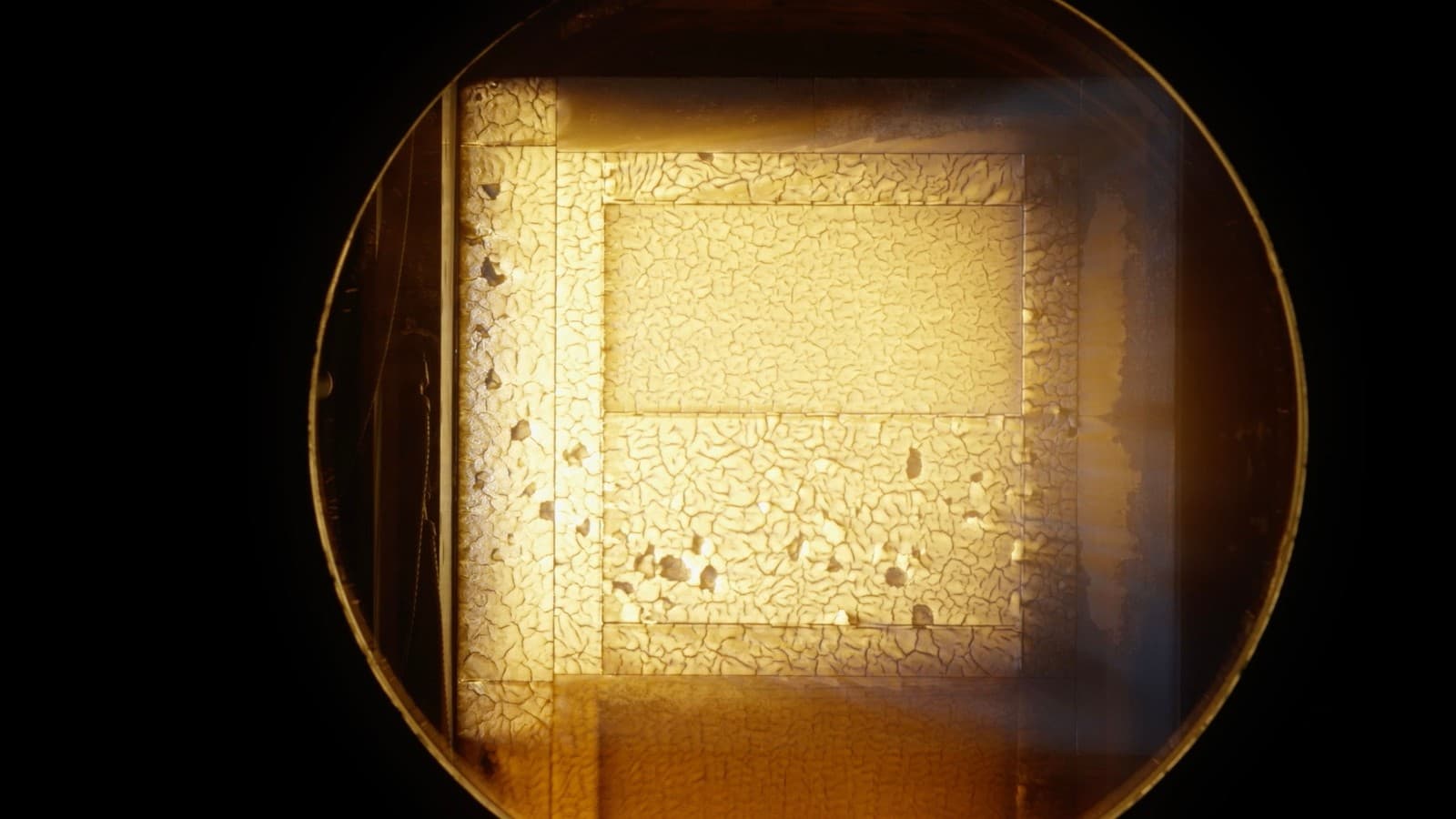
- Image: A test block of Avcoat heat shield material in an arc jet at NASA (file photo, not a KREPE-3 capsule). Photo: NASA Ames Research Center / NASA via Wikimedia Commons (Public domain).
- Author: Ryan Standley / Record of Sale, LLC / Notice Nearby.
- Discussed on @NoticeNearYou: (pending — fill xPostUrl after live post).
- Not legal advice. Not a newspaper. Not Legal Publication. Record of Sale, LLC (Oregon).
Space desk · Notice Nearby public papers shelf. @NoticeNearYou post pending.
Not legal advice. Not a newspaper. Not Legal Publication. Record of Sale, LLC (Oregon).