Public paper · October 4, 2026 · Energy desk
Private Well Drilling and Pump Systems: A Start-to-Finish Buyer Guide
A plain-language buyer guide to drilling a private water well and choosing the pump: when you need a well, siting and setbacks, permits and water rights, groundwater basics, drilled versus driven versus bored wells, casing, grout, and caps, depth and yield, cost drivers, submersible versus jet and constant-pressure pumps, pressure tanks, wiring, water testing, contractor questions, install path, and the first years of ownership.
noticenearby.com/papers/private-well-drilling-pump.pdf
A buyer falls for a piece of rural land, then learns there is no city water line on the road. An older house sputters air from the kitchen faucet and the pressure gauge in the basement keeps dropping. A shallow well goes cloudy after a wet spring. Each of these is the moment a homeowner starts learning about wells. A new well and pump system is one of the biggest checks a rural property can need, and most of what you pay for ends up underground where you will never see it. The expensive-consumer mistake is choosing a driller by the lowest per-foot price before anyone has talked about the local groundwater, the setbacks, the casing and grout, or how the finished well will be tested.
This paper is a start-to-finish buyer guide to private water well drilling and pump systems for a typical U.S. home. It is education, not a bid, not a permit application, not a water test, and not legal, engineering, or medical advice. Your state well-construction rules, your county or state health department, your state water-rights agency, a licensed well driller, and a licensed pump installer win when they disagree with anything here.
Companion Notice Nearby papers on related big home purchases: whole-home standby generators at https://noticenearby.com/papers/whole-home-standby-generators — home solar + battery packages at https://noticenearby.com/papers/home-solar-battery-packages — EV Level 2 hardwired chargers at https://noticenearby.com/papers/ev-level-2-hardwired-chargers — whole-home water softener / RO at https://noticenearby.com/papers/whole-home-water-softener-ro — septic system replacement at https://noticenearby.com/papers/septic-system-replacement — metal roofing replacement at https://noticenearby.com/papers/metal-roofing-replacement
When a private well is on the table
Most homes that use a private well fall into a few groups:
- Rural land with no public water main close enough to connect.
- An older house whose existing well has failed, gone dry, or was built in a way that lets surface water in.
- A property where the old well is too shallow and keeps going low in late summer or drought.
Before you drill, ask the county or the local water utility whether a public water line is planned or already reachable. A connection can cost a lot, but it can also be the cheaper and simpler choice over the life of the house. If you are buying land, put a well clause in the purchase offer so you are not stuck with a lot that cannot get water.
The biggest thing to understand up front: a private well is your own small water system. U.S. EPA explains that the federal rules that protect public water systems do not apply to private wells. The owner is responsible for building it right, testing the water, and keeping it safe. EPA's private well pages are at https://www.epa.gov/privatewells — CDC's well water safety page is at https://www.cdc.gov/drinking-water/safety/index.html
Groundwater basics in plain language
Groundwater is water that fills the spaces between grains of sand and gravel, or the cracks and openings in rock, below the ground. A layer that holds enough water and lets it move well enough to supply a well is called an aquifer.
Unconsolidated aquifers are loose material such as sand and gravel. Wells in these layers usually need a screen at the bottom so water can come in while sand stays out.
Bedrock aquifers are rock such as granite, basalt, sandstone, or limestone. Water moves through cracks, fractures, and openings. A bedrock well is often cased through the soil and loose layers on top, then left as an open hole in solid rock below. How much water you get depends heavily on how many water-bearing cracks the drill hits.
The water table is the level below which the ground is full of water. It rises and falls with seasons, drought, and nearby pumping. A well that works in April can struggle in September if it was drilled too shallow.
USGS explains wells and aquifers for the public at https://www.usgs.gov/special-topics/water-science-school/science/groundwater-wells and https://www.usgs.gov/special-topics/water-science-school/science/aquifers-and-groundwater — USGS water data, including some groundwater-level records, is at https://waterdata.usgs.gov
The best local knowledge often lives in well logs. Many states require drillers to file a report for each new well showing depth, layers drilled through, casing, and yield. Ask your state agency how to look up logs for wells near your property. Neighbors' wells are a clue, not a promise, especially in fractured rock.
Siting and setbacks: where the well can go
Where the well goes matters as much as how deep it goes. State and local rules set minimum distances (setbacks) between a well and things that can pollute it or that the well could harm. Common setback items include:
- Septic tanks and drainfields, including a neighbor's.
- Property lines.
- Buildings and foundations.
- Animal pens, barns, and manure storage.
- Fuel tanks, chemical storage, and old dumps.
- Streams, ponds, and flood-prone ground.
- Power lines, for drill-rig safety.
The exact distances vary by state and sometimes by county, and they can differ for each item, so do not copy a number from another state or a website. Get the distances from your state well-construction rules or the permit office.
Good siting habits: put the well uphill from the septic system and animal areas when you can, keep it out of low spots and away from driveway runoff, make sure a drill rig and a future pump hoist truck can reach it, and mark the spot on a property sketch kept with the house records.
If you are also planning a septic system, plan the well and the septic together. The Notice Nearby septic paper at https://noticenearby.com/papers/septic-system-replacement covers the wastewater side.
Permits, licensing, and water rights
Most states require a licensed or registered well driller and some form of permit, notice, or start card before drilling. Many also license pump installers separately. A licensed contractor usually handles the paperwork, but you should see the permit before the rig shows up. If a driller says you do not need anything, call the state or county yourself.
Examples of state well-program pages: the Oregon Water Resources Department well construction program at https://www.oregon.gov/owrd/programs/gwwl/wcc/pages/default.aspx — Washington State Department of Ecology wells at https://ecology.wa.gov/water-shorelines/water-supply/wells — every state has its own agency, often in water resources, environmental quality, or health.
Water rights are a separate question from the drilling permit. In many Western states, water belongs to the public and use is governed by a system of rights. Some of those states allow household wells under a limited exemption, while larger uses such as irrigation may need a water right. In many Eastern states, rules are different and household wells may be simpler. Rules also change in areas with declining groundwater or special management zones. Ask your state water-rights agency what your planned use needs before you drill, especially for irrigation, livestock, or a second home on the same lot.
Do not forget the old well. An unused well that is not properly sealed can let surface water straight into the aquifer and can be a hazard to children and animals. Many states require a licensed contractor to decommission (plug) old wells and file a report. Budget for this if your property has one.
Drilled, driven, and bored wells compared
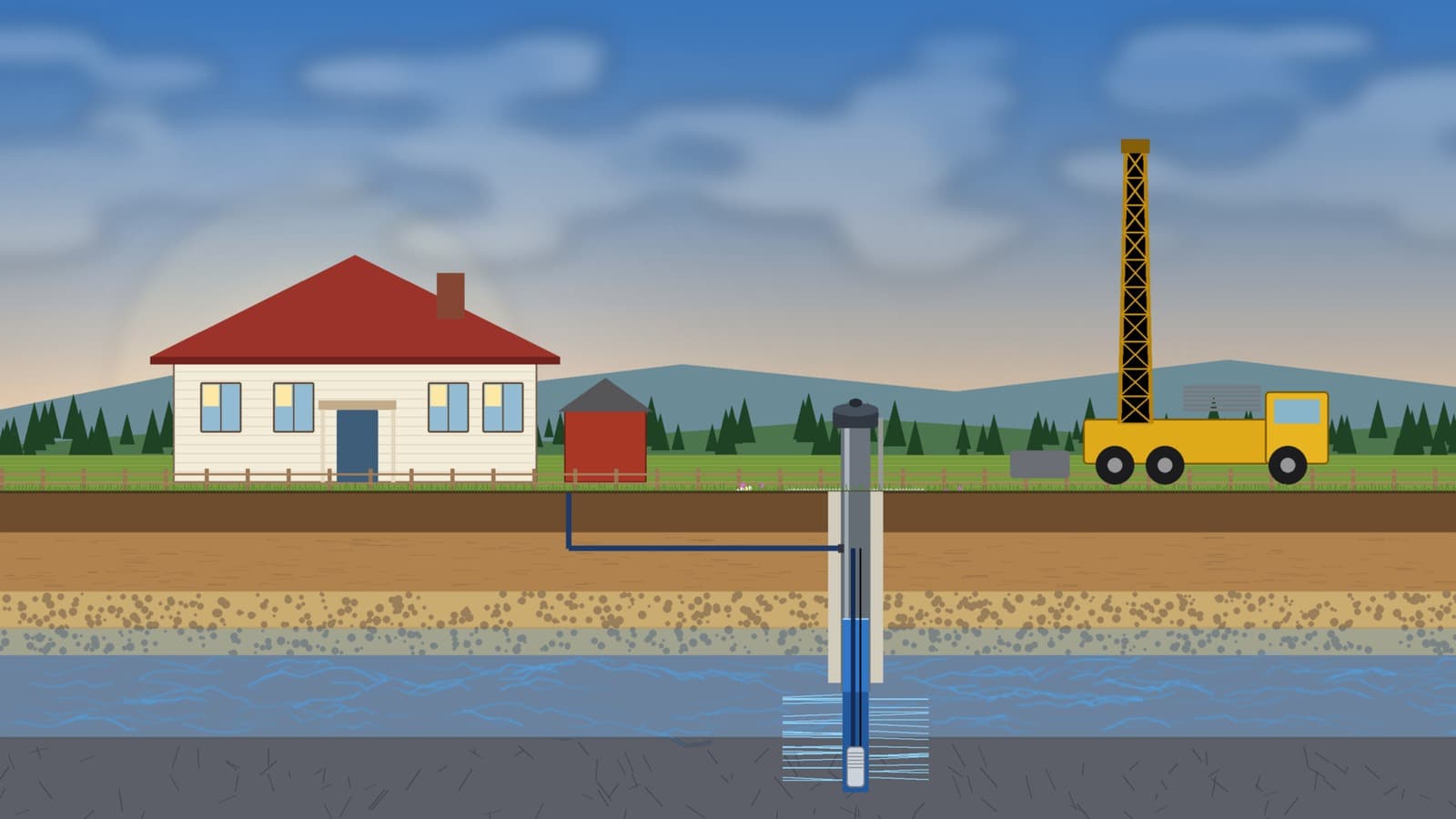
Drilled wells: made with a drill rig, usually rotary (spinning bit with air, water, or drilling fluid to lift cuttings) or cable-tool (a heavy bit raised and dropped). They can reach deep aquifers and bedrock. They use steel or plastic casing and a grout seal. Tradeoff: they cost the most to build, but a properly cased and grouted drilled well is usually the most protected from surface contamination and the most dependable in dry seasons. This is the most common choice for a new home well.
Driven wells: a small-diameter pipe with a screened well point on the end is driven into shallow sand or gravel. Tradeoff: low cost and simple, but they only work where water is close to the surface in loose material, they reach only shallow water, and shallow water is more exposed to surface pollution. Many are used for irrigation rather than drinking water.
Bored or dug wells: large-diameter, shallow holes made with an auger or by digging, often lined with concrete tile or stone. Tradeoff: they store water in the hole, which helps in low-yield ground, but they are hard to seal and more likely to pick up bacteria and nitrate. Many older farm wells are this type; if you own one, test it more often.
Honest buying rule: for a household drinking-water supply, most buyers end up with a drilled, cased, and grouted well. Cheaper well types exist for real reasons, but shallow means exposed.
Casing, grout, screens, and the well cap
These are the parts that keep a well clean, and they are where cutting corners does the most harm.
Casing: the pipe that lines the upper part of the well and holds the hole open. Steel casing is common and strong. PVC or other plastic casing is used in many areas where codes allow it. Ask what material, diameter, and wall thickness the driller will use and how deep the casing will go. In bedrock, casing is usually seated into solid rock. Longer casing usually costs more, and it is often the right money to spend.
Grout: a sealing material, often a bentonite clay or cement mix, placed in the space (the annulus) between the casing and the drilled hole. Grout blocks surface water from running down the outside of the casing into the aquifer. Your state rules set the grouting method and depth. Ask how the grout will be placed. Pouring dry material from the top is not the same as pumping grout from the bottom up, and some states require specific methods.
Screens: in sand and gravel wells, a screen at the bottom lets water in and keeps sand out. The slot size is matched to the aquifer material. A well that pumps sand can wear out a pump fast.
Well cap: the cover on top of the casing. A sanitary well cap fits tightly, has a screened vent, and keeps out insects, rodents, and surface water. The casing should stick up above the ground by the height your state code requires, with the ground sloped away from it. Buried well heads and pits are banned or limited in many places because they flood.
Pitless adapter: a fitting on the side of the casing below the frost line where the water line leaves the well and heads to the house. It lets the casing come up above ground with a sealed cap while the pipe stays below freezing depth.
The National Ground Water Association publishes the ANSI/NGWA 01 Water Well Construction Standard, which covers site selection, casing, grouting, screens, development, testing, disinfection, and decommissioning. Information is at https://www.ngwa.org/detail/product-detail/5 — NGWA's homeowner site is https://wellowner.org
Depth and yield: how much water is enough
Nobody can promise the exact depth before drilling. The driller drills until the well reaches enough water and then usually goes some distance deeper so the pump has room and the well has storage. The well log records what was found.
Yield is how many gallons per minute (gpm) the well can produce over time. It is measured with a pump test or yield test after drilling. Ask for the test method and how long it ran. A short airlift reading right after drilling is not the same as a longer pumping test.
What you need depends on the household: the number of people, bathrooms, laundry, irrigation, livestock, and any fire-protection or shop use. Your pump installer and local health or water-rights rules can tell you what minimum yield is expected for a home in your area. Lenders and buyers sometimes ask for a yield report when a house sells.
Static water level is where water sits in the well when the pump is off. Pumping level is where it drops while the pump runs. The pump must sit low enough to stay underwater at pumping level in dry seasons.
Low-yield options: if the well comes in weak, options can include drilling deeper, hydrofracturing in bedrock (pumping water under high pressure to open cracks), adding a storage tank so the well can refill a reservoir slowly, or in some cases drilling a second well. Ask how each option is priced before drilling starts.
Dry holes happen. Ask in writing how a dry or low-yield hole is billed. Many drilling contracts charge for footage drilled whether or not water is found.
Drilling cost drivers (not a quote)
This paper does not give dollar quotes, because real prices change with region, geology, season, fuel, and rig availability. What we can do is show what moves the number up or down so you can read bids side by side.
Main cost drivers:
- Depth: drilling is often priced per foot, and nobody knows the final depth until the hole is done.
- Geology: hard rock, boulders, caving sand, and mixed layers slow the rig and wear bits.
- Casing: material, diameter, wall thickness, and how many feet are needed.
- Grout: method and depth required by code.
- Screens and development work in sand and gravel wells.
- Mobilization: getting the rig to the site, especially on steep, wet, or remote land.
- Site prep: clearing, a rig pad, and handling drilling water and cuttings.
- Yield testing and the water-quality tests required at completion.
- Permit, well log filing, and inspection fees.
- Hydrofracturing or deepening if the yield is low.
- Decommissioning an old well.
- The pump system, which is often a separate line item or a separate contractor.
Ask each driller for an itemized bid with a per-foot rate, the casing plan, the grout method, what is included in mobilization, and how dry or low-yield results are handled. Compare the same assumptions across bids, or the comparison is meaningless.
Pumps: submersible versus jet
Submersible pumps: a long, narrow pump and motor that hang down inside the well casing on a drop pipe, below the water. They push water up instead of pulling it. They are the common choice for drilled wells and deeper water. Tradeoff: they cost more to buy and need a hoist or pump rig to pull for repair, but they are quiet, efficient, and well suited to deep wells.
Two-wire versus three-wire: some submersible motors have their start parts built into the motor (two-wire); others use a surface control box (three-wire), which can allow some repairs without pulling the pump.
Jet pumps: a pump that sits above ground, in a well house or basement, and pulls water up. Shallow-well jet pumps only work when the water is close to the surface, roughly 25 feet or less in practice, because suction has a physical limit. Deep-well jet pumps use two pipes and an ejector down in the well to reach deeper, but they are less efficient than submersibles at depth. Tradeoff: easier to reach for service, common on older shallow wells, but often noisier and less efficient.
Sizing: the pump is chosen for the well's yield, the depth to pumping water level, the height and distance to the house, the pressure you want, and the flow you need. A pump that is too big for a weak well can pull the water level down to the pump and run it dry. Ask the installer to show the pump curve and how it matches your well test.
Constant-pressure systems: some pump systems use a variable-speed drive (also called a VFD or constant-pressure controller) that speeds the motor up and down to hold steady pressure. Tradeoff: steadier showers and soft starts that can be easier on the motor and generator, but more electronics to fail, higher first cost, and a need for surge protection. They can often use a smaller pressure tank, but not always none.
Manufacturers publish pump curves, install manuals, and motor data. Examples of U.S.-market well pump manufacturers with public technical pages include Franklin Electric at https://franklinwater.com — Goulds Water Technology at https://www.gouldswatertechnology.com — Grundfos at https://www.grundfos.com — Pentair at https://www.pentair.com — Notice Nearby lists these as examples of where to read specs, not as endorsements or a complete list.
Pressure tanks and the pressure switch
Most well systems have a pressure tank. It holds water under pressure so the pump does not have to start every time someone opens a faucet. Inside many modern tanks, a bladder or diaphragm separates the water from a cushion of air.
The pressure switch turns the pump on at a low setting (cut-in) and off at a high setting (cut-out). Common household switches use a range such as 30/50 or 40/60 psi. The tank's air charge is usually set a little below the cut-in pressure, following the tank maker's instructions, with the water pressure off.
Short cycling is when the pump turns on and off rapidly. It is a top cause of early pump and switch failure. Common causes include a tank that has lost its air charge, a tank that is too small, a failed bladder, or a leak. If your pressure gauge needle bounces up and down fast while water runs, call your pump installer.
The Water Systems Council, a nonprofit for the private well industry, has homeowner information on wells and well systems at https://www.watersystemscouncil.org
Wiring, controls, and power
A well pump is a large electric load. It needs a properly sized circuit, wire sized for the full distance down the well and out to the house, a disconnect, correct grounding, and work that meets the electrical code adopted in your area. The National Electrical Code is published by NFPA at https://www.nfpa.org
Ask who does the electrical work and pulls that permit, what surge and lightning protection is included (especially for constant-pressure controls), whether there is dry-run protection that shuts the pump off if the well runs low, and where the controls and tank will live so they stay above freezing.
If you have or plan a backup generator, tell both contractors. The pump's starting load matters for generator sizing. The Notice Nearby generator paper at https://noticenearby.com/papers/whole-home-standby-generators covers that side. A house on a well with no power has no water.
Water testing: what to test and when
A new well is not finished until the water is tested. Many states require some testing when a new well is built or when a property sells, and lenders may require it too.
CDC recommends testing private well water at least once a year for total coliform bacteria, nitrates, total dissolved solids, and pH, and asking your health department what else to test for where you live. CDC's testing guidance is at https://www.cdc.gov/drinking-water/safety/guidelines-for-testing-well-water.html
Common tests and why:
- Total coliform and E. coli bacteria: signs that surface water or waste may be getting in.
- Nitrate: often from fertilizer, manure, or septic systems; a special concern for infants.
- pH and total dissolved solids: general quality and corrosion clues.
- Arsenic, uranium, and radon: naturally occurring in some rocks and regions.
- Iron, manganese, hardness, lead, and copper: staining, scale, and plumbing-related concerns.
- Local concerns such as pesticides, fuel compounds, or PFAS near certain land uses.
Use a state-certified laboratory. EPA keeps a list of state certification programs at https://www.epa.gov/dwlabcert/contact-information-certification-programs-and-certified-laboratories-drinking-water — EPA describes potential well contaminants at https://www.epa.gov/privatewells/potential-well-water-contaminants-and-their-impacts — EPA's public-water standards, which many labs use as comparison points, are at https://www.epa.gov/ground-water-and-drinking-water/national-primary-drinking-water-regulations
Test again after flooding, after any work on the well or pump, if the water changes taste, color, or smell, or if someone in the house gets sick and you suspect the water. New wells and repaired wells are usually disinfected with chlorine by the contractor, then flushed and tested.
Treatment tie-in
Treatment is chosen after testing, not before. A softener fixes hardness. Reverse osmosis at a kitchen tap can reduce many dissolved contaminants for drinking water. Iron and manganese filters, disinfection systems, and arsenic or radon treatment are separate tools for separate problems. Buying a box before you have a lab report is the most common treatment mistake.
The Notice Nearby water softener and RO paper at https://noticenearby.com/papers/whole-home-water-softener-ro walks those systems. NSF certifies many treatment products to public standards. NSF's consumer water-treatment information is at https://www.nsf.org/consumer-resources/water-quality/water-filters-testing-treatment — check that a product is certified for the exact contaminant you need to reduce.
Choosing a driller and pump installer
Ask:
- Are you licensed in this state for well drilling, and for pump installation if you do both?
- What have you found for depth and yield on wells near this property?
- What casing material, diameter, and depth do you plan, and what grout method and depth?
- How do you bill for depth, dry holes, and low yield?
- What yield test will you run, and for how long?
- Who pulls the permit and files the well log, and will I get a copy?
- Will you disinfect the well and send a sample to a certified lab?
- Which pump, tank, and controls will you install, and why that size?
- What warranties cover the well, the pump, and the parts?
- Can you show proof of liability insurance and workers' compensation coverage?
Get more than one written bid if you can, but in busy seasons the best drillers may book out for weeks or months. Be careful with anyone who wants a large cash deposit, skips permits, or promises a depth or yield before drilling.
NGWA's homeowner site at https://wellowner.org has information on finding and working with water well contractors.
Install path: what drilling and pump day look like
- Research and paperwork. Check public water options, look up nearby well logs, confirm water-rights needs, and get the permit or start card.
- Siting. Mark the well spot with setbacks measured from septic parts, property lines, buildings, and other hazards. Confirm rig access.
- Written contract. It should name the per-foot rate, casing plan, grout method, testing, dry-hole terms, and what is included.
- Drilling. Expect a large rig, noise, water, and cuttings for a day or more. Keep children and pets away.
- Casing and grouting. Casing goes in and the annulus is grouted to code.
- Development, yield test, and disinfection. The well is cleaned out, tested for flow, chlorinated, and flushed.
- Well log. The driller records depth, layers, casing, grout, and yield, and files it with the state where required.
- Pitless adapter and trench. A trench below frost depth carries the water line and wire to the house.
- Pump set. The installer matches the pump to the yield and lowers it on drop pipe with a safety rope and the right wire.
- Tank, switch, controls, and electrical. These go where they will not freeze, with the circuit, disconnect, grounding, and surge protection inspected where required.
- Startup and water test. The system is run, checked for leaks, and flushed, and a sample goes to a certified lab. Do not drink the water until results are clean or you have treatment.
- Paperwork. Keep the well log, permit sign-off, pump and tank data, and lab results together.
First years of ownership
A well is a long-term system. A little attention every year protects a large investment.
- Test the water at least once a year and after any repair, flood, or change in taste, color, or smell.
- Look at the well head every spring. The cap should be tight, the vent screened, and the casing undamaged, with ground sloping away.
- Keep fertilizers, fuels, paints, chemicals, and animal waste well away from the well.
- Do not pile snow, leaves, or landscaping mulch over the well head, and do not bury it.
- Check the pressure tank air charge on the schedule the tank maker recommends, with the pump power off and the water drained.
- Watch for short cycling, sputtering air, lower pressure, or higher electric bills. Each can mean a pump, tank, or well problem.
- Keep the septic system maintained, and know where your breaker, switch, and well head are.
- Keep a file with the well log, test results, pump model, depth setting, and service dates.
NGWA's homeowner site at https://wellowner.org has seasonal maintenance tips. EPA's home water protection tips are at https://www.epa.gov/privatewells/protect-your-homes-water — EPA's source water protection pages explain how land use around a well matters at https://www.epa.gov/sourcewaterprotection
Common mistakes that blow budgets
- Picking the driller by per-foot rate only, without comparing casing, grout, and testing.
- Siting the well where it is convenient instead of where setbacks and drainage are best.
- Drilling only as deep as the first water and losing it in a dry season.
- Buying a pump that is too big for a weak well.
- Skipping the yield test or the water test.
- Buying water treatment before getting a lab report.
- Ignoring an old unused well on the property.
- Paying a large cash deposit to someone who skips permits.
Comparing options side by side
Put the choices in one mental table before you sign.
Drilled, cased, and grouted well: best for most household drinking water. Wrong only when local rules or geology point to another type, or a public water line is a practical option.
Driven well: best for shallow sandy ground and non-drinking uses such as irrigation, where allowed. Wrong as a main drinking supply when surface pollution is nearby.
Submersible pump: best for drilled wells and deeper water. Wrong when the well is very shallow and an easy-service jet pump does the job.
Constant-pressure controller: best when steady pressure and soft starts matter. Wrong when you want the simplest, lowest-parts system or have no surge protection.
Connecting to public water: still worth pricing if a main is reachable. A well is a long-term responsibility, not a must.
Standards and education links (manufacturer, standards, and public agencies only)
- EPA private drinking water wells: https://www.epa.gov/privatewells
- EPA protect your home's water: https://www.epa.gov/privatewells/protect-your-homes-water
- EPA potential well water contaminants: https://www.epa.gov/privatewells/potential-well-water-contaminants-and-their-impacts
- EPA state certified drinking water labs: https://www.epa.gov/dwlabcert/contact-information-certification-programs-and-certified-laboratories-drinking-water
- EPA national primary drinking water regulations: https://www.epa.gov/ground-water-and-drinking-water/national-primary-drinking-water-regulations
- EPA source water protection: https://www.epa.gov/sourcewaterprotection
- CDC well water safety: https://www.cdc.gov/drinking-water/safety/index.html
- CDC guidelines for testing well water: https://www.cdc.gov/drinking-water/safety/guidelines-for-testing-well-water.html
- USGS groundwater wells: https://www.usgs.gov/special-topics/water-science-school/science/groundwater-wells
- USGS aquifers and groundwater: https://www.usgs.gov/special-topics/water-science-school/science/aquifers-and-groundwater
- USGS water data: https://waterdata.usgs.gov
- National Ground Water Association: https://www.ngwa.org
- ANSI/NGWA 01 Water Well Construction Standard: https://www.ngwa.org/detail/product-detail/5
- NGWA homeowner site: https://wellowner.org
- Water Systems Council: https://www.watersystemscouncil.org
- NSF water treatment information: https://www.nsf.org/consumer-resources/water-quality/water-filters-testing-treatment
- NFPA (National Electrical Code publisher): https://www.nfpa.org
- State well program examples: https://www.oregon.gov/owrd/programs/gwwl/wcc/pages/default.aspx — https://ecology.wa.gov/water-shorelines/water-supply/wells
- Manufacturer examples for spec reading: https://franklinwater.com — https://www.gouldswatertechnology.com — https://www.grundfos.com — https://www.pentair.com
Notice Nearby does not link to retailers or affiliate shopping pages in this series.
What to bring to the first meeting
- A property map with the septic system, buildings, and property lines marked if you know them.
- Nearby well logs, any old well details, and any past water test results.
- Your household size and any irrigation, livestock, or shop water use.
- Generator plans, if any, so the pump and generator are sized together.
How this paper fits the expensive-consumer series
Notice Nearby's expensive-consumer papers walk large home purchases with standards links and no retailer carts. Generators cover backup power. Solar and battery cover on-site electricity. EV Level 2 covers hardwired charging. Water softener and RO cover water treatment. Septic replacement covers onsite wastewater. Metal roofing covers the weather surface that protects the house. Private wells and pumps cover the water supply itself, where the house's water starts. The same honesty rules apply: education links, cost drivers instead of fake bids, and an install path you can hand to a licensed well driller, a licensed pump installer, and your local health department.
Bottom line
Start by asking whether public water is reachable, then learn your local groundwater from well logs and your state agency. Site the well with real setbacks and good drainage, get the permit, and answer the water-rights question before the rig arrives. Hire a licensed driller and compare bids on the same casing, grout, testing, and dry-hole terms, not just the per-foot rate. Match the pump to the tested yield, size the tank to prevent short cycling, and protect the wiring and controls. Test the water at a certified lab before you drink it, choose treatment from the lab report, and test again every year. Keep the well cap tight, the paperwork together, and the septic system healthy.
Not legal advice. Not a newspaper. Not Legal Publication. Record of Sale, LLC (Oregon).
Notes and sources
- Author: Ryan Standley / Record of Sale, LLC / Notice Nearby.
- Discussed on @NoticeNearYou: (pending — fill xPostUrl after live post).
- Not legal advice. Not a newspaper. Not Legal Publication. Record of Sale, LLC (Oregon).
Energy desk · Notice Nearby public papers shelf. @NoticeNearYou post pending.
Not legal advice. Not a newspaper. Not Legal Publication. Record of Sale, LLC (Oregon).