Salted Pork Sunday · Sunday Edition · October 4, 2026
Salted Pork Sunday: the budget menu, with the receipts
A Sunday waste-watch feast. Named public dollars, the soft words that cure them, and the repairs that waited in line.
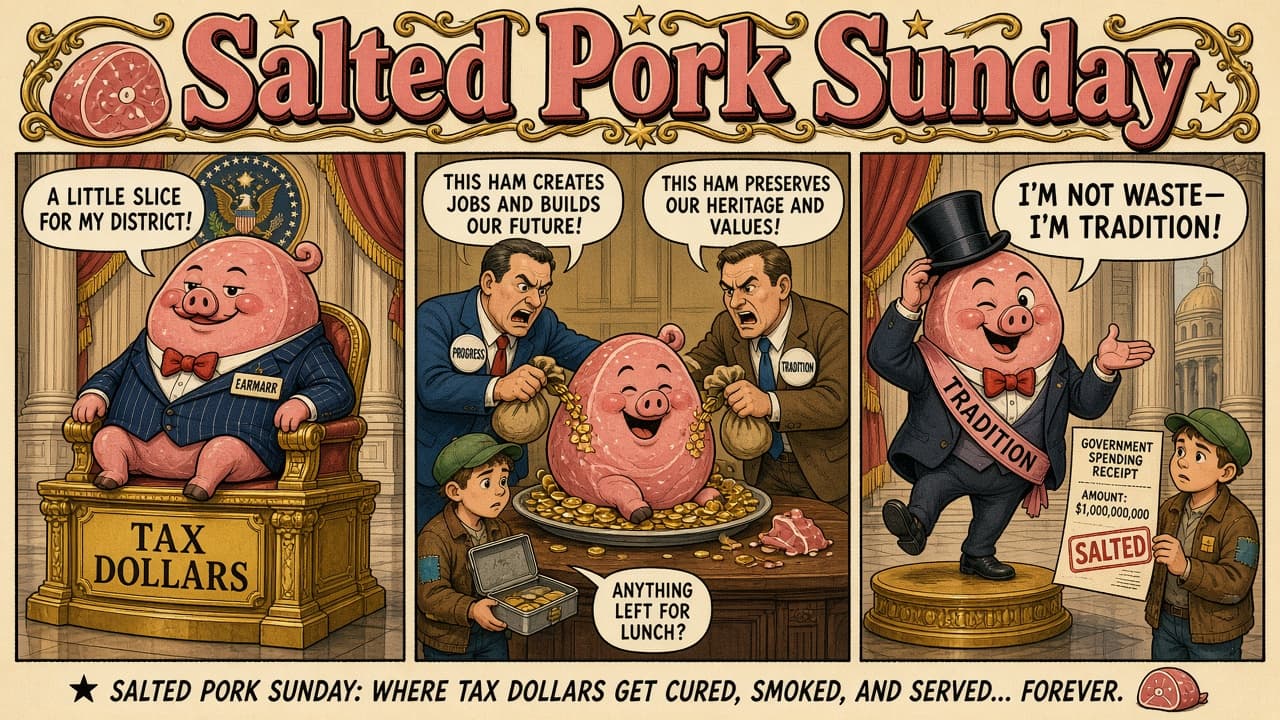
Salted Pork Sunday is where Notice Nearby says the quiet part about the budget menu.
You already paid for the meal. The question is who picked the plates.
This is not a crime blotter, and it is not legal advice. A lot of the money below is legal. Legal is not the same word as wise, and it is not the same word as fair. Legal means the check cleared rules the same people wrote.
Salted pork is public money that travels with a story. It is cured for a town, a base, a campus, a theater, a dock, or a building someone wants in the record. It does not have to beat every other bridge or barracks in an open contest. It has to win a member of Congress, then survive the Friday night when the bill gets written.
The House calls this Community Project Funding. The Senate calls it Congressionally Directed Spending. Those are soft names for the same old cut of meat. Both parties load the tray. The receipts name Republicans and Democrats in the same columns. If you came here for a team cheer, you are in the wrong dining room.
The size of the smokehouse
The Government Accountability Office keeps the guest book. For fiscal years 2022, 2023, and 2024, Congress designated about $39 billion for 20,294 of these projects. That is GAO's own round number, on its Tracking the Funds page. We added the rows in the spreadsheets GAO published with reports GAO-25-107274 and GAO-25-107549. The rows add to $38,957,547,994. That is the figure GAO rounds to $39 billion. Same projects. Same count: 20,294.
Split it by year, from those same rows. Fiscal year 2022: 4,963 projects, $9,064,392,164. Fiscal year 2023: 7,233 projects, $15,328,321,787. Fiscal year 2024: 8,098 projects, $14,564,834,043. The pile got a little smaller in dollars in 2024 and a little bigger in headcount. More plates. Still a feast.
GAO says nineteen federal agencies hand the money out. Tribal, state, local, and territorial governments got the most, and they can pass pieces to nonprofits. Some jobs, like dredging, the federal government does itself. Two-thirds of the money has to be promised, by contract or grant, within one to five years. The other third has no time limit.
GAO looked at a sample of 790 projects from those three years. It estimates that by the end of fiscal year 2024, agencies had legally promised about 61 percent of the $39 billion and had actually paid out about 16 percent. The menu was printed. Most of the food was still in the back. The confidence intervals are in figure 4 of GAO-26-107944.
Fiscal year 2025? GAO's tracking page says Congress did not designate any of these community-project or directed-spending items that year. A continuing resolution kept the lights on and left the named menu off the new bill. The old checks did not vanish. They were already curing. One year you vote for the favorites. The next year you pass a patch and call the year clean.
Who got the biggest trays in fiscal year 2024
These are agency totals from the fiscal year 2024 GAO spreadsheet, not a second opinion and not a rumor.
Housing and Urban Development: $3,289,034,336 across 2,407 projects. That is the largest tray. More than three billion dollars with a member's name on the request line.
Transportation: $2,761,247,858 across 1,014 projects. Roads, trails, streetscapes, bridges that a member wanted written down by name.
Defense: $1,565,758,000 across 143 projects. A lot of the labels are gentle. Planning and design. Unspecified minor construction. Cost to complete. The project still has a base, a building, and a senator or a representative.
The Army Corps of Engineers: $1,488,596,000 across 217 projects. Harbors, flood work, and the famous little checks. The smallest Corps line in the sheet is $8,000.
The Environmental Protection Agency: $1,460,035,172 across 1,039 projects. Water projects are real. So is the habit of pulling a named slice out of the pot before the state formula gets a fair pour.
Health and Human Services: $1,049,005,000 across 622 projects. Agriculture: $778,338,147 across 622 projects. Justice: $597,375,161 across 786 projects. Commerce: $442,582,000 across 222. Homeland Security: $293,757,369 across 200. Education: $290,428,000 across 331.
The menu, with the receipts
A museum can be a real place. A child care center on a base can be a real need. We are not calling every recipient a crook. GAO sampled fiscal year 2022 and 2023 projects and found nearly all recipients described work that broadly matched what Congress wrote. About two-thirds of those that moved forward were underway or done by summer 2025. About 3 percent had not started.
The lines below are fiscal year 2024 designations in GAO's dataset. The dollar is the amount Congress wrote. The names are the requestors GAO recorded from the joint explanatory statements.
Museums, stages, and a symphony
Eisenhower Presidential Library and Museum campus improvements, in Kansas: $17,500,000. Requested by Senator Jerry Moran. A presidential campus is not a pothole. It is a story with a budget line.
Urban Civil Rights Museum in Harlem, for the National Urban League: $4,000,000. Senators Kirsten Gillibrand and Charles Schumer.
The National World War II Museum, in Louisiana: $3,000,000. Senators Bill Cassidy and John Kennedy. Remembering the war is not waste. Writing a private museum into the federal bill, by name, is still a choice about what else $3 million does not repair.
Iola Theatre historic restoration, in Kansas: $3,000,000. Senator Jerry Moran again. The requestor on the sheet is the Iola Theatre Association.
Foster Theater renovation in Youngstown, Ohio: $1,020,000. Youngstown Neighborhood Development Corporation. Senator Sherrod Brown.
The Public Theater, for the Anspacher Theater preservation and rehabilitation project, in New York: $500,000. Senators Gillibrand and Schumer.
Baltimore Symphony Orchestra, for music education, including equipment: $249,000. Senators Benjamin Cardin and Christopher Van Hollen. A quarter of a million dollars is a rounding error on a $14.6 billion menu.
Welcome mats
West Virginia had a visitors-center mood. Wheeling Gateway Visitors Center: $5,000,000, for the Wheeling Convention and Visitors Bureau. City of Summersville visitor center: $1,800,000. Tucker County's new visitors center: $1,260,000. All three requested by Senators Shelley Capito and Joe Manchin. Three welcome mats, one state, more than $8 million, while bridges elsewhere sit in the poor column.
Gettysburg Welcome Center, for the Borough of Gettysburg, Pennsylvania: $1,272,436. Senators Robert Casey and John Fetterman, with a House requestor also on the line. A battlefield town already has a story. Congress added a welcome center to the appropriations story anyway.
Claflin University welcome center, in South Carolina: $1,000,000. Representative James Clyburn.
Wayfinding at the Salesforce Transit Center, Transbay Joint Powers Authority, California: $1,000,000. Representative Nancy Pelosi. One million dollars for signs and directions in a transit center that already has a corporate name on the roof.
Waterfront favorites
Bayfront Promenade, Jersey City Redevelopment Agency, New Jersey: $1,616,279. Senators Cory Booker and Robert Menendez, plus a House requestor. A promenade is a walk.
Redondo Beach marina dock replacement, California: $1,466,279. Representative Ted Lieu. Useful if you keep a boat there.
Shore Road boardwalk, Village of Lindenhurst, New York: $1,000,000. Representative Andrew Garbarino. Boards by the water. A million dollars. Named in the bill.
Zapata County 4-H rodeo arena, Texas: $1,000,000. Representative Henry Cuellar. 4-H is a real youth program. A rodeo arena still did not have to win a national contest.
Markets
Oak Park community event hub and farmers market, Michigan: $1,000,000. Senators Gary Peters and Deborah Stabenow, with a House requestor.
Minneapolis farmers market sustainable modernization: $850,000. Senators Amy Klobuchar and Tina Smith, with a House requestor.
B and O Roundhouse farmers market and events center, Berkeley County, West Virginia: $750,000. Senators Capito and Manchin. Three market projects, three states, both parties, about $2.6 million. None had to outrank a water plant in a county without a well-placed member.
The tiny checks are part of the same cure
Claiborne Harbor operation and maintenance, Maryland, Army Corps of Engineers: $8,000. Senators Cardin and Van Hollen. Eight thousand dollars. You could almost respect the modesty if it were not sitting in the same law as the $17.5 million library campus.
Patrol vehicle equipment for the Town of Clay, West Virginia, under Justice's COPS Tech account: $8,000. Senator Capito. Tied for the smallest amount in the whole fiscal year 2024 sheet.
Marshfield Area United Way, Wisconsin, to reduce childhood hunger, including food: $10,000. Senator Tammy Baldwin. Do not sneer at feeding kids. Sneer at a Congress that hand-writes a $10,000 grocery line into a national spending act. If the need is real, it should not have to hitch a ride on an 8,098-item menu.
The defense side door
Some Defense lines are barracks, fire stations, and child care. The insult is the method. The President's budget is where the military is supposed to rank its needs. Then members write extra buildings in by name.
Fort Jackson, South Carolina, reception barracks complex, phase 2, cost to complete: $101,000,000. Senator Lindsey Graham. Cost to complete means the project was already alive and came back for another slab of the ham.
Lexington Armory, New York, National Guard readiness center addition and alteration: $90,000,000. Senators Gillibrand and Schumer, with a House requestor.
Advanced helicopter training system hangar, Naval Air Station Whiting Field, Florida: $50,000,000. Then-Representative Matthew Gaetz.
Child development center, Fort Liberty, North Carolina: $36,000,000. Senator Thomas Tillis and Representative Richard Hudson. Child care for military families is serious. Rank it in the open budget. Do not make it a souvenir of who sits on the subcommittee.
AMC standard dual-bay hangar, planning and design only, Eielson Air Force Base, Alaska: $25,000,000. Senator Lisa Murkowski. Planning and design. Not the hangar. The idea of the hangar, for twenty-five million dollars, written in by name.
Replace the Gunter fitness center, unspecified minor construction, Maxwell Air Force Base, Alabama: $8,800,000. Senator Katie Britt.
The wish list that is not supposed to be the budget
There is a second menu, and statute requires it. GAO-25-107581, September 2025, says Defense components submitted $134 billion in unfunded priorities from fiscal year 2020 through fiscal year 2025. The yearly ask rose from $14.7 billion to $30 billion. Adjusted for inflation, GAO calls that a 73 percent increase. The military services accounted for $91.8 billion. The Navy alone accounted for $27 billion, largely aircraft and ships.
In fiscal year 2025, U.S. Indo-Pacific Command put up $11 billion, 37 percent of that year's roughly $30 billion. The year before, the same command submitted $3.5 billion. New leadership put everything on the list, not just a short list. That is a public side door that gets wider when someone decides the regular door was too small.
GAO says the Defense discretionary budget was $848.3 billion in fiscal year 2025. A $30 billion wish list is not the whole Pentagon. It is a second helping after the kitchen said the meal was planned. Five of eleven components GAO checked left out facts the law asked for, including why the item missed the President's budget.
The jet that keeps the tab open
The F-35 is not a little earmark. It is the other kind of pork: a program so large, and so late, that killing a piece of it feels rude. GAO's September 2025 report, GAO-25-107632, is the receipt.
GAO says the December 2023 cost estimate put total F-35 acquisition at $485.2 billion. That is $89.5 billion more than the March 2012 baseline. The program office's estimate to operate and sustain the fleet over a 77-year life is at least $1.58 trillion. Acquisition plus sustainment, GAO says, is over $2 trillion. Those are Defense figures that GAO is reporting, not a number we cooked.
Block 4 is the upgrade. Cost had already grown from $10.6 billion to $16.5 billion as of 2021, and completion is at least five years late. The trimmed version still had no fresh cost estimate when GAO finished. Technology Refresh 3, a $1.9 billion suite, was the main reason aircraft showed up late in 2024.
In calendar year 2024, Lockheed Martin delivered 110 F-35s. All of them were late. The average lateness was 238 days. In 2023 the average had been 61 days. The trend went the wrong way. Pratt and Whitney delivered all 123 engines late that year too, an average of 155 days, worse than 68 days the year before.
The deals let Lockheed earn some of the on-time incentive even if a jet was up to 60 days late. GAO says the government still paid hundreds of millions in incentive fees while the jets got later. When a later lot was clearly going to miss, the program retargeted unearned incentive money: more than a hundred million dollars for software lab capacity, and more than a hundred million dollars for TR-3 repairs and test gear.
Extra wear on the engine, from power and cooling the jet was not built to give, has added $38 billion to the life-cycle estimate, GAO says. The original development program, finished in March 2024, was more than a decade late and cost $250 billion more to acquire than the first estimates.
The leak that is bigger than the menu
Member projects are the photogenic pork. The quiet leak is larger.
GAO's June 4, 2026 WatchBlog, with report GAO-26-108044, says agencies estimated $186 billion in improper payments for fiscal year 2025, about $24 billion more than the year before. Improper does not always mean stolen. It means the payment should not have gone out, the amount was wrong, or nobody can show which. Fiscal year 2024, in GAO-25-107753, was an estimated $162 billion. More than $135 billion of that was overpayments. Underpayments were $7.9 billion. Unknown payments were $12.6 billion. Technically improper payments were $5.9 billion.
Since fiscal year 2003, GAO now says as much as $3 trillion has been lost to these errors. In fiscal year 2025, about 73 percent of reported errors sat in Medicare, Medicaid, the Earned Income Tax Credit, SNAP, and a Small Business Administration shuttered-venue grant. About $153 billion of the year's overpayments traced to Medicaid eligibility checks as pandemic coverage rules wound down.
Some likely errors are not in the $186 billion. Temporary Assistance for Needy Families spent about $16.5 billion in fiscal year 2025, and GAO says Health and Human Services did not report an improper-payment estimate for it. The department cannot force states to hand over the data. Put the three-year earmark pile, about $39 billion, next to one year of estimated payment errors, $186 billion. The named menu is the appetizer.
The buildings we keep and do not use well
GAO testimony GAO-25-108400, April 9, 2025, says the federal government owns 277,000 buildings, and the annual maintenance and operating bill for them was more than $10.3 billion in fiscal year 2023. Deferred maintenance and repair for Defense and civilian buildings more than doubled, from $171 billion in fiscal year 2017 to $370 billion in fiscal year 2024. In March 2025, the General Services Administration said its own deferred-maintenance backlog was over $17 billion.
Federal real property has been on GAO's High-Risk List for 22 years. In 2025 GAO added building condition. As of December 4, 2024, GSA had 34 properties lined up for disposal: more than 6 million square feet, and an estimated $1.8 billion saved over ten years. We are paying to hold buildings we have already decided we do not need, while the repair tab climbs toward $370 billion.
The same testimony says GAO found in 2023 that some military barracks were in poor condition, including sewage overflow and fire systems that did not work. That is GAO-23-105797, cited again in 2025. Now remember the $8.8 million Maxwell fitness center, labeled unspecified minor construction. Gyms matter. Sewage in a barracks matters more. Soft labels made them look like the same kind of decision.
The overlap that nobody finishes
Since 2011, GAO's yearly duplication report has tracked programs that overlap or split into too many kitchens. The 15th edition is GAO-25-107604, reissued May 13, 2025. Action on that work has produced about $725 billion in financial benefits. Finishing the leftovers could yield one hundred billion dollars or more. The new report added 148 measures in 43 topic areas. About $57 billion in newly counted savings pushed the running total to $725 billion.
589 matters and recommendations were still open. About 170 had a dollar attached. Some had bills introduced. As of February 2025, GAO said those bills had not been enacted. The to-do list is still on the counter.
What the same money is not buying
FHWA's 2024 National Bridge Inventory condition table counts 623,218 bridges, and 42,080 of them are in poor condition. A separate 2024 FHWA replacement-cost sheet counts 42,067 poor bridges and estimates $82,227,945,700 to replace them. Rehabilitation, at 68 percent of replacement, is estimated at $55,915,003,076. The counts differ by 13 bridges. Both tables are FHWA. Both say the poor-bridge pile is over forty-two thousand, and the repair math is tens of billions.
Fiscal year 2024 Transportation member projects were $2,761,247,858. That will not clear a $56 billion rehab tab or an $82 billion replacement tab. It would still hit a lot of the worst spots if it were aimed at the inventory instead of at the members. A promenade, a boardwalk, a marina, and a wayfinding package are not the 42,000 poor bridges. They got names. The poor bridges got a condition code.
One year of estimated improper payments, $186 billion, is more than three times FHWA's $55.9 billion rehab estimate. Medicare and Medicaid dominate that error pile, so this is not a claim you can slide a hospital payment onto a bridge crew with a speech. It is a claim about attention. Congress will debate a theater by name. It will not sit still for the dull work of checking a payment.
How the smokehouse works
The polite words are Community Project Funding, Congressionally Directed Spending, member-directed, and federal nexus. Tie the project to an old authorization and it looks like national policy. For fiscal year 2024 the House told its members that museums, memorials, pools, and golf courses were out of bounds. The enacted sheet still has museums, a theater, and a rodeo arena.
The dollars sit in joint explanatory statements that ride with the spending acts. GAO built its rows from the Consolidated Appropriations Act, 2024, the Further Consolidated Appropriations Act, 2024, and the 2022 and 2023 acts. If your project is a row, the contest was already over. It happened in a member's office, then a committee, then the hours when the bill closed.
When Congress cannot finish the spending bills, it passes a continuing resolution and says keep going. GAO says the fiscal year 2025 patch designated none of these named projects. Last year's designations kept their life anyway. Two-thirds of the three-year pot had a clock of one to five years. One-third had no clock. A Friday deal does not need to be spent on Friday. It needs to be safe on Friday.
Unfunded priority lists are the Defense version. The law gives the services and commands days after the President's budget to send what did not fit. For fiscal years 2024 and 2025, GAO says the Secretary of Defense told Congress that nothing on those lists outranked the President's request. The lists still showed up, $30 billion in fiscal year 2025, and Congress still uses them to write checks above the request.
Oversight is real. GAO samples the projects. Agencies review plans and visit sites. Recipients mostly build what was described. The waste is a real visitors center or a real dock standing ahead of a poor bridge, because a story beat a ranking.
You are already on the guest list
If you pay taxes, you helped cure this. The Eisenhower campus line is yours. The $8,000 harbor line is yours. The late F-35 incentive is yours. The estimated $186 billion in bad or unproven payments is yours. The $370 billion repair tab is the bill for decisions already made.
Come back next Sunday. The menu changes. The smokehouse does not. We will keep naming dollars a public record will stand behind, and we will throw out any figure that will not. The quiet part is not a conspiracy. It is a column in a spreadsheet, a soft label, and a country that claps for the story.
Sources, all public
Tracking the Funds, the $39 billion and 20,294 projects, the fiscal year 2025 gap, and the 61 percent and 16 percent estimates: https://www.gao.gov/tracking-funds and GAO-26-107944. Row-level file: https://files.gao.gov/multimedia/gao-25-107549/interactive/2024_Tracking_the_Funds_data_with_map.zip with GAO-25-107549 and GAO-25-107274.
Unfunded priorities, GAO-25-107581: https://www.gao.gov/products/gao-25-107581. F-35, GAO-25-107632: https://www.gao.gov/products/gao-25-107632.
Improper payments, fiscal year 2025, GAO-26-108044: https://www.gao.gov/blog/186-billion-was-lost-improper-payments-last-year-how-can-we-prevent-them-future. Fiscal year 2024, GAO-25-107753: https://www.gao.gov/blog/federal-government-made-estimated-162-billion-improper-payments-last-fiscal-year.
Buildings and barracks, GAO-25-108400: https://www.gao.gov/products/gao-25-108400, citing GAO-23-105797. Duplication, GAO-25-107604: https://www.gao.gov/products/gao-25-107604.
Bridges, FHWA 2024 condition table: https://www.fhwa.dot.gov/bridge/nbi/no10/condition24.cfm. FHWA 2024 replacement costs: https://www.fhwa.dot.gov/bridge/nbi/sd2024.cfm. Every project dollar in the menu is a row in the GAO fiscal year 2024 spreadsheet. If a figure was not in one of these public records, it is not in this paper.
Notes and sources
- Body sha256: feaf424410397959c7c62950dc8e087fdab894431756fa97a7ac6d72e7a2efb0
- Feature rewrite of the live Salted Pork Sunday paper. Every dollar is taken from a public record named in the text: GAO Tracking the Funds datasets for GAO-25-107274 and GAO-25-107549, GAO-25-107581, GAO-25-107632, GAO-25-107753, GAO-25-108400, GAO-25-107604, GAO-26-107944, GAO-26-108044, and the FHWA 2024 bridge tables. No figure was added that was not in those records.
- Author: publisher@noticenearby.com / Record of Sale, LLC / Notice Nearby.
- Not legal advice. Not a newspaper. Not Legal Publication. Record of Sale, LLC (Oregon).
Salted Pork Sunday. Sunday Edition. No portfolio byline. xPostUrl null.
noticenearby.com/papers/salted-pork-sunday-2026-10-04.pdf
Not legal advice. Not a newspaper. Not Legal Publication. Record of Sale, LLC (Oregon).