Salted Pork Sunday · October 11, 2026 · Waste watch
Salted Pork Sunday: The $8.2 Billion Menu Congress Printed, Then Closed the Kitchen
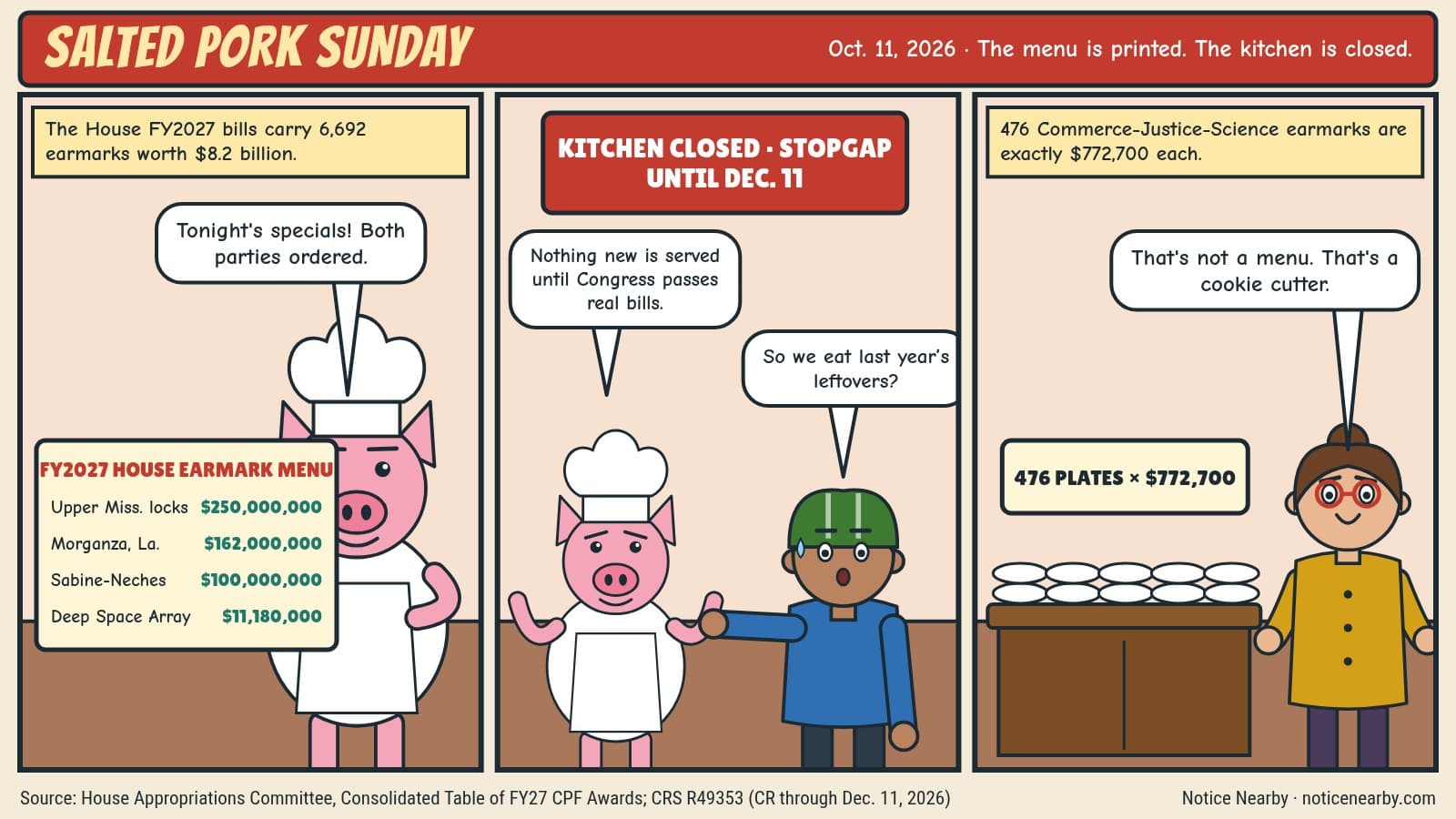
The House's FY2027 bills name 6,692 earmarks worth $8.2 billion, led by $250 million for the Upper Mississippi River–Illinois Waterway, $162 million for Morganza to the Gulf and 476 identical $772,700 plates. A stopgap law keeps all of them off the table until at least Dec. 11. Here is the menu, the strange lines, and the bigger fixes GAO says Congress still has not made.
noticenearby.com/papers/salted-pork-sunday-2026-10-11.pdf
Every Sunday, Notice Nearby goes through public spending records and asks a plain question: what did they buy, who asked for it, and does it look like a good use of tax money? This week the answer begins in a spreadsheet. The House Appropriations Committee posts a "Consolidated Table of FY27 Community Project Funding Awards." We downloaded it and added it up row by row. It holds 6,692 projects totaling $8,197,157,576.90. That is about $8.2 billion. Each project is tied to a named member of Congress, a place and an amount.
The same week, that menu stopped mattering for a while. Fiscal year 2027 began on October 1 without any regular appropriations bills enacted. Congress is running on a continuing resolution, H.R. 6500, signed September 2, 2026 as Public Law 119-103. The Congressional Research Service describes it as funding the government from October 1 through December 11, 2026, generally at fiscal 2026 rates. A continuing resolution does not carry new earmarks. So the $8.2 billion menu is printed and posted, but the kitchen is closed. Nothing on it is served until a full-year bill passes, and the plates can still change before then.
That makes this a good moment to read the menu closely. Below is what the committee's own table shows, what the nonpartisan Congressional Research Service and the Government Accountability Office have flagged, and what voters can check themselves.

The top three plates
1. $250,000,000 for the Upper Mississippi River–Illinois Waterway System. This is the largest single earmark in the House table. It is an Army Corps of Engineers construction line for locks and dams that serve Illinois, Iowa, Minnesota, Missouri and Wisconsin. The committee lists three requesters: Rep. Nikki Budzinski (D-Ill.), Rep. Sam Graves (R-Mo.) and Rep. Eric Sorensen (D-Ill.). The requests table shows each of the three asked for $350,000,000, so the committee funded less than any one of them requested. The table labels it bipartisan. The barge industry has argued for decades that the old locks are a bottleneck for grain exports. It is a real infrastructure need. It is also a quarter of a billion dollars picked by a committee instead of ranked through the Corps' own budget request, and that is what an earmark is.
2. $162,000,000 for Morganza to the Gulf, Louisiana. This hurricane-protection levee project in coastal Louisiana is listed under House Majority Leader Steve Scalise (R-La.). It is the second-largest line in the table. The Congressional Research Service's report on the fiscal 2027 Energy and Water bill rounds it to $160 million. Scalise has the largest earmark total of any single sponsor in the table: four projects, $186.5 million. Coastal protection in southern Louisiana is not a vanity project. But the size of the line tracks the seniority of the requester, and that pattern repeats across the table.
3. 476 plates at exactly $772,700 each, totaling $367,805,200. This is the strangest pattern in the table. In the Commerce-Justice-Science bill, 476 separate projects are funded at precisely $772,700. That is 297 at the Justice Department, 166 at the Commerce Department and 13 at NASA. Every one of the 476 was requested by a Democrat. They run from police equipment to small-business programs to science classrooms, and they all get the same number. The CJS bill has 1,226 earmarks in total, and $772,700 is both its median and its 75th percentile. The table does not explain why. A single dollar figure stamped on hundreds of different projects looks more like a formula that divides a minority-party pot evenly than 476 separate judgments about what each project needs. It is also, by coincidence, the median for the entire 6,692-row table.
How the $8.2 billion is split
Here is the committee table, added up by bill:
- Transportation-HUD: 3,014 projects, $3,636,423,577 (44% of all dollars)
- Commerce-Justice-Science: 1,226 projects, $1,075,224,300
- Interior-Environment: 1,196 projects, $1,031,881,700
- Energy and Water: 71 projects, $859,157,000
- Agriculture: 592 projects, $604,215,000
- Military Construction-VA: 18 projects, $444,710,000
- Labor-HHS-Education: 462 projects, $420,344,000
- Homeland Security: 113 projects, $125,202,000
And here it is by the party code the committee assigns:
- Republican: 2,622 projects, $4,898,522,151
- Democratic: 4,051 projects, $3,018,330,777
- Bipartisan: 6 projects, $267,993,100
- Independent: 13 projects, $12,311,549
Democrats requested more projects. Republicans, who hold the gavels, got more money. The average Republican project is about $1.87 million. The average Democratic project is about $745,000. That is how earmarks have always worked: the majority eats first and eats bigger. Both parties take part, both parties defend the practice, and both parties' members put out press releases when a check arrives.
The table is only what the committee approved. The companion requests table lists 7,340 requests from 401 members, adding up to $27.87 billion on paper. That figure double counts projects that several members requested together, so the real demand is lower. Even so, the gap between what was asked for and what was granted shows how much of this money is decided by a committee rather than by a competitive grant process.
The long tail: the plates worth a second look
Most earmarks are small and dull: a water line, a sewer plant, a fire truck, a clinic roof. Many of them fix things local governments cannot pay for alone. But a 6,692-row list rewards anyone who reads to the bottom, and some lines raise fair questions.
Rep. Harold Rogers (R-Ky.), 20 projects, $142,005,000. Rogers, the dean of the House and a senior appropriator, has the third-largest single-sponsor total in the table. His list includes:
- $26.6 million for the US 460 Corridor Improvement Project.
- $20 million for "CPF Airport Runway Project," for the Hazard-Perry County board.
- $20 million for "Law Enforcement Equipment" in Somerset, Kentucky. The recipient is The Center for Rural Development. The same table lists other law-enforcement equipment earmarks for county sheriffs in Mississippi, Louisiana, Florida and New York at $404,000 to $4.2 million. The Somerset line is nearly five times the next-largest.
- $11.18 million for the Morehead State University Deep Space Array, through NASA.
- $2 million each for the Corbin Parking Garage and the Prestonsburg Parking Structure, through HUD.
Eastern Kentucky has real needs, and Notice Nearby has covered them, including federal abandoned-mine-land grants there this month. The question is not whether the region deserves help. The question is whether a $20 million line called only "Law Enforcement Equipment," sent to a nonprofit and not to a police agency, would survive a competitive grant review. Voters should ask.
Parking garages and drones. Searching the project titles finds 18 parking projects worth $19.4 million and 38 drone-related projects worth $31.2 million. Some are for public safety programs, and some may be well justified. Federal parking garages are a classic earmark punch line for a reason: the benefit stays local, and the bill goes national.
The big asks that did not make the menu. Some of the largest requests were left off the table entirely. Rep. Nick Begich (R-Alaska) asked for $300 million for an Arctic deep-draft port. Rep. John James (R-Mich.) asked for $638 million for Selfridge Air National Guard Base. Rep. Brian Mast (R-Fla.) and Rep. Debbie Wasserman Schultz (D-Fla.) each asked for $725 million for South Florida Ecosystem Restoration. Requests that size are not earmarks so much as entire programs, and the committee kept them out of this table.
Military construction by earmark. Eighteen military construction earmarks total $444.7 million. Three of them are $55 million each:
- an ammunition supply point for special operations forces, requested by Rep. Richard Hudson (R-N.C.);
- a rotational unit billeting area, requested by Rep. Mike Johnson (R-La.);
- an E-7 AWACS squadron operations facility, requested by Rep. Tom Cole (R-Okla.), the Appropriations Committee chairman.
Cole has the second-largest single-sponsor total in the table: 20 projects, $183.4 million. Rep. Randy Weber (R-Texas) is fourth with 10 projects, $134.0 million. That includes $100 million for the Sabine-Neches Waterway, against a request of $319 million. Rep. Steve Womack (R-Ark.) is fifth at $105.4 million. When the people who write the bills are also near the top of the list, voters are entitled to notice.
Money for commissions that are not running
Earmarks are not the only place to look. The Congressional Research Service's report on the fiscal 2027 Energy and Water bill (R48944, updated June 23, 2026) flags spending that deserves a harder look than any single earmark.
Inactive regional commissions. The fiscal 2026 Energy and Water law, P.L. 119-74, signed January 23, 2026, provided $5 million to the Great Lakes Authority and $1 million to the Northwest Regional Commission. CRS describes both as inactive as of May 2026. Federal regional commissions exist to fund economic development, and they need a Senate-confirmed federal co-chair to operate. CRS reports that the Senate never confirmed a Biden nominee for the Great Lakes Authority, and no Trump nominee has been submitted. Even so, CRS's funding table shows the House committee bill for fiscal 2027 (H.R. 9022) would give the Great Lakes Authority another $5 million. The bill gives the Northwest Regional Commission nothing this time. Five million dollars is small by Washington standards. It is also a perfect example of spending on autopilot: a second year of money for an authority that, by CRS's account, cannot yet operate.
A commission whose authorization just expired. CRS notes that the authorizing statute for the Appalachian Regional Commission sunset on October 1, 2026. The administration proposed cutting it 40% to $120 million. The House committee rejected that cut and recommends $200 million for fiscal 2027, the same as last year. Congress can keep funding an agency whose authorization has lapsed, and it often does. But it should be said plainly: appropriating $200 million for a program whose underlying law expired is the opposite of oversight.
The plutonium pit line. The administration asked for $4.912 billion for the National Nuclear Security Administration's Plutonium Modernization program. That is an 87% jump over the fiscal 2026 level of $2.633 billion. The House bill recommends $3.409 billion. Plutonium pits are the cores of nuclear weapons, and the program has a long record of schedule slips and cost growth that GAO has documented for years. A program that big should be judged on milestones met, not percentage increases requested.
What got zeroed. The administration asked for nothing for wind and solar research, which received $320 million in fiscal 2026. CRS reports the House committee went along. Whatever your view of those programs, it shows that appropriators can and do cut a line to zero when they choose to. The same committee kept level funding for the Appalachian Regional Commission, the Great Lakes Authority and $8.2 billion in earmarks. Budgets are choices, and this table shows the choices.
The spending GAO has already said to fix
If the earmark menu is the dessert cart, the Government Accountability Office's annual duplication report is the list of leaks in the kitchen. GAO's 2026 report (GAO-26-108505, May 12, 2026) finds:
- Its work on fragmentation, overlap and duplication has produced $774.3 billion in cumulative financial benefits, up $49.3 billion from the year before.
- Of 2,148 matters for Congress and recommendations to agencies since 2011, 1,662 (77%) have been fully or partially addressed.
- 610 remain open, and 182 of them would produce financial benefits. GAO estimates more than $100 billion in additional possible savings.
- Of 82 open matters for Congress, legislation had been introduced for 30, and none had been enacted.
A separate GAO tally (GAO-26-108932) puts the value of open recommendations at $132 billion to $251 billion. And GAO's improper-payments review reported about $186 billion in improper payments in fiscal 2025 (GAO-26-108044). Improper payments are payments that should not have been made or were made in the wrong amount. Not all of that is fraud, but all of it is money that went out the door wrong.
Put those numbers next to the earmark table. The entire 6,692-project menu is $8.2 billion. GAO's open, already-identified fixes are worth more than ten times that. A Congress that wanted to save money would not start with the parking garages. It would start with GAO's open list, and it would hold hearings on why 30 bills were introduced and zero were passed.
Does earmark money even get spent?
GAO is required to track community project funding. Its "Tracking the Funds" work counts about $39 billion across 20,294 projects designated in fiscal years 2022 through 2024. Based on GAO's sample, by the end of fiscal 2024 about 61% of that money had been obligated (committed to a contract or grant), but only about 16% had actually been paid out.
That is not proof of waste. Construction takes years, and agencies cannot pay for work before it is done. But it does mean earmarks are announced, celebrated and press-released years before the public sees a finished project. Congress did not designate earmarks in fiscal 2025. They came back in fiscal 2026, and GAO says its review of those funds is still to come.
For voters, the lesson is simple. The ribbon-cutting announcement and the finished project can be years apart, so check both.
This week's other tabs
The earmark table is not the only federal money that moved through Notice Nearby's papers this week. Four of them show how public money gets committed on terms most taxpayers never read.
A $1.5 billion "maybe." On October 7, the Department of War's Office of Strategic Capital offered the chipmaker Wolfspeed a conditional loan of up to $1.5 billion for U.S. chip materials. "Conditional" is the important word. Before any money moves, the deal still needs due diligence, final agreements, congressional authorization, appropriations and OMB sign-off. The company's own securities filing says there is no assurance the loan will close. Taxpayers should treat announcements like this as an offer, not a deal. The real number is what gets signed, what gets drawn and what gets paid back. Notice Nearby's paper on the loan is at noticenearby.com/papers/dow-osc-wolfspeed-conditional-loan-1-5-billion-2026-10-07.
One clause, every award. On October 9, FEMA said the "Fusion Center" article in every fiscal 2026 Homeland Security Grant Program award had the wrong wording. FEMA called it an administrative error. The fix, Information Bulletin No. 589, amends every one of those awards at once, effective immediately. Grant terms are where the strings live. When one wrong clause can sit in every award in a program, someone should be checking the fine print before the money goes out, not after. Our paper is at noticenearby.com/papers/fema-homeland-security-grants-fusion-center-amendment-oct-9-2026.
A farm board that wants a credit line. USDA set a November 2–20 grower referendum on whether the Almond Board of California may borrow through a seasonal line of credit. The last time growers voted on the idea, in 2023, it got 63.59% of growers and 56.15% of volume. The rule requires two-thirds, so it failed. This is not tax money. Marketing-order boards are funded by grower assessments. But it is a federal rule, and the vote shows how borrowing decisions should work: the people who pay get a vote, and the threshold is written down in advance. Our paper is at noticenearby.com/papers/usda-california-almond-board-line-of-credit-referendum-nov-2.
Space stations for rent. NASA released its final request for proposals for commercial space stations in low Earth orbit. Industry proposals are due December 8, and NASA expects awards in spring 2027. The goal is to replace a government-owned station with commercial ones NASA would rent. That can save money, or it can create a new long-term bill. The contract terms will decide which. Our paper is at noticenearby.com/papers/nasa-commercial-space-stations-final-rfp-proposals-dec-8.
The common thread: the headline number is never the whole story. The terms are.
Five questions to ask your member of Congress
If your representative is on the list, and 401 members asked for something, here are fair questions to ask at a town hall or by email:
- Which of your requests were funded in the House table, and which were not?
- Who will receive the money: a city, a county, a state agency or a nonprofit? Why that recipient?
- Would this project have competed well in a regular grant program? If not, why should it get federal money anyway?
- Of the earmarks you secured in fiscal 2022 through 2024, how many are finished, and how much has been paid out?
- GAO lists more than 600 open fixes worth over $100 billion. Which of them will you co-sponsor?
A member who can answer all five is doing the job. A member who cannot should be asked again.
Why the closed kitchen matters
The continuing resolution, P.L. 119-103, keeps the government open through December 11 at fiscal 2026 rates, with targeted exceptions that CRS describes in its report on the law (R49353). It is 72 days of stopgap. Stopgaps have real costs. Agencies cannot start new programs, contracts get delayed, and managers spend time planning for a shutdown that may not come. They also have one useful side effect: they freeze the earmark menu in public view.
Between now and December 11, every one of those 6,692 lines can still be cut, trimmed or swapped when the House and Senate negotiate a final bill. The Senate has its own list. The final numbers will not match the House table exactly, and some lines will vanish while others appear. That is why the posted House table matters. It is the clearest public record of who asked for what before the final deal is made in private.
How to read the menu yourself
You do not need a lobbyist to check this. You need about fifteen minutes.
- Download the House tables. The Appropriations Committee posts both the awards table and the requests table as spreadsheets. Filter by your state or your representative.
- Read your member's disclosure page. House rules require each member to post their requests and to certify that they have no financial interest in them.
- Check the CRS reports. CRS writes plain-language reports on each appropriations bill. R48944 covers Energy and Water. R49353 covers the current continuing resolution.
- Follow the money after it passes. Once a project is funded, USAspending.gov shows the grant or contract, the recipient and how much has actually been paid.
- Read GAO's open list. GAO's duplication report and its open-recommendations dashboard show the fixes Congress has not made.
The bottom line
Earmarks are about 0.1% of a federal budget measured in trillions. Defenders say they let members who know their districts fix real problems: locks, levees, water lines. Critics say they reward seniority, invite favoritism and buy votes for bigger spending bills. The fiscal 2027 House table gives evidence to both sides. Most lines are ordinary local infrastructure. A few are hard to justify on a plain reading. And 476 identical numbers show that some of this money is handed out by formula, not judged project by project.
The bigger waste story is not on the earmark menu. It is the more than $100 billion in fixes GAO has already identified, the $186 billion in improper payments, the commissions funded while inactive, and the program authorizations allowed to lapse while the money keeps flowing. Those do not get ribbon cuttings, and that is exactly why someone has to keep writing them down.
The kitchen reopens when Congress passes a real budget. Until then, the menu is posted. Read it.
Notes and sources
- Author: Ryan Standley / Record of Sale, LLC / Notice Nearby.
- Sources: House Appropriations Committee Consolidated Table of FY27 Community Project Funding Awards and Requests (appropriations.house.gov); CRS R48944 and R49353 (congress.gov); GAO-26-108505, GAO-26-108932, GAO-26-108044 and GAO Tracking the Funds (gao.gov); USAspending.gov. Counts and sums are Notice Nearby's own row-by-row addition of the committee spreadsheet.
- Comic: Salted Pork Sunday, Oct. 11, 2026, Notice Nearby Sunday Comics. Original illustration; not a photograph.
- Not legal advice. Not a newspaper. Not Legal Publication. Record of Sale, LLC (Oregon).
Salted Pork Sunday · Notice Nearby Sunday Edition. @NoticeNearYou post pending.
Not legal advice. Not a newspaper. Not Legal Publication. Record of Sale, LLC (Oregon).