Notice Nearby · American-based · Support your Neighbor
Be ready
This page is for people who read Notice Nearby. It is a simple plan for home: how to talk when the power and phones fail, what to pack, and what to do in a blackout, an earthquake, or a tsunami on the coast.
American-based · Support your Neighbor
Emergency Comms Kit V1
The simplest way to stay in touch when the power and cell phones go out.
No tools. No wiring. Just plug it in.
Get Starlink
Order your Starlink Mini and choose a plan. To keep it ready, use Standby Mode for $10 a month. It's slow, but enough for texts and email. When disaster hits, switch to Roam 100GB for $55 a month.
What's in the kit and why
| # | Item | What it does | Price |
|---|---|---|---|
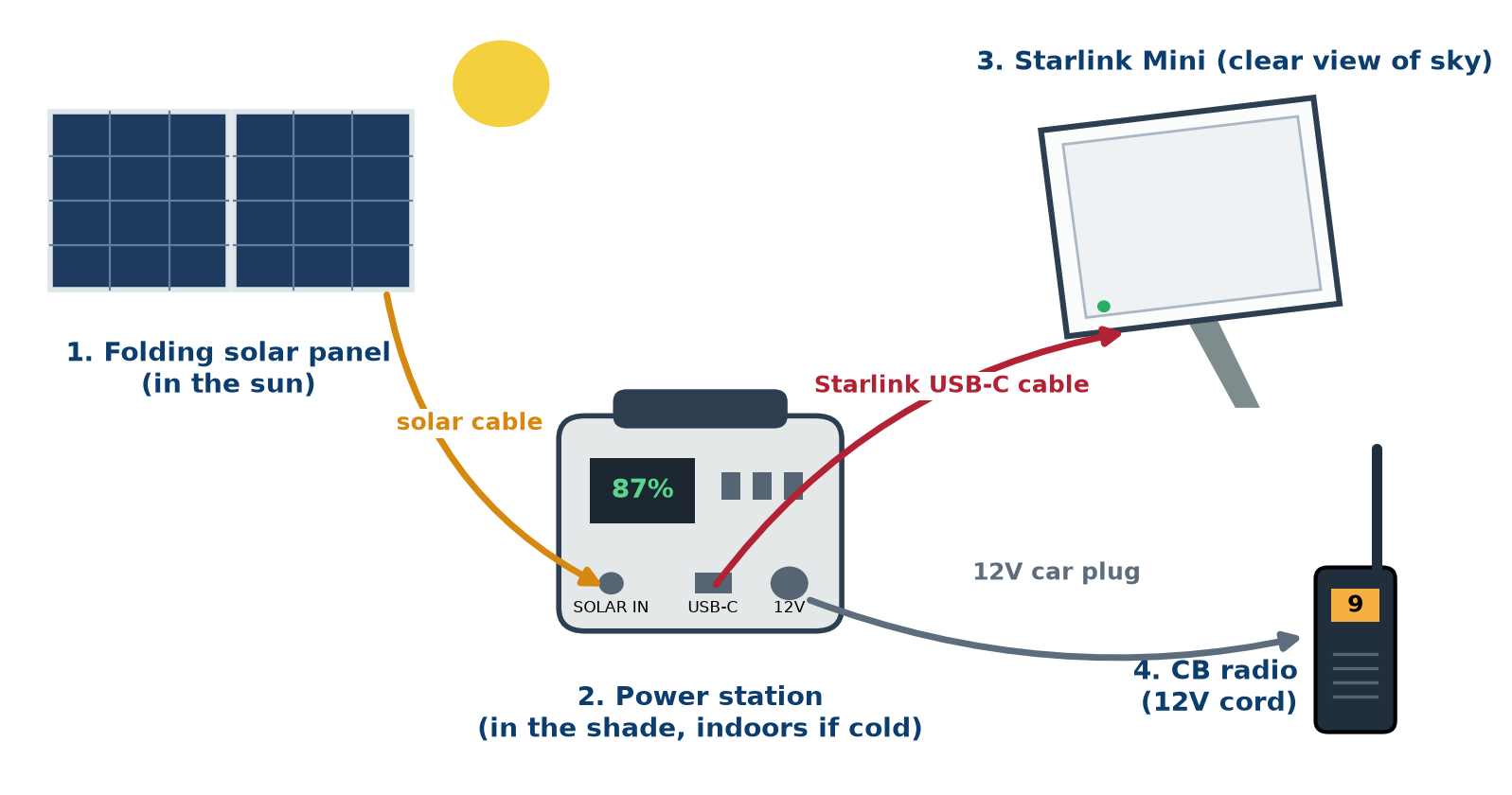
| 1 | 1. Starlink Mini | A small satellite dish. It gets you internet from space, so you can text, email and check the news when cell towers are down. | $149* |
| 2 | 2. Starlink Mini USB-C cable (5 m / 16 ft) | Starlink's own cable. It runs the dish straight from the power station's USB-C port. | $38.99 |
| 3 | 3. Jackery Explorer 1000 v2 power station | A big rechargeable battery in a box (1,070 watt-hours). It has a 100-watt USB-C port, a 12V car socket and wall plugs. | $519 |
| 4 | 4. Jackery SolarSaga 100W folding solar panel | Folds up like a briefcase. It plugs straight into the power station to recharge it from the sun. | $199 |
| 5 | 5. Cobra HH 50 WX ST handheld CB radio | A walkie-talkie that reaches other CB radios nearby. It also has NOAA weather channels and comes with a 12V car cord. | $99.95 |
| 6 | 6. Panasonic eneloop AA rechargeable batteries (12-pack) | The CB radio takes 9 AA batteries. These can be recharged over and over. | $42.99 |
| Kit total | $1,048.93 | ||
| opt. | opt.. Midland ER310 crank weather radio | Keeps working even if everything else dies. You turn the crank to power it, and it can charge a phone in a pinch. | $89.99 |
| Total with the crank radio | $1,138.92 |
Prices as of October 11, 2026. They change often. *The Starlink Mini is $149 from Starlink right now. Its normal price is $249, which would bring the kit total to $1,148.93. You also need a Starlink plan (see "Get Starlink" below).
Why these picks?
- Nothing to build. Every part plugs into the next one.
- No power wasted. The Starlink runs on the USB-C port, not a wall plug. Wall plugs on a power station waste energy turning battery power into house power. Owners report the Mini uses about 30 watts on a wall plug versus about 20 watts on USB-C.
- A handheld CB is small, comes with its own antenna, and can run on AA batteries if you have to walk.
Set it up in 10 minutes
- Charge the power station all the way from a wall outlet before an emergency. It takes about 1.5 hours.
- Put the solar panel in the sun. Unfold it and tilt it so it faces the sun. In winter, face it south and tilt it up steeply, because the sun is low. Plug its cable into the station's solar input.
- Put the Starlink Mini outside where it can see a big patch of open sky, away from trees and roofs. Flip out the stand.
- Plug the Starlink USB-C cable into the station's 100W USB-C port (not the small 30W one) and into the dish. Press the station's DC/USB button. The dish takes a few minutes to find satellites.
- Connect your phone to the Starlink Wi-Fi. Open the Starlink app the first time to set it up.
- Plug the CB's 12V cord into the station's car socket, or run it on its AA batteries. Turn it on and set it to Channel 9.
- Keep the power station in the shade and dry, and indoors if it's below freezing. It can't recharge below 32°F.
How long does it last?
These are our best estimates, not promises. Real results depend on weather, use and the gear itself.
Normal use is the Starlink for 2 hours a day, the CB listening 12 hours a day, two phones charged, and a small light at night. That's about 250 watt-hours a day. (A watt-hour is a unit of stored energy. The station holds 1,070 of them, and about 870 are usable.)
| Weather | How long it lasts |
|---|---|
| No sun at all | about 3½ days |
| Gray winter day, panel aimed at the sun | about 1 week |
| Spring or fall sun | about break-even: the panel refills about what you use |
Power-saver mode is the Starlink for 1 hour a day and the CB on for 6 hours. That's about 150 watt-hours a day:
| Weather | How long it lasts |
|---|---|
| No sun at all | about 6 days |
| Gray winter day, panel aimed at the sun | about a month |
How to make it last longer
- Turn the Starlink off between check-ins. Pick set times, like 8 AM, 1 PM and 7 PM, for 20–40 minutes each. Off means unplugged: it uses about 15–20 watts even when you're not using it.
- Do the big stuff at midday, when the sun is helping.
- Turn off the CB when no one is listening. Use the CB's low-power button when you talk to people close by.
- Move the panel to follow the sun two or three times a day. Wipe off rain and dirt.
- Turn off station buttons you don't need (AC, USB). A switched-on port wastes a little power all day.
- Charge phones in the afternoon, when the panel is working.
CB radio basics
CB means Citizens Band. It's two-way radio anyone can use. No license, no test.
- Channel 9 is for emergencies only. It's set aside by law for emergencies and helping travelers.
- Channel 19 is for road traffic. Truckers and drivers share road news here. It's a good place to ask about road conditions.
- Push to talk, release to listen. Hold the radio a few inches from your mouth and speak slowly. Wait a second after pressing before you start talking.
- Squelch is the knob that hides background hiss. Turn it until the hiss just stops.
- Range is usually a few miles. It's farther from high ground and shorter in hills and buildings.
How to call for help on Channel 9
- Listen first, so you don't talk over someone.
- Press and say: "Emergency, emergency, emergency. This is [your name] at [your location]."
- Say what happened, how many people, and what you need. For example: "Two people, one hurt, road blocked, need medical help."
- Release and listen. If no one answers, wait a minute and try again. Then try Channel 19.
- Write down who answered and what they said.
Also on this radio: the WX button plays NOAA weather alerts. Check them every morning and evening.
Monthly checklist
- Power station is above 80%. Top it up if not.
- Turn on the Starlink for 15 minutes. Make sure it connects and gets updates.
- CB radio check: say "radio check" on Channel 19 and ask someone how you sound.
- Press WX on the CB and confirm you hear the weather station.
- Charge the AA batteries.
- Unfold the solar panel, check the cable, and wipe it clean.
- All cables are in the bag: Starlink USB-C cable, solar cable, CB 12V cord.
- Crank the weather radio for a minute, if you have one.
- Keep a paper list of family phone numbers and meeting spots with the kit.
Notice Nearby Emergency Comms Kit — V1. American-based. Support your Neighbor.
Where the numbers come from: the Starlink Mini spec sheet and Starlink plan pages; Jackery's Explorer 1000 v2 spec page (100W USB-C port at 20V/5A, 12V car socket, charging limit of 32°F); owner power tests of the Starlink Mini; Cobra's CB manuals; the FCC CB radio rules (Channel 9 is for emergencies); and NREL/NASA sun data for Seattle winters. Illustrations are original drawings. Starlink is a trademark of SpaceX. This guide is not endorsed by SpaceX, Jackery, Cobra, Panasonic or Midland.
72-hour go-bag
A go-bag is a bag you can carry if you have to leave home fast. Ready.gov says to pack enough for at least three days. Put the bag where you can grab it, and keep one in the car if you can.
- Water and food that will not spoil, for three days.
- A flashlight, a battery radio or hand-crank radio, and extra batteries.
- A small first-aid kit, a whistle, and a dust mask.
- Plastic sheeting, duct tape, garbage bags, and moist wipes.
- A wrench or pliers to turn off the water or gas if officials tell you to.
- A manual can opener, local maps, and a phone charger or battery pack.
- Needed medicine, cash in small bills, and copies of important papers.
- A warm blanket or sleeping bag, a change of clothes, and sturdy shoes.
- Matches in a waterproof box, hygiene items, and supplies for a baby or a pet.
The American Red Cross lists the same kind of kit. Check the bag twice a year. Swap food and water before they expire. Swap batteries too.
Water and food for 2 weeks
Three days is the minimum. If you can, store two weeks at home. That is the longer supply Ready.gov asks households to consider.
- Store one gallon of water per person per day, for drinking and washing. Add the same for each pet. People who are sick, nursing, or in hot weather need more. See Ready.gov on water.
- Keep water in a cool, dark place. Store-bought bottles are fine. Mark the date.
- Pick food you already eat that needs no cooking, or only a little water: canned food, peanut butter, crackers, dried fruit, and cereal.
- Keep a manual can opener with the food. Do not forget formula, pet food, and special diets.
- If the tap is unsafe, officials will say so. Use stored water until they say the tap is safe.
First aid and medications
Ready.gov and the Red Cross both put a first-aid kit and your daily medicine in the basic kit. You do not need a hospital bag. You need the things you already use.
- Bandages, gauze, tape, antiseptic wipes, tweezers, and gloves.
- Pain and fever medicine you are allowed to take, and any allergy medicine.
- A week of prescription medicine if you can get it, and a list of the drug names, doses, and your doctor.
- Glasses, hearing-aid batteries, and spare supplies for medical devices.
- A cooler pack plan for medicine that must stay cold, if the power goes out.
Important documents
Ready.gov says to keep copies of papers you would hate to lose, in a waterproof bag, and another copy with someone you trust who lives out of the area.
- Photo IDs, insurance cards, and proof of address.
- Insurance policies for home, renters, health, and the car.
- Bank and loan account numbers, and a little cash.
- Medical lists, prescriptions, and emergency contacts.
- Deeds or lease papers, and photos of the rooms in your home.
Paper still works when the phone is dead. Keep the paper list with the comms kit.
Family plan: a meeting spot and an out-of-area contact
Ready.gov's family plan is short. Pick the places and the person before a storm, then practice once.
- A spot right outside your home for a fire or a gas smell. The mailbox, a tree, or a neighbor's porch is enough.
- A spot outside the neighborhood if you cannot go home. A library, a school, or a grocery store you all know.
- An out-of-area contact. After a local disaster, a long-distance call or text can get through when a local call cannot. Each person calls or texts that one contact to say they are safe.
- Text instead of calling when the lines are busy. Keep the plan on paper, in each go-bag.
- Ask what your school, work, and care site will do. Write it down.
If you have to leave, Find shelters and supplies.
Power outage basics
These steps follow Ready.gov on power outages. A blackout can last hours or days. Treat downed lines as live. Stay away and tell the power company.
- Use flashlights, not candles.
- Keep the fridge and freezer doors shut. A closed fridge keeps food cold for about 4 hours. A full freezer keeps food cold for about 48 hours, or about 24 hours if it is half full.
- Unplug lamps and appliances so a surge does not wreck them when the power returns. Leave one light on so you know the power is back.
- A generator stays outdoors, at least 20 feet from doors and windows, never in a garage. Carbon monoxide from the exhaust can kill. Point the exhaust away from the house.
- Charge phones before a storm. Check on neighbors who use medical machines or who live alone.
- Know how to open the garage door by hand.
Earthquake and tsunami basics for coastal areas
The Pacific coast of the United States, including Washington, Oregon, and northern California, sits near a long fault under the ocean. Scientists call that fault Cascadia. A big quake there can shake for minutes, and it can send a tsunami toward the shore.
In an earthquake
Ready.gov, FEMA, and the American Red Cross teach the same move: Drop, Cover, and Hold On.
- Drop to your hands and knees so the quake does not knock you down.
- Cover your head and neck under a sturdy table. If there is no table, cover your head with your arms next to an inside wall, away from glass.
- Hold on until the shaking stops.
- Do not run outside while the ground is moving. Keep shoes and a flashlight by the bed.
If you are on the coast
Ready.gov and the National Weather Service say you may not get a siren in time. If you are on the coast and the shaking is long or strong, a tsunami can follow.
- As soon as the shaking stops, go inland and uphill. Do not wait for a siren.
- Do not go to the beach to look. The first wave is not always the biggest.
- If you cannot get to high ground, go to a high floor of a concrete building only if that is the local plan. Know your route before the quake.
- Stay away from the shore until officials say it is safe to go back.
Where these steps come from
Sections on the go-bag, water, food, medicine, papers, the family plan, power outages, earthquakes, and tsunamis follow public guidance from Ready.gov (FEMA), the American Red Cross, and the National Weather Service. Notice Nearby wrote this page in plain language. It is not a government order, and it is not a promise that a kit will last a set number of days. Support your Neighbor. American-based.