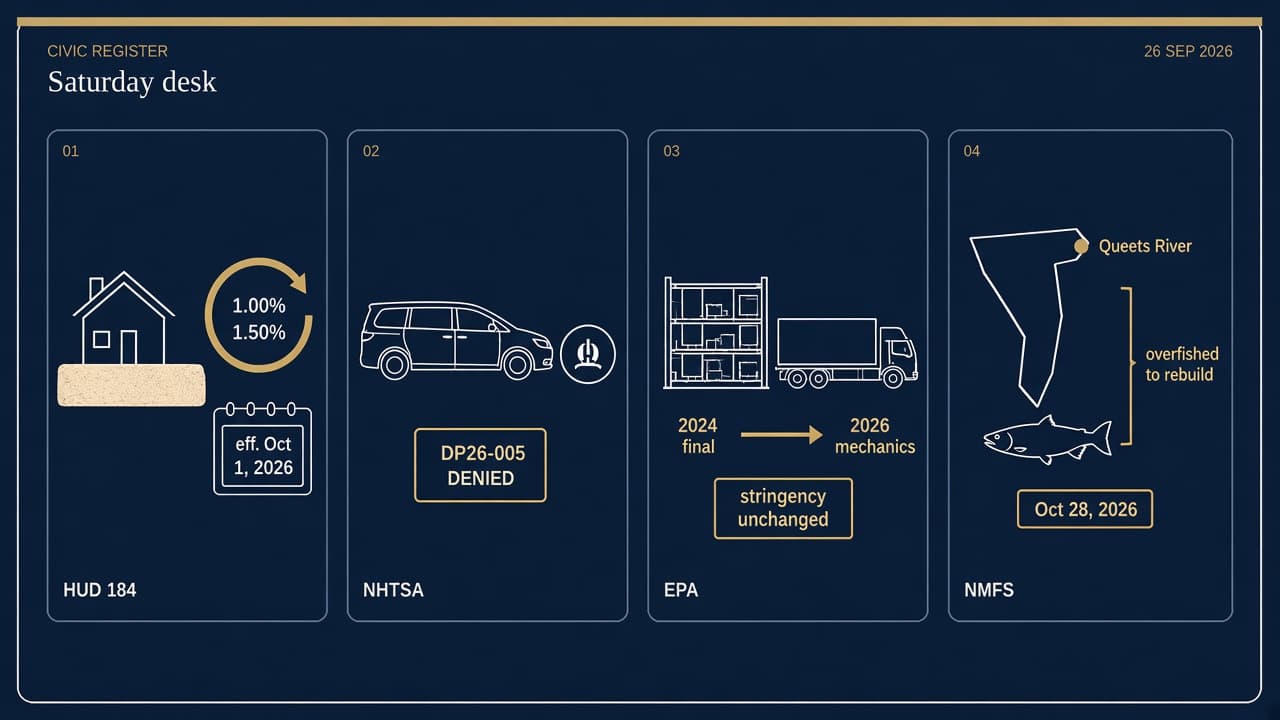
Intelligence Brief · September 28, 2026 · NN-IB-2026-0928
HUD lifts Section 184 Indian housing guarantee fees, NHTSA denies Honda Odyssey airbag petition, EPA reopens gasoline-terminal NESHAP mechanics, and NMFS locks Queets Chinook rebuilding
HUD raises Section 184 Indian housing guarantee fees; NHTSA denies Honda Odyssey airbag petition; EPA reopens gasoline-terminal NESHAP mechanics; NMFS locks Queets Chinook rebuilding.
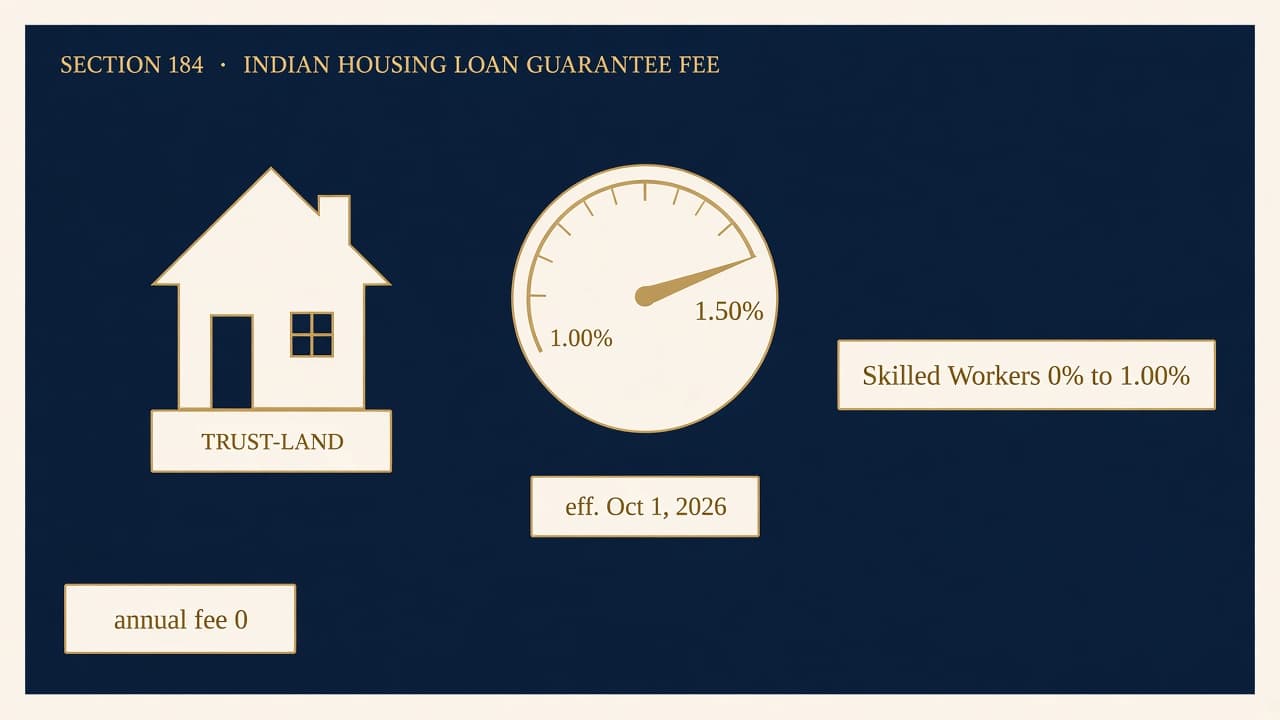
Navy civic schematic of a one-to-four family house on a trust-land chip, a fee dial moving from 1.00 percent to 1.50 percent, and a calendar stamp for October 1, 2026. 01
HUD raises Section 184 Indian housing guarantee fees
Catch-up · FAA Cessna / DOT DBE / ITC tin-mill / Terran R · September 26, 2026
HUD’s Office of Native American Programs posted a fee notice that hits tribal mortgage pipelines. Effective October 1, 2026, the upfront loan guarantee fee on all new Section 184 Firm Commitments — including refinances — rises from 1.00 to 1.50 percent of principal. The Section 184 Skilled Workers Demonstration Program, which had carried a zero upfront fee, moves to 1.00 percent on the same date. Annual loan guarantee fees stay at zero. The spice is fiscal self-sustainment language: the program blends appropriated dollars with borrower fees to cover claims and foreclosure costs on trust land and other Indian and Alaska Native areas where private mortgage financing has been hard. Statutory caps still allow up to 3.00 percent upfront and 1.00 percent annual, so this is a mid-band reset, not the ceiling. Lenders and tribal housing authorities should treat October 1 Firm Commitments as a new fee schedule, not a soft advisory — the notice is the pricing stamp for the guarantee book.
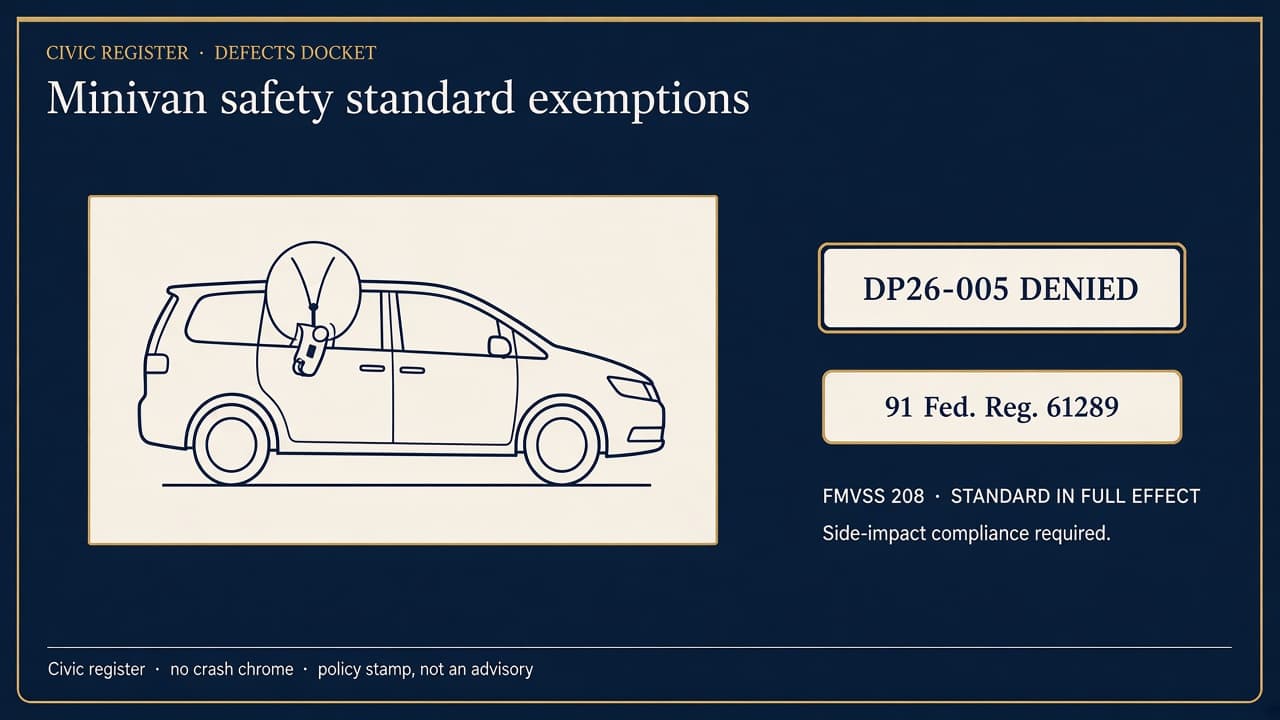
Navy civic schematic of a minivan outline with an airbag icon and a stamped DP26-005 DENIED chip. 02
NHTSA denies Odyssey inadvertent-airbag petition
NHTSA’s Office of Defects Investigation denied petition DP26-005, filed May 30, 2026 by Nathaniel W. Bowe III, seeking a safety defect investigation into alleged inadvertent airbag deployments in model-year 2011–2017 Honda Odyssey minivans. The petition also claimed Diagnostic Trouble Codes and Supplemental Restraint System status conflicted and that inaccurate airbag-system data was being recorded. After a technical review of the petition’s consumer complaints, Agency complaint databases, and other materials already in hand, ODI concluded the issues are not likely to support a finding of a defect related to motor vehicle safety — so further investigation is not warranted and the petition is denied. For an OSINT desk, the beat is process: 49 U.S.C. 30162 and 49 CFR part 552 let any interested person force a formal grant-or-deny decision, and a Monday FR denial is the public close-out, not a quiet file drawer. Owners still have ordinary complaint channels; this notice ends the petition-driven investigation path on this Odyssey allegation set.
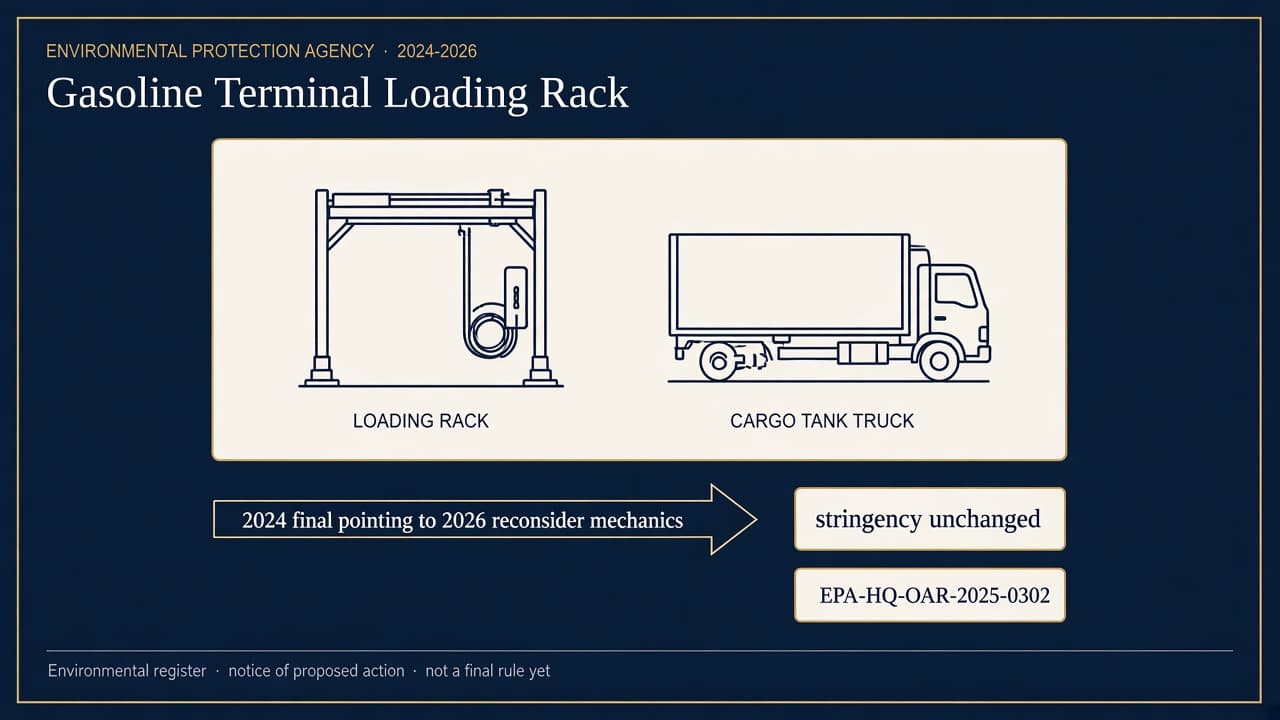
Navy civic schematic of a bulk gasoline terminal rack and cargo tank under an arrow from the 2024 final rule to 2026 mechanics, stamped stringency unchanged. 03
EPA reopens gasoline-terminal NESHAP mechanics
EPA proposed a reconsideration of pieces of its May 8, 2024 final rule on NESHAP for gasoline distribution facilities and NSPS for bulk gasoline terminals. On the table: operating limits and continuous compliance for air emission control devices, vapor-tightness requirements for gasoline cargo tanks, NSPS modification criteria, plus technical corrections — while EPA says it is not reopening the rest of the 2024 package and will not answer off-scope comments. The Agency’s own framing is the spice: it does not expect the proposal to change VOC or HAP emissions stringency, air quality, or overall human health effects, because the emission standards themselves stay put. Comments run through November 12, 2026 (PRA pieces to OMB by October 28); a virtual hearing requires a request by October 5. For terminals, truck racks, and cargo-tank fleets, read this as a compliance-mechanics fight inside an already-finalized emissions envelope — not a new stringency war. Docket EPA-HQ-OAR-2025-0302 is the paper trail.
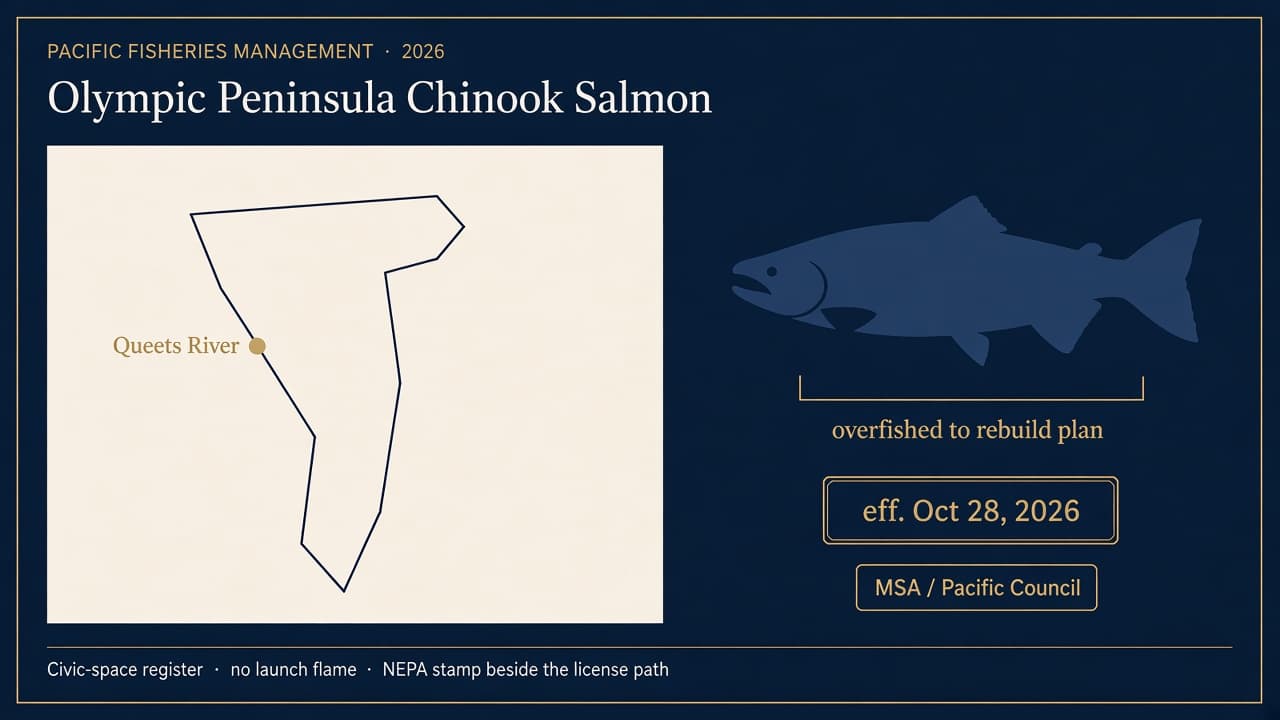
Navy civic map chip of the Olympic Peninsula with a Queets River marker, a Chinook silhouette, and an effective date of October 28, 2026. 04
NMFS locks Queets Chinook rebuilding plan
Catch-up · OFAC / Syria SST / ITC DRAM / ATF explosives · September 25, 2026
NMFS finalized the Pacific Fishery Management Council’s rebuilding plan for the Queets River spring/summer Chinook salmon stock, effective October 28, 2026. The stock was declared overfished in October 2023 after the 2019–2021 three-year geometric mean spawning escapement hit 314 against a minimum stock size threshold of 350 under the Pacific Coast Salmon FMP and the Magnuson-Stevens Act. The Council built the plan; NMFS proposed it at 91 FR 7952 (Feb. 19, 2026), took comments through March 23, and now stamps the regulatory changes that implement the Council’s recommendation. Public comments were treated as out of scope — offshore wind, other fisheries, and a mistaken reading that NMFS was proposing a total commercial fishing suspension the Council had considered but not recommended. The beat is sequential MSA governance: overfished trigger, Council rebuild, NMFS final rule — not a surprise harvest ban invented in this notice. Tribal, recreational, and commercial users should read the linked Council and NMFS packages as the operational plan behind the CFR delta.
Anchored on Base
SHA-256 90472acf 67f54189 0d198e5e 4b622837 e61c5518 02515c64 2af29b02 b8fa81cb
A content hash may be anchored on Base. The chain stores a hash, not the brief. The hash is not statutory publication. The full text stays on Notice Nearby.
After a Base anchor, this day’s body is locked. A correction is a new dated brief or a dated correction note that itself is hashed.
This is a Notice Nearby Intelligence Brief — a publisher-desk open-source federal watch. It is not official minutes, not a newspaper story, and not Legal Publication. It does not satisfy a statutory notice requirement.