Public paper · October 1, 2026 · long read
The Highway Next Door May Become a Utility Corridor
DOT’s America’s Great Corridors of Commerce RFI closes October 2 — what ROW colocation, P3 corridor managers, and local notices could mean for taxpayers.
noticenearby.com/papers/highway-next-door-utility-corridor-agcc.pdf
Most people look at a highway and see asphalt, trucks, and a median. The U.S. Department of Transportation is asking the country to look again.
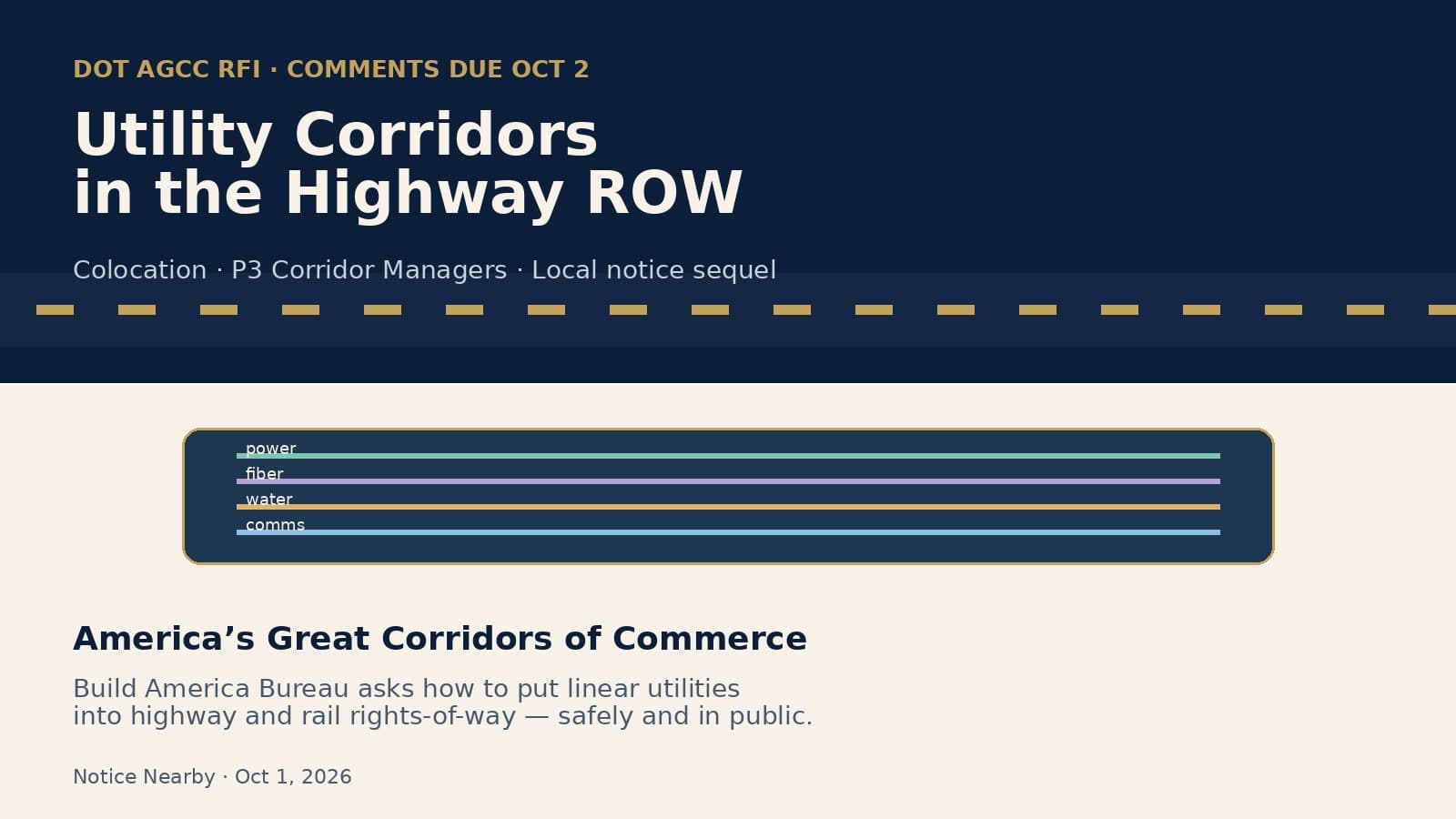
On September 11, 2026, DOT published a Request for Information (RFI) on America’s Great Corridors of Commerce (AGCC) — a Build America Bureau initiative to put more electrical lines, communications fiber, water lines, and related utilities into highway and rail rights-of-way (ROWs) through public-private partnerships. Written comments are due October 2, 2026. Late comments may be considered to the extent practicable, but the practical deadline for being on time is tomorrow.
This brief explains the proposal in plain English: what a ROW is, what “colocation” means, how a Corridor Manager would work, why the Administration frames the effort as an energy and grid response, and where local public notices would still show up if any of this moves from an RFI into real projects near your county line.
It is not a prediction that your interstate will sprout a tunnel next month. It is a field guide to a federal comment window that is about to close, written for taxpayers who care when big infrastructure ideas turn into hearings back home.
The short version
DOT says the country needs faster build-out of linear utility infrastructure — long runs of power, communications, and related lines — to serve manufacturing and emerging technology loads. At the same time, highway and rail owners need money for capital work and deferred maintenance.
AGCC’s bet is that those two problems can share a corridor. Instead of always buying new land for power lines or fiber, place more utilities inside transportation ROWs that already exist. A private partner (a concessionaire acting as Corridor Manager) would design, build, finance, operate, and maintain dedicated space — often underground channels — for decades, typically described in the RFI as a 30–50 year horizon, and lease access to utility and telecom companies. ROW owners could gain revenue. Industry could gain faster routes. Communities would still face construction, safety, and land-use questions.
DOT intends to designate up to five AGCC corridors per year for specialized federal “concierge” help on permitting and financing. The broader colocation idea could be used more widely; the premium federal help would be limited to designated corridors.
That is the model on which DOT wants comment by October 2.
What a right-of-way is, without the jargon
A right-of-way is the strip of land a highway agency or railroad controls for transportation. It includes the travel lanes you drive and often shoulders, ditches, fences, and leftover edges. For decades, those edges were treated mainly as transportation space, with utility permits handled case by case.
Colocation means putting utility infrastructure in that same strip — beside the road, under it, or otherwise within the controlled corridor — instead of cutting a brand-new path across farms, neighborhoods, or undeveloped land.
DOT’s RFI argues that case-by-case utility permits are too slow and too fragmented when the country needs large, coordinated utility builds. AGCC is meant to replace that scattershot pattern with a planned commercial model: one Corridor Manager, shared trenches or tunnels where feasible, standardized approaches, and federal coordination on environmental review and permits.
Why the White House energy frame sits in the document
The RFI links AGCC to the national emergency described in Executive Order 14156 on the U.S. power grid and energy supply — the need for a more reliable, diversified, and affordable energy system. Notice Nearby reports that framing as it appears in the federal notice. Respect for the office means reading the executive order citation as part of the public record, not as a campaign slogan and not as something to erase.
In practical terms, the document says surging power demand from manufacturing and emerging technologies needs linear infrastructure quickly. Transportation corridors are long, continuous, and already disturbed compared with many greenfield routes. DOT’s pitch is to treat AGCC work largely as brownfield-style activity inside existing ROWs, which can simplify some environmental reviews when impacts stay limited.
Whether that pitch holds for a specific corridor will depend on geology, safety clearances, local land use, and the details of each proposal. An RFI does not pour concrete. It asks questions before a designation process hardens.
The Corridor Manager: a long lease with a private partner
Under the AGCC public-private partnership (P3) model, a highway or rail ROW owner may contract with a private entity to serve as Corridor Manager. That partner’s job, as described, can include business development, design, construction, finance, and long-term operations and maintenance.
One likely delivery method is an underground utility tunnel or channel that can host multiple lines. Dig once. Lease space to utilities. Share revenue with the ROW owner under negotiated terms. Above-ground or hybrid approaches are also contemplated, especially for electric transmission where undergrounding is not the chosen path.
The RFI notes that some underground corridor infrastructure may be eligible for financing tools such as the Build America Bureau’s TIFIA or RRIF loans, or Department of Energy Energy Dominance Financing (EDF). Utility equipment itself might be financed by federal programs, private capital, or utilities directly — with different compliance consequences depending on the path.
For taxpayers, the key translation is this: AGCC is not described as a single new tax earmark you vote on next month. It is a delivery and leasing model that could create recurring ROW revenue and could also create long concession contracts. Long contracts need careful reading. Who keeps control of the transportation corridor? Who pays if a dig damages a roadway? Who shares lease revenue with local governments when a state DOT owns the ROW but a county feels the construction traffic?
Those questions are exactly the sort DOT invites in the RFI’s comment prompts.
Designation: five corridors a year and a federal task force
DOT plans an annual Request for Expressions of Interest (RFEI) from ROW owners. An interagency federal task force would screen proposals for market demand, readiness, financial feasibility, streamlining commitments, and stakeholder support. Longer multi-state corridors with regional significance would get priority attention under the vision described.
Designated corridors would receive concierge services aimed at two jobs:
- Faster, better-coordinated environmental review and permitting, with emphasis on categorical exclusions when projects stay inside transportation ROWs and impacts are limited.
- Clearer navigation of federal funding and financing tools, planning grants, and related technical help.
Up to five designations per year means most of the country’s highway and rail miles will not wear an AGCC badge in any given cycle. The RFI is careful to say the broader colocation concept can still be used without designation. The scarce resource is the specialized federal help.
Where local notices still matter
Federal RFIs can sound far from a county courthouse. They are not.
If a state DOT or railroad proposes a corridor that runs through your county, the sequel is local even when the branding is federal:
- Construction staging, lane closures, and haul routes can trigger traffic and public-works notices.
- Adjacent land repositioned for data centers, manufacturing, or distribution — an outcome the RFI explicitly discusses — can trigger zoning hearings, tax-abatement hearings, and utility-extension debates.
- Water, fiber, and power laterals that leave the ROW to serve a new facility still touch local permitting desks.
- Lease revenue sharing, if any reaches local governments, may show up in budget hearings rather than in the Federal Register.
Notice Nearby’s lane is that sequel. The federal RFI is the opening chapter. Homeowners who only read national headlines will hear “utility corridors in highways.” Homeowners who watch local agendas will see the site-plan hearing for the building that wants to plug into the corridor.
The RFI even lists community engagement and acceptance among the barriers DOT wants commenters to address. That is an invitation, not a guarantee of smooth politics.
Comment deadline: October 2, 2026
DOT asks for written comments by October 2, 2026. Submissions can go through Regulations.gov on docket DOT-OST-2026-3269, by email to AGCC@dot.gov, or by mail to DOT Docket Operations at the address in the notice. Electronic filing is encouraged for timely receipt. All submissions need the agency name and docket number.
The Department lists specific questions. You do not need to answer all of them. Useful comments often pick one concrete barrier — safety clearances, crossing state lines, revenue sharing, ratepayer impacts, or procurement templates — and explain it with field experience.
DOT also points to an illustrative P3 term sheet on the AGCC web pages. The notice says that sheet is not binding guidance. Still, reading an example term sheet is one of the fastest ways to see what a 30–50 year corridor deal might argue about: ownership, handback conditions, lease rights, and who carries which risks.
Early-trend angle for the first week of October
Two clocks are running at once this week.
One is federal: the AGCC comment window closes October 2. Missing it does not ban you from later project fights, but it does skip the chance to shape how designation criteria and concierge services are designed.
The other is local: counties across the country are posting fall bond hearings, budget workshops, and land-use calendars. If AGCC later funnels industrial growth toward corridor-adjacent land, those local calendars are where the tax base and the traffic impacts get argued.
A related federal money clock sits nearby for airport sponsors: the FAA’s Contract Tower Competitive Grant Program notice (91 FR 60190, published September 22, 2026) offers up to $100 million in FY 2027 Airport Infrastructure Grant funds under the Infrastructure Investment and Jobs Act for aging airport-owned towers, with applications due October 19, 2026. That NOFO is a different program. It is useful context for the season: Washington is running multiple infrastructure comment and application windows while local governments run their own capital ballots. The AGCC RFI is about corridors and utilities. The tower NOFO is about airport traffic-control buildings and equipment. Both are public-money adjacent. Both reward reading the deadline line.
Benefits DOT claims — and the questions still open
The RFI lists hoped-for benefits in clear categories:
- Lower development cost by avoiding new ROW purchases where colocation is safe and feasible.
- Economies of scale from shared trenching or tunneling.
- New lease revenue for highway and rail owners that can recycle into transportation repairs.
- Industrial land-use shifts toward corridor-adjacent sites for data centers and manufacturing.
- Possible downward pressure on some utility rates if clustered loads reduce scattered transmission upgrades.
- Faster NEPA paths when work stays inside existing corridors and qualifies for categorical exclusions.
Open questions, which DOT itself invites, include technical limits of putting multiple utilities in one tunnel, safety during digs next to live traffic or rail, multi-state revenue and liability splits, market appetite among utilities, and whether the model truly accelerates power and communications compared with traditional greenfield builds.
Unbiased coverage means holding both lists in view. A voluntary P3 model can create value. It can also lock in long concessions that outlast the officials who signed them. Comment season is when those tradeoffs are cheapest to debate.
What “success” would look like for a county reader
If AGCC works as advertised in a region that includes your county, you might eventually see:
- A state DOT or railroad named as a designated corridor owner.
- A procured Corridor Manager and a public summary of the concession.
- Utility lease activity and construction notices along a mapped route.
- Site-plan and tax-base debates for facilities that want corridor access.
- Budget lines showing any ROW lease revenue shared downstream.
If AGCC stays mostly a white paper, you will see fewer of those local artifacts. Either way, the October 2 RFI is the near-term civic chore: read the docket, decide whether you have a comment worth filing, and keep your local hearing list open for the sequel.
A practical checklist for this week
- Open the Federal Register notice 2026-18521 or the Regulations.gov docket DOT-OST-2026-3269.
- Skim sections on the P3 Corridor Manager model and the designation process.
- Note the October 2, 2026, comment deadline and the AGCC@dot.gov address.
- If you represent a utility, railroad, state DOT, county, or neighborhood group, pick one RFI question you can answer with specifics.
- Avoid putting confidential business information in a public comment unless you follow the notice’s marking rules.
- Check whether your state DOT has already said anything public about AGCC interest.
- Add a calendar reminder for later RFEI rounds if designation becomes real.
- Watch local planning agendas for data-center or manufacturing proposals near major highway or rail corridors.
- Separate federal concierge promises from local zoning power — counties still run many of the land-use hearings.
- Treat this brief as a map, not as legal advice or as a prediction of any specific corridor award.
Ratepayers, landowners, and who “wins” if lease money appears
DOT’s RFI says a goal of AGCC is to support affordability for utility ratepayers by encouraging least-cost, least-risk resources and avoiding unnecessary rate spikes. That goal deserves a straight read. Colocation can reduce the need to assemble dozens of private easements across a landscape. Fewer landowners to negotiate with can mean faster builds and lower soft costs. Clustering heavy users near a corridor can also reduce the temptation to upgrade the grid in a scattered, expensive pattern.
But lease payments and concession returns are not free. Someone pays for tunnel boring, for safety systems, for operations, and for the private partner’s required return. Those costs flow into utility rates, into freight and highway budgets, or into both, depending on the contract. A county reader should ask a blunt question whenever a corridor pitch arrives locally: who pays on day one, who pays in year fifteen, and who keeps surplus lease revenue?
Landowners next to a highway already live with noise and access limits. The RFI suggests some of that land could be repositioned for data centers, advanced manufacturing, or distribution hubs — uses that can raise local tax base and also raise service demands. That is neither automatically good nor automatically bad. It is a land-use fight with a utility spine attached. The federal RFI will not replace your planning commission. It may, however, change which projects show up on the agenda.
Safety and dig season: the unglamorous middle of the story
Putting power and communications next to live traffic or active rail is not a brochure exercise. Construction windows, clearances, strike risks, and emergency access all have to work on real dirt. The RFI asks commenters about safety during construction, operations, and maintenance for a reason. A Corridor Manager who digs once for many utilities can reduce repeated cuts. A Corridor Manager who digs poorly can close a lane for months.
Local public works directors already know this season. They post lane-closure notices, haul-route limits, and night-work variances. If AGCC scales, those ordinary notices become the public face of a national program. That is another reason Notice Nearby tracks registers and hearing clocks: the federal brand shows up in Washington; the cones show up on your exit ramp.
How this brief fits Notice Nearby’s public-money desk
Notice Nearby is not a cable panel. We publish from the public record — Federal Register dockets, county bond hearings, grant NOFOs, and the notices that tell you when to speak. AGCC sits in that lane because it is about long-lived claims on corridors the public already owns or regulates, wrapped in a partnership model that can outlast a single budget year.
If you file a comment by October 2, you are participating in the federal design stage. If you skip the RFI and wait, you can still show up later when a state DOT seeks local cooperation or when a site plan lands next to the corridor. Both stages are legitimate. Only one of them closes tomorrow.
Sources and honesty
Primary source: U.S. Department of Transportation, “America’s Great Corridors of Commerce; Request for Information,” 91 FR 57959 (Sept. 11, 2026), document number 2026-18521, docket DOT-OST-2026-3269, comments due October 2, 2026. Related seasonal context: FAA “Contract Tower Competitive Grant Program; Fiscal Year (FY) 2027 Funding Opportunity,” 91 FR 60190 (Sept. 22, 2026), document number 2026-19328, applications due October 19, 2026, for up to $100 million in Airport Infrastructure Grant funds under IIJA. Executive Order 14156 is cited as it appears in the AGCC RFI.
Author: Ryan Standley / Record of Sale, LLC / Notice Nearby.
Not legal advice. Not a newspaper. Not Legal Publication. Record of Sale, LLC (Oregon).
Notes and sources
- Primary: DOT AGCC RFI, 91 FR 57959 (Sept. 11, 2026), doc 2026-18521, docket DOT-OST-2026-3269, comments due Oct 2, 2026. Related: FAA Contract Tower Competitive Grant NOFO, 91 FR 60190 (Sept. 22, 2026), applications due Oct 19, 2026.
- Author: Ryan Standley / Record of Sale, LLC / Notice Nearby.
- Not legal advice. Not a newspaper. Not Legal Publication. Record of Sale, LLC (Oregon).
Companion shelf: When Your County Puts Hundreds of Millions on the Ballot · How a County Really Spends a Billion-Dollar Budget · The Comment Period Is Notice.
Not legal advice. Not a newspaper. Not Legal Publication. Record of Sale, LLC (Oregon).