Public paper · September 30, 2026 · long read
How a County Really Spends a Billion-Dollar Budget
Where your property tax goes when a county budget hits a billion — payroll, bonds, and the contractors who cash the biggest checks.
noticenearby.com/papers/how-county-spends-billion-dollar-budget.pdf
Most people never open a county budget. They pay the bill when the tax notice arrives. They hope the roads get fixed and the sheriff shows up. That is normal.
But once a county’s yearly plan crosses into the hundreds of millions — or a full billion — the numbers stop feeling abstract. A billion dollars is not a pile of cash in a vault. It is a map of who gets paid, what gets built, and what debt the county already owes. If you own a home, that map is about you. Property tax is the fuel. Payroll, bonds, and big contractors are where most of that fuel goes.
This paper walks through how U.S. counties typically move that money. It uses common patterns and example ranges you can treat as benchmarks, not as claims about one named county. Your county will differ. The shape of the budget often looks familiar.
What a “billion-dollar budget” actually means
Counties talk about “the budget” as if it were one checking account. It is not.
A large county often runs several money pots at once:
- The general fund — the everyday account. Salaries for many county offices, utilities, routine contracts, and the costs that do not have a special tax earmarked for them.
- Special funds — money locked to a purpose. Road gas tax. Library millage. Health grants. Court fees. You cannot usually raid these for something else without a vote or a law change.
- Capital funds — money for buildings, major equipment, and big projects that last years.
- Debt service — the payment schedule on bonds and loans. Principal and interest. This is the mortgage on past promises.
When a headline says “County adopts $1.2 billion budget,” that figure often mixes several of those pots. Sometimes it counts only the general fund. Sometimes it counts everything the county expects to spend that year. Always check which definition your county used. The same county can look “rich” or “tight” depending on what got rolled into the total.
National pattern, labeled as an example range: medium-to-large U.S. counties with populations in the mid-hundreds of thousands often land general funds in the low hundreds of millions. Counties with a million-plus residents can push total appropriations past a billion when capital projects and special funds are included. Small rural counties may run under $50 million total. Size of population, cost of living, and what services the county runs (hospitals, jails, airports, transit) move the number more than any slogan does.
Follow the money: three places it mostly goes
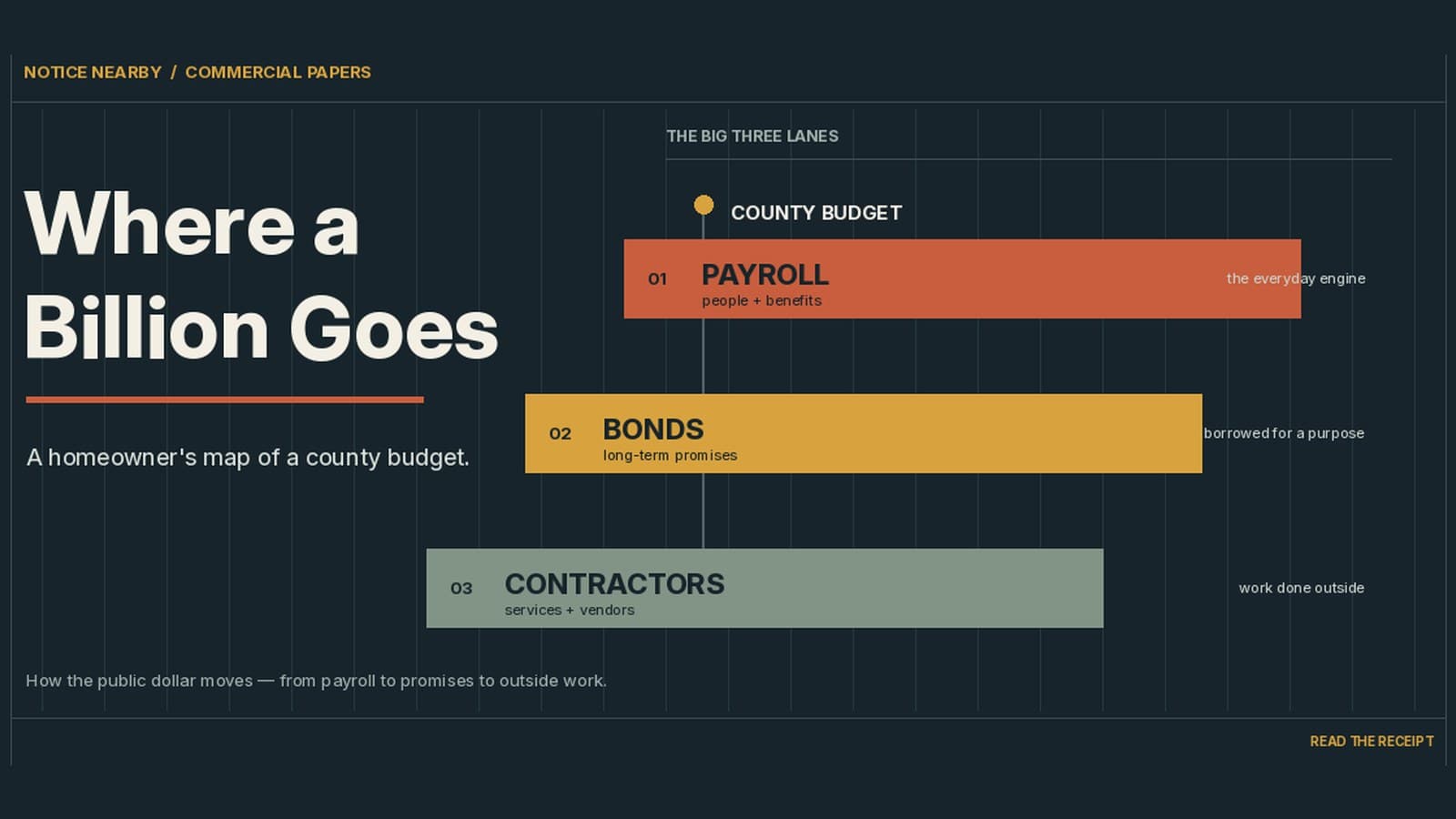
You can stare at a 400-page budget book and still miss the plot. For a homeowner, three buckets explain most of the drama:
- People — payroll and benefits for county workers.
- Debt — bonds and the yearly cost of paying them back.
- Outside help — contractors, vendors, and professional services.
Everything else matters. Public safety, health, elections, parks, courts. But those services still resolve into salaries, debt, or invoices to someone outside the building.
1. Payroll: the largest quiet line
In many counties, wages and benefits are the single biggest operating cost in the general fund. That is not a scandal by itself. Counties run jails, courts, sheriff’s offices, clerk offices, and planning desks. Those jobs do not run themselves.
What homeowners should watch is the share, not only the dollar total.
Example range (illustrative, not a quote from one county): in a general fund that is mostly operations, personnel costs often land somewhere around 50–70% of that fund’s spending. Benefits — health insurance, pensions, payroll taxes — can add 30–40 cents on top of every wage dollar. A $70,000 salary can cost the county closer to $95,000–$100,000 once benefits are counted. Multiply that by thousands of positions and you see why “a billion-dollar budget” still feels tight in a closed-door session.
Questions that cut through the fog:
- How many full-time positions are funded this year versus last year?
- Is overtime rising in the jail or the sheriff’s office?
- Are vacant jobs still budgeted as if filled? (Some budgets keep “ghost” slots that inflate the authorized total.)
- What is the county’s share of pension payments this year, and is that share climbing?
None of those questions require an accounting degree. They require the budget summary and the personnel schedule, which most counties publish online.
2. Bonds: yesterday’s choices, today’s bill
A bond is a loan the county sells to investors. The county gets cash now for a project — a courthouse, a jail wing, a road package, a stormwater fix. Investors get paid back over years with interest. The yearly payment sits in debt service.
Homeowners hear “bonds” and think of Wall Street. Think of a home mortgage instead. Same idea: you buy something large, you pay over time, interest is the price of spreading the cost.
Counties often separate:
- General obligation (GO) bonds — backed by the county’s taxing power. Voters often must approve them. When they pass, property tax can rise to cover the payments.
- Revenue bonds — backed by a specific revenue stream, such as airport fees or water bills. Property tax may not be the backstop, but ratepayers still pay.
- Certificates of participation / lease-backed deals — structures that can feel like debt without always carrying the same ballot label. Read the fine print. If payments are large and fixed for many years, treat them as debt for your own understanding even if the legal name sounds soft.
Example pattern: a large capital program might authorize hundreds of millions in bonds over a decade. The annual debt-service line in the budget might then sit in the tens of millions — a steady claim on tax capacity before anyone debates a new park or a new deputy.
What to look for:
- Total outstanding principal (how much is still owed).
- Annual debt service as a share of general-fund revenues.
- Bond ratings from agencies (higher rating usually means lower interest cost).
- What projects those bonds funded — and whether those projects are finished.
A county can look “balanced” while still being heavy on debt. Balance means this year’s plan matches this year’s projected money. It does not mean the county is light on long-term promises.
3. Contractors and big vendors: the checks that leave the building
Counties buy what they cannot (or choose not to) do in-house. Road resurfacing. Software. Medical care in the jail. Consulting studies. Temporary staffing. Election equipment. Insurance. Construction management.
In a billion-scale county, vendor spend is not a side note. It is a second payroll — one that sits outside civil-service rules and often outside the same public salary tables.
Typical places the large checks go (examples of categories, not accusations):
- Construction and engineering firms on capital projects.
- IT vendors for systems that run courts, property records, and 911.
- Health and behavioral-health providers under county contracts.
- Jail medical and food service contractors.
- Professional services: lawyers, auditors, architects, lobbyists.
Procurement rules exist to force competition. Bid thresholds, request-for-proposal (RFP) processes, and board approval for large awards are the usual guardrails. In practice, renewals, change orders, and “sole source” exceptions can keep the same firms in place for years. That may be efficient. It may also mean the market is not really testing the price.
Homeowner-useful moves:
- Search the county’s vendor payment reports or “checkbook” portals when they exist.
- Read board agendas for contracts over a set dollar amount (often $50,000 or $100,000 — your threshold will vary).
- Ask whether a multi-year renewal was competed again or simply extended.
- Separate capital contractors (building something lasting) from operating contractors (ongoing services). Both matter. They answer different questions.
How the money comes in before it goes out
Spending stories without revenue stories are incomplete. Counties fund those three buckets from a mix that usually includes:
- Property tax — often the largest local lever the county controls. Assessed value times the millage (or tax rate) equals the bill. Schools, cities, special districts, and the county may all appear on one tax bill. The county’s slice is only part of what you pay.
- Sales tax (where the state allows a county share) — more volatile; rises and falls with shopping and tourism.
- Fees and charges — recording fees, court costs, park fees, inspection fees. These rarely cover the full cost of the related service, but they matter at the margin.
- State and federal grants — money with strings. Useful. Not fully flexible. When a grant ends, the county either cuts the program or finds local money to keep it.
- Other — interest earnings, licenses, shared revenues, one-time sales of land or assets.
Property tax deserves special attention because it is the bill that feels personal. When a county says it needs more for payroll, debt, or a contractor package, the debate often lands on assessed values, exemptions, and the tax rate. Rising home values can raise collections even when the rate stays flat. That is why “we didn’t raise the rate” and “your tax bill went up” can both be true.
Example framing (illustrative): if a county’s taxable property base grows 6% in a hot market, and the rate is unchanged, property tax revenue can still climb roughly in that ballpark before new construction and appeals. That growth can fund raises and debt payments without a headline millage hike — and still surprise homeowners who expected a flat bill.
Capital vs. operating: why the distinction saves confusion
People mix these up. The mix causes bad fights.
Operating spending pays for this year’s work: salaries, fuel, software licenses, routine repairs, most contractor services that keep the doors open.
Capital spending buys or builds assets meant to last: roads, buildings, major vehicles, large IT systems. Capital often uses bonds or dedicated capital funds. Spreading the cost over time can be fairer to future users. It also locks in debt service.
A county can cut operating fat and still face a capital cliff — roofs that fail, jails that are overcrowded, systems that no longer get security updates. Another county can look thrifty on operations while loading capital onto bonds that raise tomorrow’s tax pressure.
When you read a budget, ask: is this dollar an operating dollar or a capital dollar? Then ask: is the capital dollar cash this year or borrowed?
Special funds: the quiet walls inside the budget
Special funds confuse almost everyone the first time. They exist because law or past votes set money aside.
A road fund fed by fuel taxes may not legally pay for a new deputy. A library fund may not pave a road. Grant funds may expire if unspent. Enterprise funds (water, sewer, airports in some counties) may be expected to run like businesses, with user fees covering costs.
From a homeowner’s seat, special funds matter for two reasons:
- They explain why a county can say “we’re broke” in the general fund while a special fund shows a healthy balance. Both statements can be true under the rules.
- They tell you whether a fee or tax you pay is doing the job it was sold for.
Read fund balance notes. A rising balance in a special fund might mean projects are delayed. A falling balance might mean the fund is propping up more activity than the revenue supports.
How boards actually decide — and where the public fits
County budgets usually start in the executive or administrator’s office. Department heads submit requests. Finance staff assemble a proposed book. The board of commissioners or supervisors holds hearings. Then they vote.
The public window is often shorter than people think. Drafts appear weeks before adoption. Hearings can feel formal. Comments may be limited. Still, that window is where homeowners can change a line item more cheaply than after the contracts are signed and the bonds are sold.
Useful timing habits:
- Find your county’s budget calendar (often spring or early summer for an October or January fiscal year start — calendars vary by state).
- Download last year’s adopted budget and this year’s proposed budget. Diff the summary tables.
- Watch the consent agenda for large contract awards that skip debate if nobody pulls them.
- Treat mid-year budget amendments as part of the real story. The adopted book is a plan. Amendments show what broke.
A plain-language walk through a fictional $1 billion shape
To make the pattern concrete, here is an illustrative layout for a large county. These numbers are teaching tools, not a report on a real government:
- Total appropriations: about $1.0 billion across all funds.
- General fund: about $450 million.
- Special and grant funds: about $300 million.
- Capital funds: about $150 million.
- Debt service: about $100 million.
Inside that illustrative general fund:
- Public safety and justice (sheriff, jail, courts, prosecutor): maybe 40–50%.
- Health and human services: 15–25%.
- General government (clerk, assessor, finance, IT, facilities): 15–20%.
- Everything else: the remainder.
Personnel might take roughly three-fifths of the general fund. Contractual services might take another fifth. Supplies, utilities, and transfers fill the rest. Debt service sits mostly outside that general-fund slice but still claims tax capacity.
Your county will not match this sketch. The sketch exists so you have a mental ruler. When your county’s public safety share is far higher or lower, you have a reason to ask why — different service mix, different city-county splits, different state mandates.
Why this topic is worth your evening
Property tax is one of the few local bills you cannot easily shop away. Bonds last longer than most elected terms. Large vendors often outlast both. Understanding the budget is not about loving spreadsheets. It is about knowing whether tomorrow’s tax notice is paying for today’s payroll, yesterday’s courthouse, or a contractor’s multi-year renewal.
Commercially, the same facts matter to anyone who prices risk around local government: homeowners, small businesses watching fee schedules, bond-watchers, and vendors who bid for work. The budget is the county’s public price list and its promise book at the same time.
You do not need to become a budget analyst. You need a habit: open the summary, find the three buckets, and ask one hard question in each.
How to read your county’s budget (checklist)
Use this on the next document your county posts:
- Find the definition. Does “total budget” mean general fund only, or all funds?
- Locate the three buckets. Personnel total. Debt service total. Contractual / professional services / capital project awards.
- Check the trend. Compare this year to last year for each bucket. Percent change beats raw outrage.
- Separate operating from capital. Note what is cash-funded versus bond-funded.
- Scan special funds. Spot any large balance sitting unused — or any fund running a repeated deficit.
- Open the tax page. What is the county millage or rate? What is the taxable base growth? Did the bill rise mainly from value or from rate?
- Pull the vendor list. Identify the largest ten payments or awards. Note renewals versus new competitions.
- Read one bond footnote. Outstanding principal, next year’s payment, and what the money built.
- Mark the calendar. Hearing dates, adoption date, and where public comment goes.
- Write one question. Send it to your commissioner before the vote. Specific questions get better answers than general anger.
A billion-dollar county budget is not a mystery novel. It is a set of choices written in tables. Payroll, bonds, and contractors write most of the plot. Once you can see those three lines clearly, the rest of the book gets easier — and your tax notice stops feeling like a random number from a distant office.
Notes and sources
- National patterns and clearly labeled example ranges. Not a claim about one named county.
- Illustrative fund-shape and general-fund split charts are teaching tools, not a report on a real government.
- Author: Ryan Standley / Record of Sale, LLC / Notice Nearby.
- Not legal advice. Not a newspaper. Not Legal Publication. Record of Sale, LLC (Oregon).
Companion shelf: Your Tax Dollar at the County Door · Installment II · Installment III · The County Is the Door.
Not legal advice. Not a newspaper. Not Legal Publication. Record of Sale, LLC (Oregon).