Public paper · October 13, 2026 · Supreme Court desk
FCC v. Brown, No. 26A476: The Fight Over Political Ad Rates Before the Midterms, and Why the Chief Justice Paused a Fourth Circuit Order
The FCC asked the Supreme Court to stop a Fourth Circuit order requiring it to decide, within 48 hours, a challenge to a Media Bureau notice on the lowest-unit-charge rule for political ads. On October 8, 2026 the Chief Justice paused the order. Here are the parties, the history from the filings and the terms, explained.
noticenearby.com/papers/scotus-case-fcc-v-brown-26a476-political-ad-rates.pdf
On October 8, 2026, Chief Justice John G. Roberts, Jr. stayed the Fourth Circuit's October 7 judgment in case No. 26-2230 "pending further order" (Order, No. 26A476, Oct. 8, 2026).
This paper uses only the Court's dockets, orders and the official filings and opinions named under Sources. Each fact is cited. Legal terms are explained in plain words at the bottom of the page.
Who the parties are
- Applicant: the Federal Communications Commission, represented by Solicitor General D. John Sauer (docket No. 26A476).
- Respondents: Sherrod Brown, Jon Ossoff, Roy Cooper and Kristen McDonald Rivet, represented by David R. Fox of Elias Law Group. The National Republican Congressional Committee and the National Republican Senatorial Committee are also respondents (FCC Application, Parties; Opposition, cover).
- A related application, No. 26A477, was filed by the National Republican Congressional Committee and others. The candidates answered both applications in one filing (Opposition, Nos. 26A476 & 26A477).
What happened in the lower courts
- The FCC says that in March 2026, its Media Bureau issued a public notice "concerning the lowest-unit-charge requirement, which governs the rates that broadcasters charge for political advertising" (FCC Application, p. 1).
- On August 25, 2026, a divided Fourth Circuit panel held that the notice was reviewable and unlawful (Brown v. FCC, No. 26-1785). On September 4, 2026, the Supreme Court stayed that ruling in NRCC v. Brown, No. 26A274, in a per curiam opinion (FCC Application, pp. 1-2, Related Proceedings).
- On October 7, 2026, the same panel issued a writ of mandamus ordering the FCC to decide the candidates' pending application for review by noon on October 9. Judge Wilkinson dissented (FCC Application, p. 2, citing App. 19a, 25a).
The question the Court is deciding
This is an emergency application, not a granted case, so there is no questions-presented page. The FCC asks the Court to "stay the order issued by the U.S. Court of Appeals for the Fourth Circuit ... pending further proceedings in this Court" (FCC Application, p. 1). The candidates frame the question as whether a federal agency may "stave off judicial review of an unlawful agency directive until it is too late to matter" (Opposition, Introduction, p. 1).

Case timeline
- Mar. 2026: Media Bureau public notice (FCC Application, p. 1).
- Aug. 25, 2026: Fourth Circuit rules against the notice (No. 26-1785).
- Sept. 4, 2026: Supreme Court stays that ruling (No. 26A274).
- Oct. 7, 2026: Fourth Circuit orders FCC to decide within 48 hours (No. 26-2230).
- Oct. 8, 2026: FCC applies for a stay, and the Chief Justice grants an administrative stay.
- Oct. 10, 2026: Candidates' opposition.
- Oct. 11, 2026: FCC reply.
What's at stake (in the official documents' own words)
- The FCC says its September 4 stay was needed because the Fourth Circuit's ruling was "hampering [political parties'] efforts to reach the electorate in the critical weeks leading up to the midterms" (FCC Application, p. 2, quoting NRCC v. Brown, slip op. 3).
- The candidates say they "are up for election in just over three weeks" and are facing party ad spending "at the candidate rate" (Opposition, p. 1).
- The law requires the FCC to act on the candidates' application, and the FCC says it "sets no deadline" for doing so (FCC Application, pp. 2-3, citing 47 U.S.C. 155(c)(4)).
What happens next, and when
The Chief Justice or the full Court may rule at any time. As of October 13, 2026, the docket shows no ruling (docket No. 26A476). Notice Nearby will update this paper from the docket.
What these terms mean
- Stay and administrative stay (say it: STAY; ad-MIN-ih-stray-tiv STAY). Means: A stay pauses a lower court's order. An administrative stay is a short, temporary pause that a Justice can grant while waiting for the other side's response. Origin and history: The Court's guide says stay applications "usually concern an effort to buy time, to maintain the status quo." Source: Supreme Court of the United States, "A Reporter's Guide to Applications Pending Before the Supreme Court."
- Application and Circuit Justice (say it: ap-lih-KAY-shun; SUR-kit JUS-tis). Means: An application is a request for emergency or procedural relief, such as a stay. It goes to the Justice assigned to the federal circuit the case came from, called the Circuit Justice. Origin and history: The country is divided into 13 federal judicial circuits. The Circuit Justice can act alone or refer the application to the full Court. Source: Supreme Court of the United States, "A Reporter's Guide to Applications."
- Mandamus (say it: man-DAY-mus). Means: A court order commanding a government official or a lower court to do something the law requires. Origin and history: The Judiciary Act of 1789 gave the Supreme Court power to issue writs of mandamus. In Marbury v. Madison, the Court held that the Constitution did not allow that part of the Act. Source: uscourts.gov, "About the Supreme Court" (Marbury v. Madison discussion).
- Per curiam (say it: per KYOOR-ee-um). Means: An opinion issued by the court as a whole, usually unsigned, so no single Justice is named as its author. Origin and history: Latin for "for the court." Source: uscourts.gov Glossary of Legal Terms, "Per curiam."
- Moot (say it: MOOT). Means: No longer something a court can rule on, because the dispute has ended or never actually arose. Origin and history: The FCC told the Court the Fourth Circuit's order would "become moot" before the Court could review it unless it was paused. Source: uscourts.gov Glossary, "Moot"; FCC Stay Application, No. 26A476 (Oct. 8, 2026).
- Amicus curiae (say it: uh-MEE-kus KYOOR-ee-eye). Means: A brief filed by a person or group that is not a party to the case but has an interest in it, offering its own arguments. Origin and history: Latin for "friend of the court." Source: uscourts.gov Glossary, "Amicus curiae"; uscourts.gov, "Supreme Court Procedures."
- Docket (say it: DOK-it). Means: The court's running log of a case, with a short dated entry for every filing and order. Origin and history: Each Supreme Court case gets a docket number, such as No. 25-1103. Source: uscourts.gov Glossary of Legal Terms, "Docket."
Each term card has a short audio clip of the term spoken by Ryan Standley. The clip players appear when the term-card display goes live.
Read next
- U.S. DOGE Service v. U.S. District Court for D.C.
- Blanche v. Ozurumba
- Berry v. United States
- Beaird v. United States
- Salazar v. Paramount Global
- Howard v. Texas / In re Howard
- Roofing Designs v. Royal American
- Silva Ochoa v. United States
- Monsanto v. Dennis
- Hobson v. United States
- Order list, Oct. 13, 2026
- Chief Justice stays the Fourth Circuit in FCC v. Brown
- Arguments this week and the November calendar
- Howard stay denials, Oct. 7
Sources
- Order of the Chief Justice, No. 26A476, Oct. 8, 2026.
- Supreme Court docket No. 26A476, read Oct. 13, 2026.
- Application to Stay, FCC v. Brown, No. 26A476 (Oct. 8, 2026).
- Respondents' Opposition to Stay Applications, Nos. 26A476 & 26A477 (Oct. 10, 2026).
Notes and sources
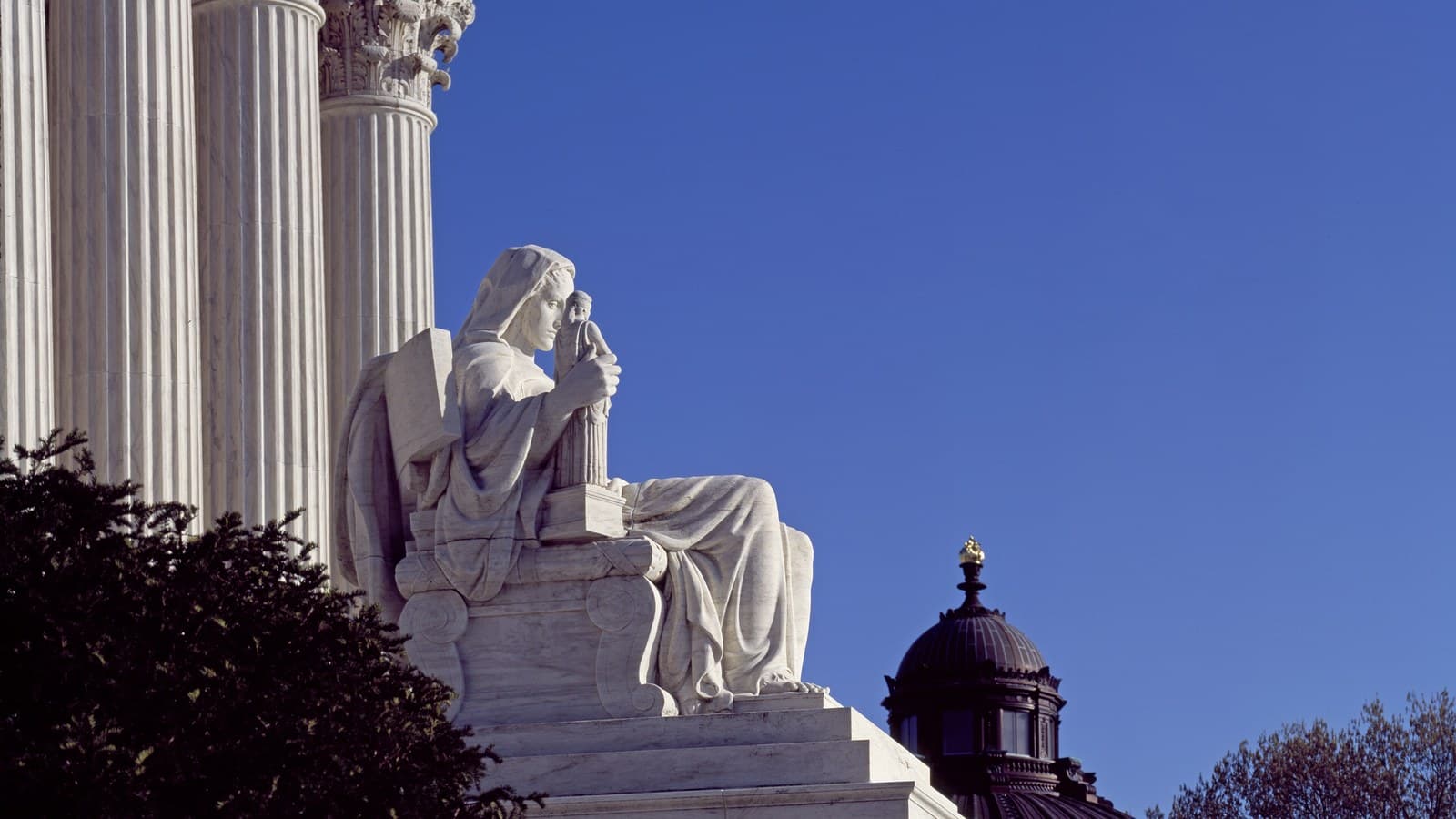
- Image: James Earle Fraser's statues outside the U.S. Supreme Court Building (file photo). Photo: Carol M. Highsmith, Library of Congress (public domain).
- Author: Ryan Standley / Record of Sale, LLC / Notice Nearby.
- Discussed on @NoticeNearYou: (pending — fill xPostUrl after live post).
- Not legal advice. Not a newspaper. Not Legal Publication. Record of Sale, LLC (Oregon).
Supreme Court desk · Notice Nearby public papers shelf. @NoticeNearYou post pending.
Not legal advice. Not a newspaper. Not Legal Publication. Record of Sale, LLC (Oregon).