Public paper · October 13, 2026 · Supreme Court desk
Chief Justice Roberts Temporarily Stays a Fourth Circuit Judgment in FCC v. Sherrod Brown, No. 26A476; Briefing Closed October 11
On October 8, 2026, Chief Justice John G. Roberts, Jr. stayed the Fourth Circuit's October 7 judgment in case No. 26-2230 pending further order, on the Federal Communications Commission's application in FCC v. Sherrod Brown, No. 26A476. The response was filed October 10 and the FCC's reply October 11.
noticenearby.com/papers/scotus-chief-justice-stays-fourth-circuit-fcc-v-brown-26a476.pdf
On Thursday, October 8, 2026, Chief Justice John G. Roberts, Jr. signed an order in Federal Communications Commission v. Sherrod Brown, et al., No. 26A476 (Order, Oct. 8, 2026).
What the order says
The order reads, in part: "IT IS ORDERED that the October 7, 2026 judgement of the United States Court of Appeals for the Fourth Circuit, case No. 26-2230, is hereby stayed pending further order of the undersigned or of the Court." It directed that a response be filed "on or before Saturday, October 10, 2026, by 5 p.m. (EDT)" (Order, Oct. 8, 2026).
The stay holds the lower-court judgment in place while the application is briefed. The order does not decide the application.

The docket so far
The Court's docket for No. 26A476 lists these entries (Supreme Court docket No. 26A476):
- October 8, 2026: Application for a stay, submitted to the Chief Justice by the FCC.
- October 8, 2026: Order entered by the Chief Justice, quoted above.
- October 8, 2026: Amicus brief of the Republican National Committee, et al., submitted.
- October 10, 2026: Response to the application from respondents Sherrod Brown, et al., filed.
- October 11, 2026: Reply of the Federal Communications Commission in support of the application, submitted.
The docket lists D. John Sauer as counsel for the applicant (docket No. 26A476). As of Tuesday morning, October 13, 2026, the docket shows no further order on the application.
What comes next
The Chief Justice, or the full Court on referral, may rule on the application at any time. Notice Nearby will update this page from the docket when it does. This paper does not describe the merits of the dispute beyond what the order and docket entries state.
What these terms mean
- Stay and administrative stay (say it: STAY; ad-MIN-ih-stray-tiv STAY). Means: A stay pauses a lower court's order. An administrative stay is a short, temporary pause that a Justice can grant while waiting for the other side's response. Origin and history: The Court's guide says stay applications "usually concern an effort to buy time, to maintain the status quo." Source: Supreme Court of the United States, "A Reporter's Guide to Applications Pending Before the Supreme Court."
- Application and Circuit Justice (say it: ap-lih-KAY-shun; SUR-kit JUS-tis). Means: An application is a request for emergency or procedural relief, such as a stay. It goes to the Justice assigned to the federal circuit the case came from, called the Circuit Justice. Origin and history: The country is divided into 13 federal judicial circuits. The Circuit Justice can act alone or refer the application to the full Court. Source: Supreme Court of the United States, "A Reporter's Guide to Applications."
- Mandamus (say it: man-DAY-mus). Means: A court order commanding a government official or a lower court to do something the law requires. Origin and history: The Judiciary Act of 1789 gave the Supreme Court power to issue writs of mandamus. In Marbury v. Madison, the Court held that the Constitution did not allow that part of the Act. Source: uscourts.gov, "About the Supreme Court" (Marbury v. Madison discussion).
- Per curiam (say it: per KYOOR-ee-um). Means: An opinion issued by the court as a whole, usually unsigned, so no single Justice is named as its author. Origin and history: Latin for "for the court." Source: uscourts.gov Glossary of Legal Terms, "Per curiam."
- Moot (say it: MOOT). Means: No longer something a court can rule on, because the dispute has ended or never actually arose. Origin and history: The FCC told the Court the Fourth Circuit's order would "become moot" before the Court could review it unless it was paused. Source: uscourts.gov Glossary, "Moot"; FCC Stay Application, No. 26A476 (Oct. 8, 2026).
- Docket (say it: DOK-it). Means: The court's running log of a case, with a short dated entry for every filing and order. Origin and history: Each Supreme Court case gets a docket number, such as No. 25-1103. Source: uscourts.gov Glossary of Legal Terms, "Docket."
Each term card has a short audio clip of the term spoken by Ryan Standley. The clip players appear when the term-card display goes live.
Read next
Every case, explained
Sources
- Supreme Court of the United States, Order in No. 26A476, Federal Communications Commission v. Sherrod Brown, et al., signed by Chief Justice John G. Roberts, Jr., October 8, 2026 (supremecourt.gov, Orders of the Court, file 100826zr).
- Supreme Court of the United States, docket No. 26A476 (supremecourt.gov docket search), read October 13, 2026.
Notes and sources
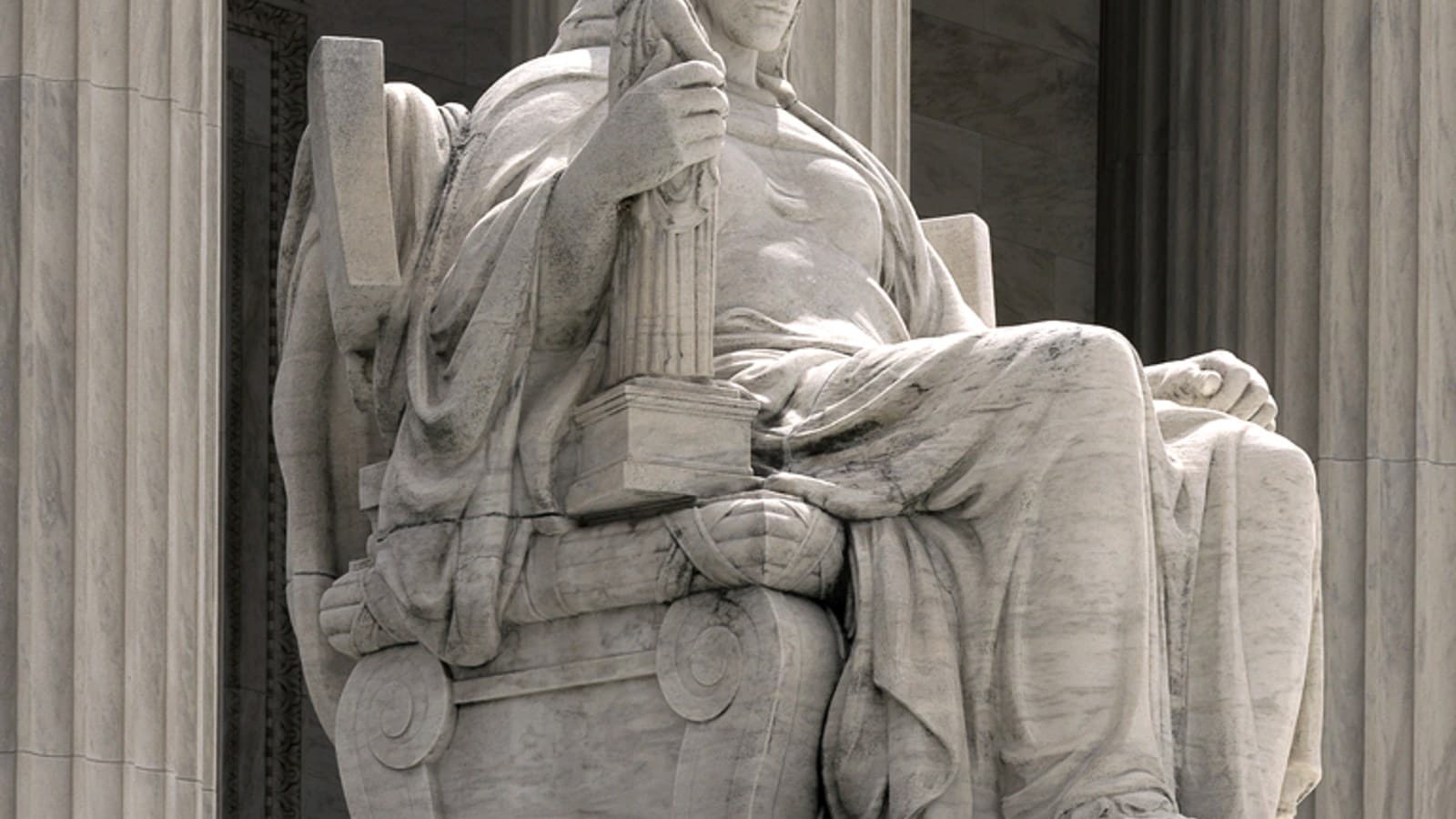
- Image: Contemplation of Justice, the statue by James Earle Fraser on the Supreme Court Building's main steps (file photo). Photo: U.S. Capitol via Wikimedia Commons (public domain).
- Author: Ryan Standley / Record of Sale, LLC / Notice Nearby.
- Discussed on @NoticeNearYou: (pending — fill xPostUrl after live post).
- Not legal advice. Not a newspaper. Not Legal Publication. Record of Sale, LLC (Oregon).
Supreme Court desk · Notice Nearby public papers shelf. @NoticeNearYou post pending.
Not legal advice. Not a newspaper. Not Legal Publication. Record of Sale, LLC (Oregon).