Public paper · October 13, 2026 · Supreme Court desk
Supreme Court Arguments This Week: Beaird v. United States on Sentencing Guidelines Commentary (Oct. 13) and Salazar v. Paramount Global on the Video Privacy Protection Act (Oct. 14); November Session Calendar
The Supreme Court hears Beaird v. United States on Tuesday, October 13, 2026, on whether Stinson v. United States still sets the deference owed to Sentencing Guidelines commentary, and Salazar v. Paramount Global on Wednesday, October 14, on the Video Privacy Protection Act. The November session opens November 2.
noticenearby.com/papers/scotus-arguments-oct-13-14-beaird-salazar-november-calendar.pdf
The October 2026 Term's first argument session began Monday, October 5, 2026. Monday, October 12 was a legal holiday. The Court convenes at 10 a.m. (Argument Calendar, Session Beginning October 5, 2026, amended September 14, 2026).
Tuesday, October 13: No. 25-5343, Beaird v. United States
Full case explainer: Beaird v. United States, No. 25-5343.
- The Court granted review on April 20, 2026, limited to one question: "whether Stinson v. United States, 508 U. S. 36 (1993), still correctly states the rule for the deference that courts must give the commentary to the Sentencing Guidelines" (Question Presented, No. 25-5343).
- By order of May 6, 2026, the Court invited Anthony J. Dick of Washington, D.C., to brief and argue as amicus curiae in support of the position that Stinson still states the correct rule (Question Presented, No. 25-5343).
- The lower-court case number is 24-10764; the decision below is reported at 2025 WL 1410410 (same document).
Wednesday, October 14: No. 25-459, Salazar v. Paramount Global
Full case explainer: Salazar v. Paramount Global, No. 25-459.
- The Court granted review on January 26, 2026. The decision below is 133 F.4th 642, lower-court case No. 23-5748 (Question Presented, No. 25-459).
- The petition says the question "is whether the phrase 'goods or services from a video tape service provider,' as used in the VPPA's definition of 'consumer,' refers to all of a video tape service provider's goods or services or only to its audiovisual goods or services" (Question Presented, No. 25-459). The statute is 18 U.S.C. § 2710.
Earlier in the session
- October 5: No. 25-170, Suncor Energy (U.S.A.) Inc. v. Commissioners of Boulder County, and No. 25-735, Johnson v. United States Congress.
- October 6: No. 25-498, Anderson v. Intel Corp. Investment Policy Committee.
- October 7: No. 25-579, Department of the Air Force v. Prutehi Guahan.
(Argument Calendar, Session Beginning October 5, 2026.)
November session
The calendar for the session beginning November 2, 2026 lists (Argument Calendar, dated August 11, 2026):
- Nov. 2: No. 25-5930, Maxwell v. Dinis; No. 25-352, Younge v. Fulton Judicial Circuit District Attorney's Office.
- Nov. 3: No. 25-581, St. Mary Catholic Parish v. Roy.
- Nov. 4: No. 25-1003, Guerrero v. Johnson.
- Nov. 9: No. 25-417, Nielsen v. Watanabe; No. 25-159, Hoffmann v. WBI Energy Transmission, Inc.
- Nov. 10: No. 25-966, Department of Labor v. Sun Valley Orchards, LLC.
- Nov. 11: Legal holiday.
An argument is not a decision. The Court issues opinions later in the term.
What these terms mean
- Certiorari (writ of certiorari) (say it: ser-shee-uh-RAIR-ee). Means: An order from the Supreme Court telling a lower court to send up the records of a case the Justices have agreed to hear. Origin and history: The Certiorari Act of 1925 gave the Supreme Court the choice of whether to hear most appeals. Today it agrees to hear about 100 to 150 of the more than 7,000 cases it is asked to review each year. Source: Meaning: uscourts.gov Glossary of Legal Terms, "Writ of certiorari." History: uscourts.gov, "About the Supreme Court" (Administrative Office of the U.S. Courts).
- Cert granted (say it: SURT GRAN-tid). Means: The Supreme Court has agreed to hear the case. It is not a ruling on who wins. Origin and history: "Cert" is short for certiorari. When a party asks the Court to review its case, it files a petition for a writ of certiorari. Source: uscourts.gov, "About the Supreme Court"; Supreme Court Order List, Oct. 13, 2026 ("The petitions for writs of certiorari are granted").
- Amicus curiae (say it: uh-MEE-kus KYOOR-ee-eye). Means: A brief filed by a person or group that is not a party to the case but has an interest in it, offering its own arguments. Origin and history: Latin for "friend of the court." Source: uscourts.gov Glossary, "Amicus curiae"; uscourts.gov, "Supreme Court Procedures."
- In forma pauperis (say it: in FOR-muh PAW-per-iss). Means: Permission to file a case without paying the court's fees, because the person cannot afford them. Origin and history: Latin for "in the manner of a pauper." Source: uscourts.gov Glossary of Legal Terms, "In forma pauperis."
- Docket (say it: DOK-it). Means: The court's running log of a case, with a short dated entry for every filing and order. Origin and history: Each Supreme Court case gets a docket number, such as No. 25-1103. Source: uscourts.gov Glossary of Legal Terms, "Docket."
Each term card has a short audio clip of the term spoken by Ryan Standley. The clip players appear when the term-card display goes live.
Read next
Every case, explained
Sources
- Supreme Court of the United States, Argument Calendar, October Term 2026, Session Beginning October 5, 2026 (amended September 14, 2026).
- Supreme Court of the United States, Argument Calendar, Session Beginning November 2, 2026 (dated August 11, 2026).
- Supreme Court of the United States, Questions Presented, No. 25-5343 (Beaird v. United States) and No. 25-459 (Salazar v. Paramount Global).
Notes and sources
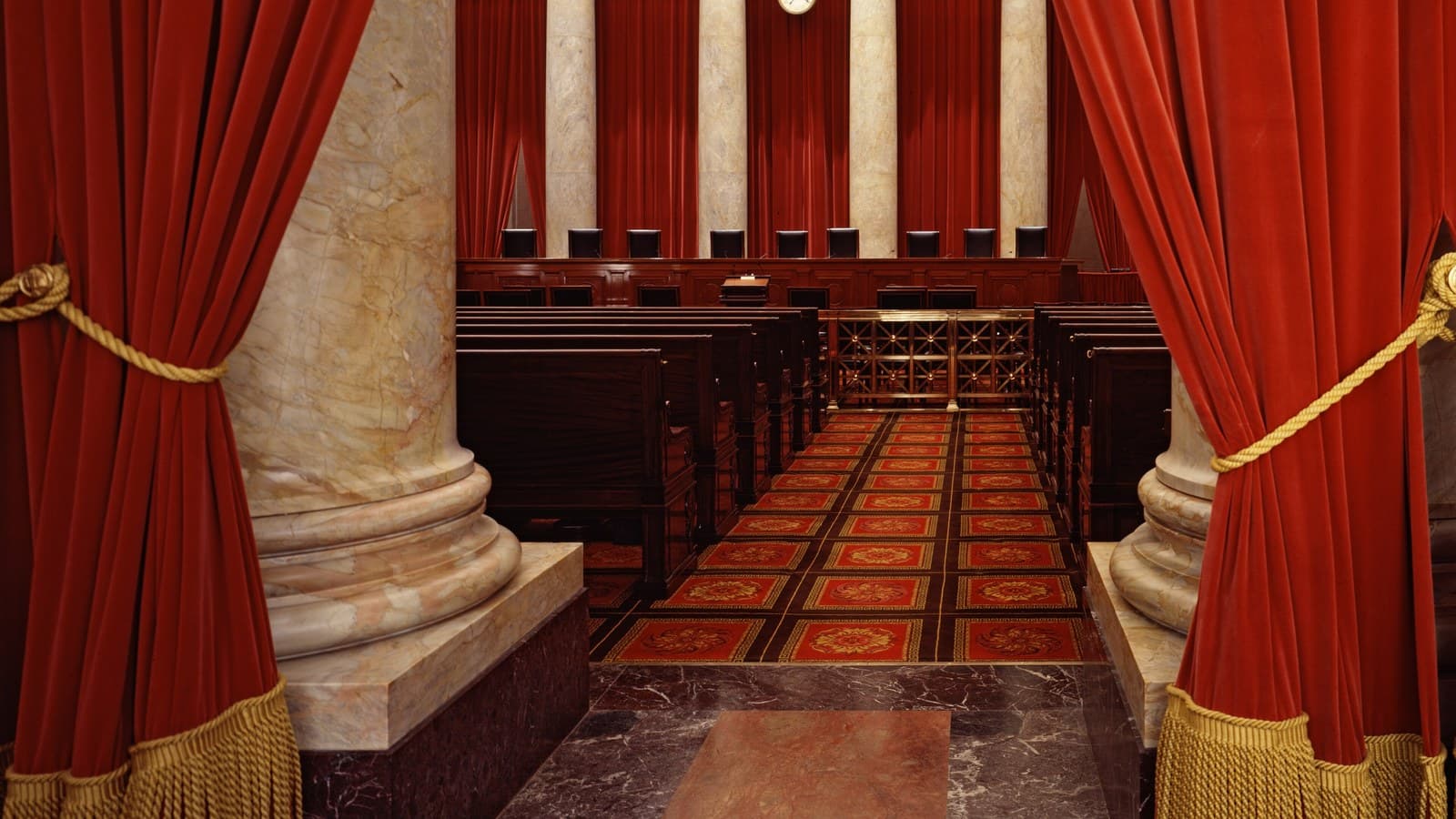
- Image: Interior of the U.S. Supreme Court, Washington, D.C. (file photo). Photo: Carol M. Highsmith, Library of Congress (public domain).
- Author: Ryan Standley / Record of Sale, LLC / Notice Nearby.
- Discussed on @NoticeNearYou: (pending — fill xPostUrl after live post).
- Not legal advice. Not a newspaper. Not Legal Publication. Record of Sale, LLC (Oregon).
Supreme Court desk · Notice Nearby public papers shelf. @NoticeNearYou post pending.
Not legal advice. Not a newspaper. Not Legal Publication. Record of Sale, LLC (Oregon).