Public paper · October 13, 2026 · Supreme Court desk
Supreme Court Denies Jamaal Howard's Three Applications for a Stay of Execution From Texas on October 7, 2026; Justice Jackson Would Have Granted One
In three order lists dated Wednesday, October 7, 2026, the Supreme Court denied Jamaal Howard's applications for a stay of execution of a Texas death sentence, along with his petitions for certiorari, habeas corpus and mandamus. Justice Jackson noted she would grant the stay in No. 26-5759.
noticenearby.com/papers/scotus-denies-stay-jamaal-howard-texas-oct-7.pdf
The Supreme Court issued three separate order lists on Wednesday, October 7, 2026 (610 U.S.), each on a filing by Jamaal Howard. Full case explainer: Howard v. Texas and In re Howard. Each application was presented to Justice Alito and referred by him to the full Court.
The three orders
- No. 26-5759 (26A459), Jamaal Howard v. Texas. "The application for stay of execution of sentence of death presented to Justice Alito and by him referred to the Court is denied. The petition for a writ of certiorari is denied." The order adds: "Justice Jackson would grant the application for stay of execution." (Order List, Oct. 7, 2026, Certiorari Denied.)
- No. 26-5773 (26A470), In re Jamaal Howard. The stay application is denied, and "The petition for a writ of habeas corpus is denied." (Order List, Oct. 7, 2026, Habeas Corpus Denied.)
- No. 26-5754 (26A456), In re Jamaal Howard. The stay application is denied, and "The petition for a writ of mandamus is denied." (Order List, Oct. 7, 2026, Mandamus Denied.)
What the orders do not say
The orders give no reasons. Except for Justice Jackson's notation in No. 26-5759, no Justice is noted as dissenting. This paper does not report on the underlying case or on events in Texas beyond what the Court's orders state.
What these terms mean
- Capital case (say it: KAP-ih-tul KAYSS). Means: A case involving a crime punishable by death. Origin and history: The Court's guide notes that applications for stays in capital cases are often, though not always, referred to the full Court. Source: uscourts.gov Glossary, "Capital offense"; Supreme Court, "A Reporter's Guide to Applications."
- Stay and administrative stay (say it: STAY; ad-MIN-ih-stray-tiv STAY). Means: A stay pauses a lower court's order. An administrative stay is a short, temporary pause that a Justice can grant while waiting for the other side's response. Origin and history: The Court's guide says stay applications "usually concern an effort to buy time, to maintain the status quo." Source: Supreme Court of the United States, "A Reporter's Guide to Applications Pending Before the Supreme Court."
- Application and Circuit Justice (say it: ap-lih-KAY-shun; SUR-kit JUS-tis). Means: An application is a request for emergency or procedural relief, such as a stay. It goes to the Justice assigned to the federal circuit the case came from, called the Circuit Justice. Origin and history: The country is divided into 13 federal judicial circuits. The Circuit Justice can act alone or refer the application to the full Court. Source: Supreme Court of the United States, "A Reporter's Guide to Applications."
- Habeas corpus (say it: HAY-bee-us KOR-pus). Means: A court order requiring the authorities holding a prisoner to bring the prisoner before a court and justify keeping that person locked up. Origin and history: Latin for "you have the body." Source: uscourts.gov Glossary of Legal Terms, "Habeas corpus."
- Mandamus (say it: man-DAY-mus). Means: A court order commanding a government official or a lower court to do something the law requires. Origin and history: The Judiciary Act of 1789 gave the Supreme Court power to issue writs of mandamus. In Marbury v. Madison, the Court held that the Constitution did not allow that part of the Act. Source: uscourts.gov, "About the Supreme Court" (Marbury v. Madison discussion).
- Certiorari (writ of certiorari) (say it: ser-shee-uh-RAIR-ee). Means: An order from the Supreme Court telling a lower court to send up the records of a case the Justices have agreed to hear. Origin and history: The Certiorari Act of 1925 gave the Supreme Court the choice of whether to hear most appeals. Today it agrees to hear about 100 to 150 of the more than 7,000 cases it is asked to review each year. Source: Meaning: uscourts.gov Glossary of Legal Terms, "Writ of certiorari." History: uscourts.gov, "About the Supreme Court" (Administrative Office of the U.S. Courts).
- In forma pauperis (say it: in FOR-muh PAW-per-iss). Means: Permission to file a case without paying the court's fees, because the person cannot afford them. Origin and history: Latin for "in the manner of a pauper." Source: uscourts.gov Glossary of Legal Terms, "In forma pauperis."
- Docket (say it: DOK-it). Means: The court's running log of a case, with a short dated entry for every filing and order. Origin and history: Each Supreme Court case gets a docket number, such as No. 25-1103. Source: uscourts.gov Glossary of Legal Terms, "Docket."
Each term card has a short audio clip of the term spoken by Ryan Standley. The clip players appear when the term-card display goes live.

Read next
Every case, explained
Sources
- Supreme Court of the United States, Order List (610 U.S.), Wednesday, October 7, 2026, Certiorari Denied, No. 26-5759 (file 100726zr1).
- Supreme Court of the United States, Order List (610 U.S.), Wednesday, October 7, 2026, Habeas Corpus Denied, No. 26-5773 (file 100726zr2).
- Supreme Court of the United States, Order List (610 U.S.), Wednesday, October 7, 2026, Mandamus Denied, No. 26-5754 (file 100726zr).
Notes and sources
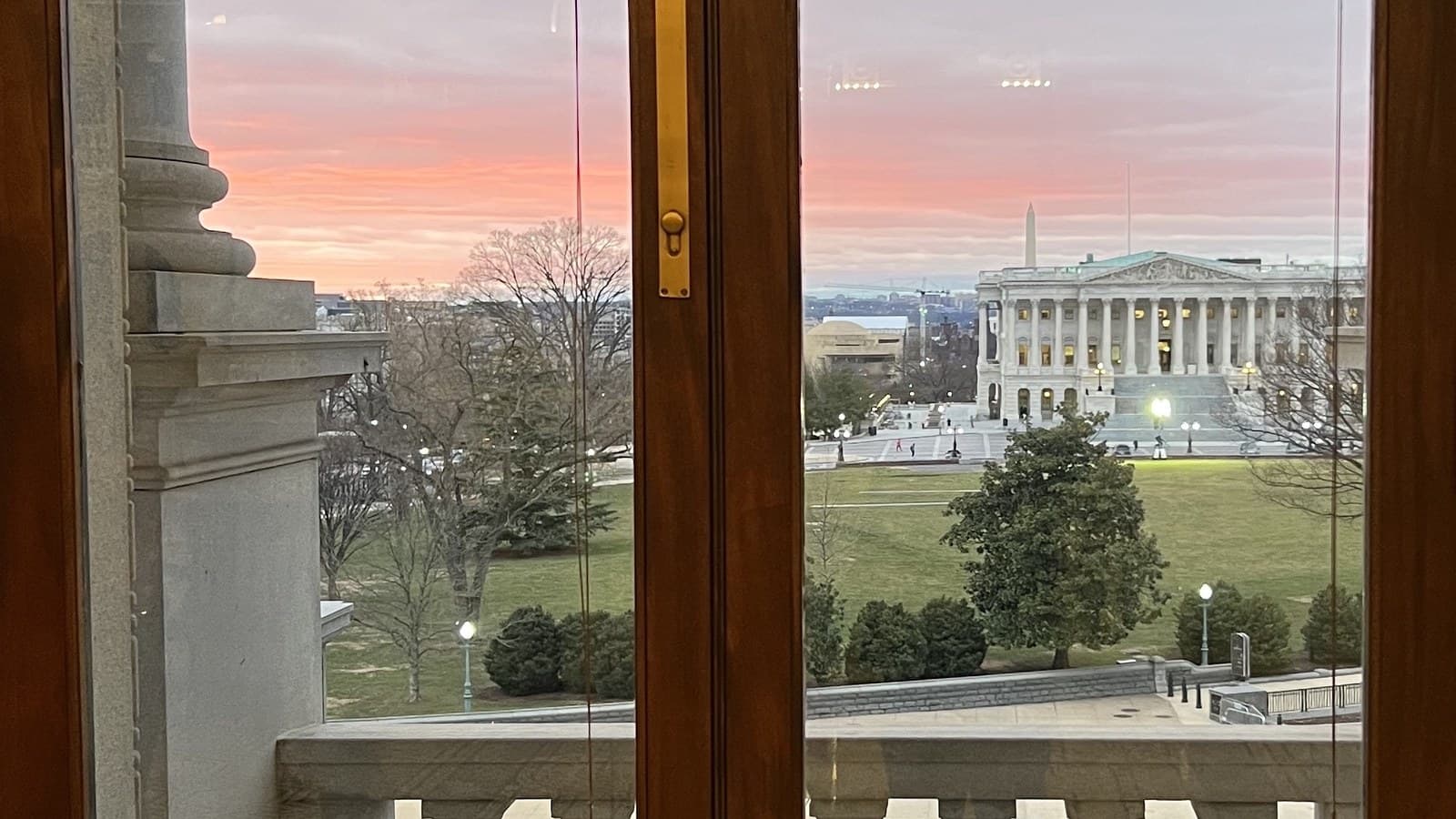
- Image: The U.S. Supreme Court Building, with the Washington Monument behind it, seen from the Library of Congress (file photo). Photo: Packer1028 via Wikimedia Commons (CC0 public domain dedication).
- Author: Ryan Standley / Record of Sale, LLC / Notice Nearby.
- Discussed on @NoticeNearYou: (pending — fill xPostUrl after live post).
- Not legal advice. Not a newspaper. Not Legal Publication. Record of Sale, LLC (Oregon).
Supreme Court desk · Notice Nearby public papers shelf. @NoticeNearYou post pending.
Not legal advice. Not a newspaper. Not Legal Publication. Record of Sale, LLC (Oregon).