Public paper · October 13, 2026 · Supreme Court desk
U.S. DOGE Service v. U.S. District Court for D.C., No. 25-1103: The Supreme Court Will Decide How Far Courts Can Order Discovery Into a White House Advisory Office Under FOIA
The Supreme Court granted review on October 13, 2026 in No. 25-1103. The government asks whether courts may order broad discovery into the U.S. DOGE Service just to decide whether the Freedom of Information Act applies to it. Here are the parties, the history, the exact questions and the terms, explained.
noticenearby.com/papers/scotus-case-us-doge-service-v-district-court-25-1103.pdf
On Tuesday, October 13, 2026, the Supreme Court granted the government's petition in No. 25-1103, U.S. DOGE Service v. United States District Court for the District of Columbia (Supreme Court Order List, Oct. 13, 2026, p. 3). The Court will hear the case. It has not ruled on who is right.
This paper uses only the Court's dockets, orders and the official filings and opinions named under Sources. Each fact is cited. Legal terms are explained in plain words at the bottom of the page.
Who the parties are
- Petitioners (the side asking the Court to step in): the U.S. DOGE Service; Amy Gleason, Acting Administrator of the U.S. DOGE Service; Elon R. Musk, in his official capacity; the Office of Management and Budget and its Director, Russel Vought; the National Archives and Records Administration; and the Archivist of the United States (Petition, No. 25-1103, Parties to the Proceeding). The petition notes that Elon R. Musk "is no longer in government service" (same page).
- Respondents: the U.S. District Court for the District of Columbia, and Citizens for Responsibility and Ethics in Washington (CREW), the plaintiff in district court case No. 25-cv-511 (same page).
- Lawyers: Solicitor General D. John Sauer for the government; Jonathan Edward Maier of CREW and Nathaniel Zelinsky of Washington Litigation Group for the respondents (Supreme Court docket No. 25-1103).
What happened in the lower courts
- CREW sued under the Freedom of Information Act (FOIA), 5 U.S.C. 552. The district court "entered a wide-ranging and intrusive discovery order" against the U.S. DOGE Service to decide whether it is an "agency" covered by FOIA. That is the government's description (Petition, Questions Presented).
- The district court granted discovery on April 15, 2025 and scheduled it on May 20, 2025. The D.C. Circuit denied the government's request for a writ of mandamus on May 14, 2025 (Petition, Related Proceedings, Nos. 25-cv-511 and 25-5130).
- The petition says the Supreme Court then "granted certiorari, vacated the court of appeals' denial of a writ of mandamus, and remanded for the court of appeals to 'narrow' discovery in light of 'separation of powers concerns'" (Petition, Questions Presented).
- On remand, the D.C. Circuit again denied mandamus on July 14, 2025, and denied rehearing on December 18, 2025 (Petition, Related Proceedings; docket No. 25-1103). The petition says CREW withdrew several requests but the remaining discovery "includes numerous requests for internal communications and a deposition of USDS's head" (Petition, Questions Presented).
The question the Court is deciding
"1. Whether the court of appeals' order departed from this Court's instructions and the separation-of-powers principles that this Court articulated in Cheney v. United States District Court, 542 U.S. 367 (2004). 2. Whether a court may order broad discovery against an Executive Office advisory body—potentially providing much information sought on the merits of a plaintiff's FOIA claims—to determine whether FOIA's disclosure requirements apply in the first place." (Petition, No. 25-1103, Questions Presented.)
Case timeline
- Apr. 15, 2025: District court orders discovery (No. 25-cv-511).
- May 14, 2025: D.C. Circuit denies mandamus.
- July 14, 2025: D.C. Circuit denies mandamus again on remand.
- Dec. 18, 2025: Rehearing denied.
- Mar. 18, 2026: Government files petition; docketed Mar. 20.
- June 22, 2026: CREW files brief in opposition.
- July 1, 2026: Government reply.
- Oct. 9, 2026: Conference.
- Oct. 13, 2026: Certiorari granted.
What's at stake (in the official documents' own words)
- The government's petition says the discovery could "potentially provid[e] much information sought on the merits" of the FOIA claims before a court decides whether FOIA applies at all (Petition, Question 2).
- Whatever the Court decides will set the rule for when courts may order discovery from an advisory office inside the Executive Office of the President to test whether FOIA covers it (Petition, Questions Presented).
What happens next, and when
The Court will set a briefing schedule and an argument date. As of October 13, 2026, the docket lists no argument date (docket No. 25-1103). Notice Nearby will add the date when the Court posts it.
What these terms mean
- Certiorari (writ of certiorari) (say it: ser-shee-uh-RAIR-ee). Means: An order from the Supreme Court telling a lower court to send up the records of a case the Justices have agreed to hear. Origin and history: The Certiorari Act of 1925 gave the Supreme Court the choice of whether to hear most appeals. Today it agrees to hear about 100 to 150 of the more than 7,000 cases it is asked to review each year. Source: Meaning: uscourts.gov Glossary of Legal Terms, "Writ of certiorari." History: uscourts.gov, "About the Supreme Court" (Administrative Office of the U.S. Courts).
- Cert granted (say it: SURT GRAN-tid). Means: The Supreme Court has agreed to hear the case. It is not a ruling on who wins. Origin and history: "Cert" is short for certiorari. When a party asks the Court to review its case, it files a petition for a writ of certiorari. Source: uscourts.gov, "About the Supreme Court"; Supreme Court Order List, Oct. 13, 2026 ("The petitions for writs of certiorari are granted").
- Discovery and deposition (say it: dis-KUV-er-ee; dep-uh-ZISH-un). Means: Discovery is how each side gathers facts and documents from the other before trial. A deposition is sworn testimony given out of court. Origin and history: Common discovery tools include depositions, written questions and requests for documents. Source: uscourts.gov Glossary, "Discovery" and "Deposition."
- Mandamus (say it: man-DAY-mus). Means: A court order commanding a government official or a lower court to do something the law requires. Origin and history: The Judiciary Act of 1789 gave the Supreme Court power to issue writs of mandamus. In Marbury v. Madison, the Court held that the Constitution did not allow that part of the Act. Source: uscourts.gov, "About the Supreme Court" (Marbury v. Madison discussion).
- Docket (say it: DOK-it). Means: The court's running log of a case, with a short dated entry for every filing and order. Origin and history: Each Supreme Court case gets a docket number, such as No. 25-1103. Source: uscourts.gov Glossary of Legal Terms, "Docket."
- Application and Circuit Justice (say it: ap-lih-KAY-shun; SUR-kit JUS-tis). Means: An application is a request for emergency or procedural relief, such as a stay. It goes to the Justice assigned to the federal circuit the case came from, called the Circuit Justice. Origin and history: The country is divided into 13 federal judicial circuits. The Circuit Justice can act alone or refer the application to the full Court. Source: Supreme Court of the United States, "A Reporter's Guide to Applications."
Each term card has a short audio clip of the term spoken by Ryan Standley. The clip players appear when the term-card display goes live.
Read next
- Blanche v. Ozurumba
- Berry v. United States
- FCC v. Brown
- Beaird v. United States
- Salazar v. Paramount Global
- Howard v. Texas / In re Howard
- Roofing Designs v. Royal American
- Silva Ochoa v. United States
- Monsanto v. Dennis
- Hobson v. United States
- Order list, Oct. 13, 2026
- Chief Justice stays the Fourth Circuit in FCC v. Brown
- Arguments this week and the November calendar
- Howard stay denials, Oct. 7
Sources
- Supreme Court of the United States, Order List, Oct. 13, 2026.
- Supreme Court docket No. 25-1103, read Oct. 13, 2026.
- Petition for a writ of certiorari, U.S. DOGE Service v. U.S. District Court for D.C., No. 25-1103 (filed Mar. 18, 2026).
Notes and sources
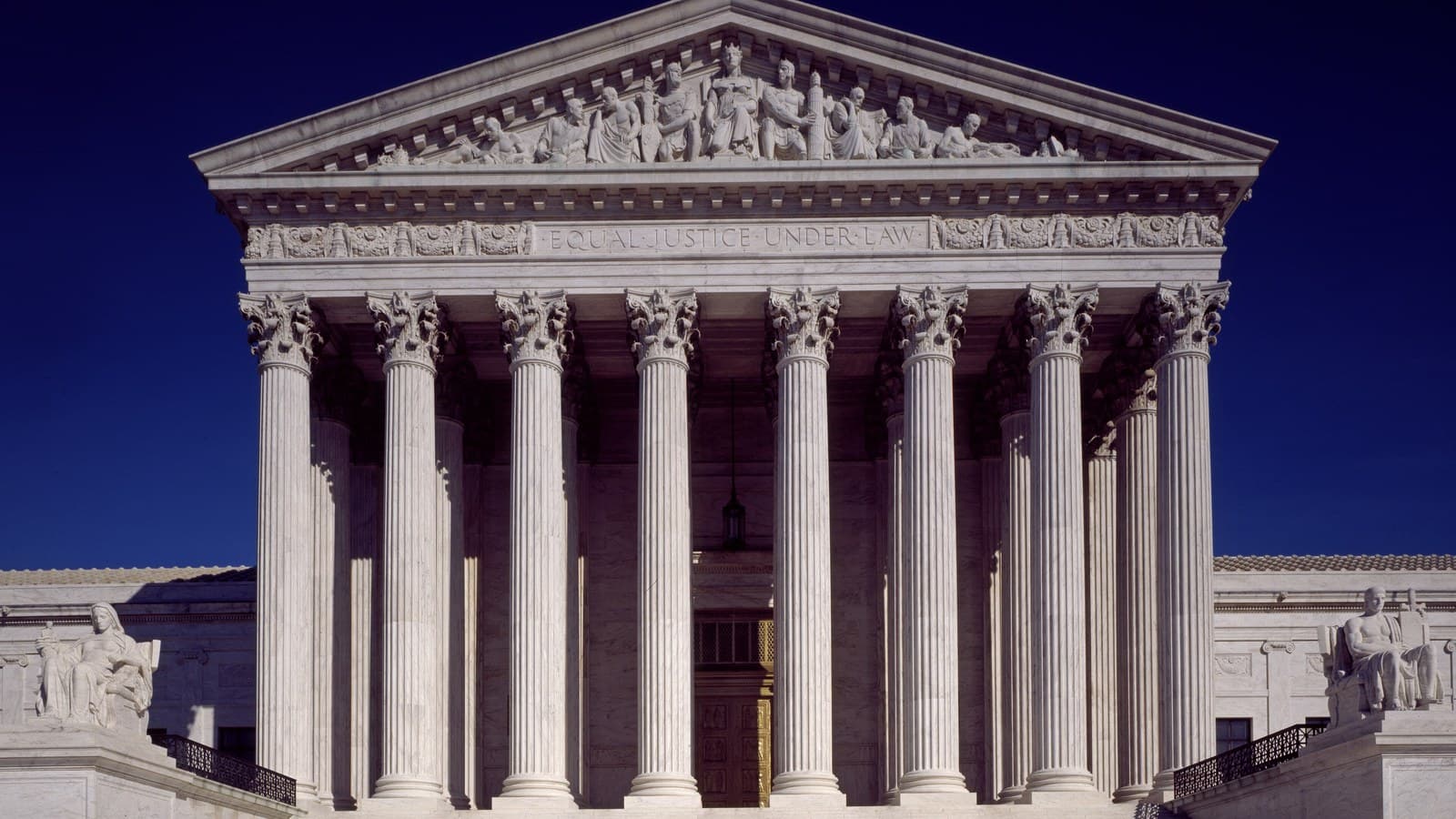
- Image: The Supreme Court Building, Washington, D.C. (file photo). Photo: Carol M. Highsmith, Library of Congress (public domain).
- Author: Ryan Standley / Record of Sale, LLC / Notice Nearby.
- Discussed on @NoticeNearYou: (pending — fill xPostUrl after live post).
- Not legal advice. Not a newspaper. Not Legal Publication. Record of Sale, LLC (Oregon).
Supreme Court desk · Notice Nearby public papers shelf. @NoticeNearYou post pending.
Not legal advice. Not a newspaper. Not Legal Publication. Record of Sale, LLC (Oregon).